Showing posts with label Greece and the Eastern Kingdoms. Show all posts

Friday, 8 September 2023

State of Play: Commands and Colors: Ancients, Expansion 1: Greece and the Eastern Kingdoms (6/6), and Here I Stand(!)


So, we played at T’s place again for the last Commands and Colors: AncientsGreece and the Eastern Kingdoms (GMT Games, 2006) for the year. Probably. When I got there, T had set up the Jaxartes River scenario. This is a tough one; I’ve heard a lot of people complain over the years about hour unbalanced the scenarios for Commands and Colors of any stripe are. Jaxartes River (328BC) is one of those set-ups that lend a specific example to that complaint. I’m inclined to think, if you insist on balance out of the gate in every game game, stick to chess. Or draughts.

Hopelessly outnumbered.

The situation was as follows: Alexander, having defeated the remaining Persian states, began building a settlement on the Jaxartes to anchor the defence of his northern border. The Scythian tribal leader Satraces thought the works looked ripe for a quick smash ‘n’ grab – apparently, he hadn’t got the memo. Historically, Alexander lured the Scythians in with some puny-looking light troops on foot, then when Satraces took the bait, he sent his own Macedonian cavalry to cut off the Scythians’ routes of escape and set upon them. Satraces fell in battle, and with his death his army lost heart and fled. While most of the Scythians survived, their spirit was broken, and they never again bothered Alexander’s army.

Disposition at start (from the Macedonian side)

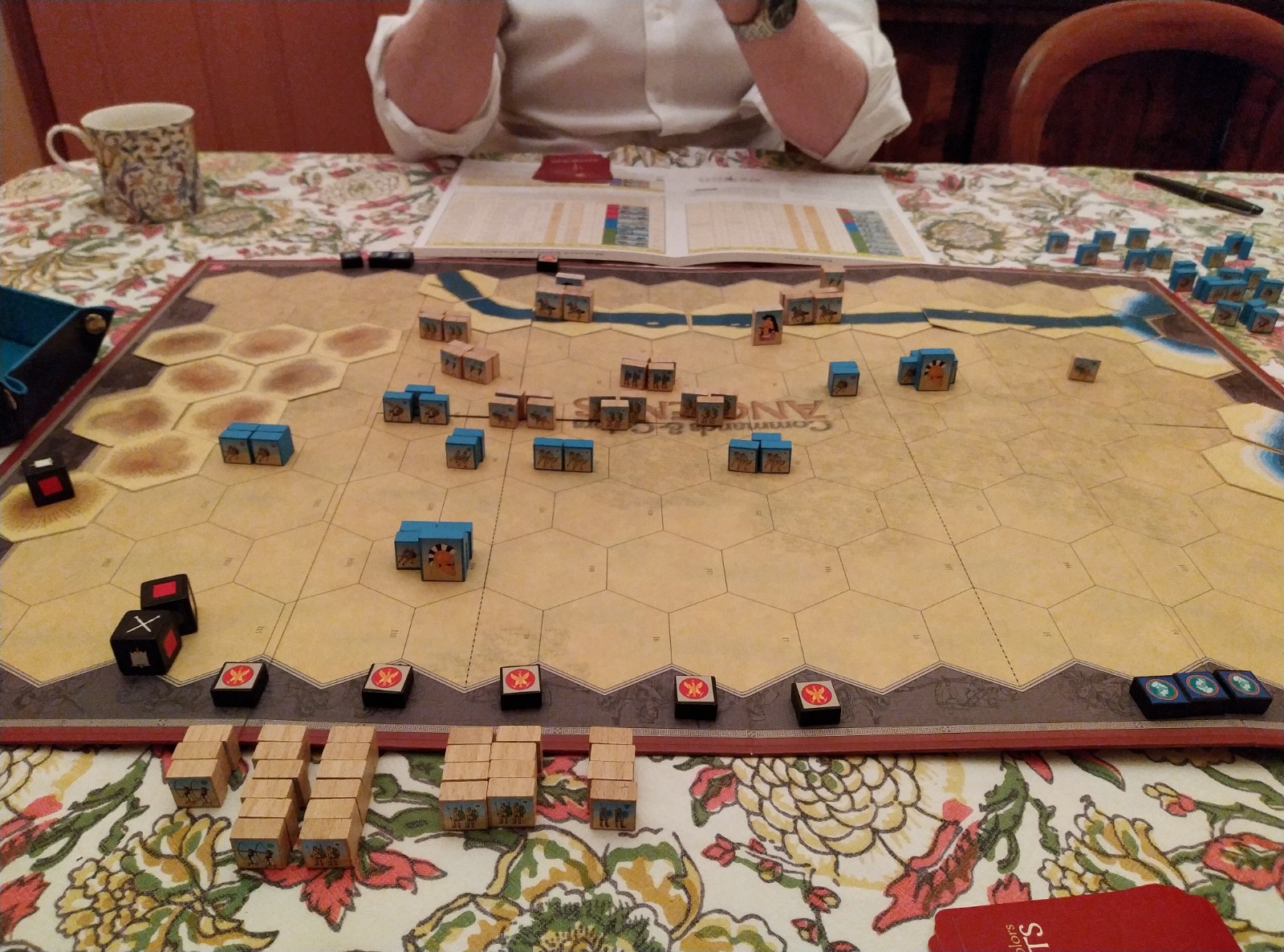
T began the game bringing his cavalry up on my right; the river is fordable but stops movement, so he had to fight from the river, rolling no more than two dice, reducing the hitting power of his Medium horse. The result was no block loss, but with two units pushed into retreat (lucky the withdrawal for the Scythians is so deep or this would have been a much shorter game).

This game saw war machines come out for the very first time in all the C&C: Ancients games we’ve played, and they were devastating. I think I took hits every time they were deployed, fortunately, that was only once each. The way the cards played out, T never had the opportunity to get his Heavy Infantry into play, and I’d already decided at the beginning to sit on the shore of the Jaxartes and attack anyone that tried to ford it while they’re still in the water. If I’d had some Medium horse, I may have tried to cross to the other side of the river and take the fight to the enemy, but that would have amounted to handing the Macedonians two or three banners with the Light Cavalry I had to hand.

Near defeat.

T was hamstrung with his choice of cards; with a good hand and welcome draws, he would likely have been able to collect on his five banners in three to four rounds. That’s not hyperbole; early on, when we’d been playing C&C: Napoleonics (base set) for less than a year, we were replaying Rolica second French position), I won the game 6-1 in five rounds, taking the last three banners in the final turn. As it transpired, a combination of poor hands and indecisive actions drew our altercation on the Jaxartes River out to nine rounds. In round seven, after he’d dispatched the third unit on my left, I managed to get my three centre units activated to swarm the Companion Cavalry and actually destroy the unit (though Alexander escaped the entrapment and formed up with his Auxilia across the river), at a cost of a single block of my Light Bow, for my second and last banner of the game.

It was a good win for T; he played a solid game with what he had to work with. I chose to look at every round I survived after the first three as a Pyrrhic victory for the doomed Scythians.  

End state: overwhelming Macedonian win.

In the scenario, Alexander’s Macedonians hold several advantages. The Macedonians have a numerical advantage on the board, with thirteen units to the Scythians’ nine. This is compounded by the weight of the Macedonian forces. A completely arbitrary but somewhat useful tabulation of the force available to Alexander might look like this; if we say that, purely based on punch, Light units are uniformly weighted at a value of 1, Medium troops/cavalry at 1½, and heavy units of all stripes are weighted at 2, the Scythian forces add up[ to roughly 9½, while the Macedonians clock in at 17, and that doesn’t take into account the bonus granted the Companion Cavalry (they can ignore one sword hit in every engagement). The Scythians only had two things in their favour; starting the match so far forward, so as to mitigate any single retreat results on my Light horse, and the river, which somewhat levelled the initial blows dealt.

The intention is to create a situation where the historical outcome is the likely one. That doesn’t mean it’s unwinnable, but it is going to be an uphill slog, and will require both cunning and luck (in both cards drawn and dice-rolls). I went into the game under no illusions about the likely outcome, but I did think that I should be able to make two or three palpable hits on the Macedonians before suffering my own fifth hit; and I managed two banners, including Alexander’s Companion Cavalry, though Alexander himself slipped through my fingers.

-----


After a couple of weeks’ absence, I returned to our Wednesday game. This week we began our first foray into Here I Stand (GMT Games, 2006), Ed Beach’s classic multi-player concerning the political and cultural upheaval of the Reformation period in Europe. Were all new to the game, but B assigned us all some homework; Beach’s C3I article on learning the basics of the game, and Filippo Cipriani’s video introduction. There are six factions and five of us, so B – our host and owner of HIS – is handling both the English and the Protestants. K, the junior member of the household played the Papal States; D, the Hapsburgs; H the Ottoman Empire; and yours truly as the French.

We played out the first round. The English put down a rebellion of uppity Scots, the Ottomans built up their forces and glowered across the border at the Austro-Hungarians, the Protestants made some gains in the northern reaches of the Holy Roman Empire, and France acquired Florence and eyed Menz. The year ended with me getting unsubtle hints of excommunication from the Pope, but I think he will have bigger problems to deal with in the next round.

As mentioned, HIS is new to all of us, so we’re all feeling our way at this point. We fully intend to see the game through, but based on Wednesday’s performance, I can’t see us getting through more than a turn a week. Regardless, I’ll bring weekly reports to this channel with a little more depth than this quick sketch.


Sunday, 3 September 2023

State of Play: Commands and Colors: Ancients - Expansion 1: Greece and the Eastern Kingdoms (5/6)


Things have been a little busy lately, with family crises and other impositions on our time, but T and I managed to carve out a couple of hours to play the Gaugamela scenario from Commands and Colors: Ancients, Expansion 1: Greece and the Eastern Kingdoms (GMT Games, 2006). As it turned out, we didn’t need two hours. Set up always takes a little time, but once we got into the game, things moved apace, and with another ahistorical result.


I took the role of Alexander for a change, and T played the Persians under Darius. Blood was spilt in the second round; the first three banners were scored by T on my left flank, sweeping up some of my Light troops. The scenario has a seven-banner victory threshold, and by the fourth round, T had swept around to my right flank with his cavalry, and now held four banners to my one.

Mid-game I made some gains, including miraculously dispatching his War Elephants in the centre with a volley from my light bow (in truth, I was hoping for retreats, rather than hits, for the chance to maybe thin out the adjacent units, but I was happy to take the point).

The parlous state at the end of the fourth round.


The elephants vanquished.

Blows continued to be exchanged, until a Leadership Centre order allowed me to bring Alexander, with his Companion Cavalry and another medium cavalry unit, up through the centre to meet Darius and his infantry. The blow was swift and bloody, and Darius’s supporting units were cleared from the field of battle, earning me the two banners I needed to close the gap between our scores. Darius – true to history – fled, joining up with an Auxilia unit which, by happy chance, happened to be in the path of the Persian leader’s escape.  

Darius escapes.

The banners held were now even, at six a piece. My next action, already selected (Three Units Center), was at hand. Then, treachery! T played an Order Light Troops, allowing his Auxilia to destroy the Cavalry unit accompanying Alexander’s Companion Cavalry. It was the second time in the game that a Light unit had completely destroyed a superior unit in a single blow, and proved the winning play for Darius, who presumably made his departure in the midst of the battle’s confusion.

End state: Persian win, 7 banners to 6.

T and I are fairly evenly matched at Commands and Colors: Napoleonics (GMT Games, 2010), mostly by dint of playing nearly all the published scenarios at least twice. One or the other of us may have a winning streak for three or four weeks, but overall I’ll only best him around fifty percent of the time. Neither of us have as much experience with C&C Ancients, and until this year, all of that experience has been with various Roman situations, but after a disproportionately high win-rate on my side, the scales are balancing for Ancients as well. A victory is a victory, but a tight game, well fought on both sides, is the most satisfying game, win or lose. At just eight rounds – sixteen orders between us – Gaugamela was nasty, brutish, and short, but very satisfying.


Wednesday, 23 August 2023

State of Play: Commands and Colors: Ancients – Expansion 1: Greece and the Eastern Kingdoms (4/6)


Having finished our exhaustive play (six games) of French and Indian War, 1757-1759 (Worthington Publishing, 2020; read my review of the game here), I’d planned to go on to This War Without an Enemy (Nuts! Publishing, 2020). The campaign game is too long for a weeknight game, but there are a couple of shorter (four and six turns) scenarios that I thought might be doable in an evening. I got This War to the table on the weekend with the intention of just setting it up and pushing some blocks around, maybe playing through a turn and set-piece combat situation, to get a feel for the game before inflicting my inexperience on somebody else. I didn’t get that far; it took me the better part of an hour to set up the Royalist faction for the scenario and start placing the Commonwealth units. This War is a really promising game, with gorgeous components, but anything that challenging to set up is not going to be suitable for a school-night. I’m certainly not giving up on it, but I’m going to have to drop it from my 6x6 list. Hopefully the Christmas break will provide a clear afternoons to tackle the whole magnificent beast.

Theorie...

As it turned out, T needed to be at home Monday night, so I went around to his and we played the Issus, 333 BC scenario from Commands and Colors: Ancients, Expansion 1: Greece and the Eastern Kingdoms (GMT Games, 2006). T’s a big Commands and Colors fiend; we started playing through the C&C Napoleonics (GMT Games, 2010) base set on Monday nights while my wife had a protracted stay in hospital back in 2010, and we just kept going with it. We’ve played nearly everything Napoleonics, and a lot of the C&C Ancients Roman scenarios, but until this year we hadn’t played any of the Greece and the Eastern Kingdoms scenario; looking back over my game notes for the year, I was reminded that we spent one Monday evening in January this year stickering-up the Greek and Persian armies because hadn’t got around to them in however long he’s had his set.

...und Praxis.

Another complication I the set-up was that some of the terrain tiles seemed to me missing (probably stashed in another box – wouldn’t have happened at my house; just saying). We made do with a couple of river bends and a straight stretch of coastline and got on with it.

Issus was a peculiar battle; it saw Darius get something of an upper hand on the seemingly infallible Alexander, manoeuvring behind the Macedonian leader and cutting his line of supply. Alexander reversed to meet Darius on a battleground of the latter’s choosing, the banks of the Pinarus River.

Alexander's cavalry, left flank.

Looking at the disposition of the two forces, you could be forgiven for thinking that Darius has the upper hand. More units on the board (by nearly half a dozen) and more cavalry to hand. But look closer and you’ll see Alexander has the greater weight of force (a majority of Medium and heavy troops) and six Command Cards to Darius’s four. And he begins the battle.

In truth we both seemed to be hampered by our card draws. Most of my options were left-flank movement, while T could only seem to bring up his centre in the very beginning. I tried to make a virtue of necessity and get my auxilia and light bow on the left into an actionable position, then taking the forward and auxilia into the hills, where they took some hits from missile attacks but gave back more in melee, holding the defensible high ground.

Parmenio surrounded.

A double-time order gave T the opportunity to bring his heavy infantry into striking range, which withered my light units in the front, costing ground and allowing T an early lead in points. My medium foot held their ground, while my single heavy cavalry unit was finally able to come up and maul the attackers (due mostly to some uncharacteristically good dice rolls), taking out Craterus’s personal guard and forcing him take flight to the rear. Well into the battle (around five banners each) cavalry order allowed me to bring my medium and light horse under Narbazanes to get up and hit T’s shallow left flank, causing terrific strife. Sadly, Narbazanes was lost in the fray, as was Parmenio of the Macedonians. Two more rounds, and it was here the battle was won, with the last banner claimed by the Persian heavy cavalry who had pursued Craterus across the field of battle to the Alexandrian rear, swiftly disposing of the medium cavalry the general had tried to rally, though wily Craterus himself eluded capture once more.

The killing blow.

It was a close game, with only two points in it at the end (8-6 in favour of the Persians). An ahistorical result, which for all the complaints of lack of balance in C&C scenarios, does happen from time to time.

One odd artifact of the Command Card selection was that neither Alexander and his companion cavalry, nor Darius and his Immortals were ever activated, even to defend. The battle raged and (due to the vagaries of the draws) neither leader was roused to action.

Macedonians casualties.

All in all, a good game, well-fought. At this point, the plan for next week is to return to Napoleon 1806 (Shakos, 2017). We played the introductory scenario twice early in the year, but have yet to play the Campaign scenario. Tune in next time.


Monday, 27 February 2023

State of play: Commands and Colors: Ancients (Himera, 480BC)


Game at T’s place this week, and the second C&C:A Greece and the Eastern Kingdoms scenario, Himera – 480BC was set up and ready to go. I settled down for a defensive action, playing the Carthaginians under Hamilcar (obviously not Hannibal’s brother, Hamilcar – an earlier namesake), while T took the role of the treacherous Syracusan force.

T opened with a strong offense on both sides of the battlefield, but couldn’t get his cavalry up as quickly as detailed inn the historical note (I was hopeful this would be the case as I had one of the “Cavalry Charge” cards in my opening hand). Given what cards I’d received I had to maintain a defensive posture right through the game, only getting my chariots up near the end. For several rounds we sat a five-all, the sixth banner eluding both of us. Too many of T’s attacks on both flanks broke against my rampart fortifications, denying him what should have been a swift victory. Still, he had managed to breach my defensive line on my left and all hope seemed lost. 

At the last, my reduced heavy chariots were able to eliminate T’s retreating medium infantry for a win that could have easily gone in favour of the Syracusans.


It's these knife-edge games that are the most satisfying. Final score: Carthage 6 banners to Syracuse’s 5.

Saturday, 18 February 2023

State of Play: Commands and Colors: Ancients (Marathon, 490BC)


A slight change of plan last night. T was going to come over to my place for your next run at Napoleon 1806, but the intrusion of Life Outside Games intervened, so I went to his place instead for a game of Commands and Colors: Ancients (GMT, 2006). We’ve played a lot of C&C: Napoleonics (GMT, 2010) over a lot of years, but Not nearly as much of C&C: Ancients, even though we both have the base game and several supplements. And everything we have played up to now has been Romans vs the rest of the world (or each other). T has been listening to a podcast about the Peloponnesian War of late, and we have never played a scenario from the first expansion, Greece and the Eastern Kingdoms (GMT, 2006), so a couple of weeks ago, it seemed like a good time to break it out. Which we did, only to find that, in all the time it has sat on the shelf in T’s study, he has never got around to stickering-up the blocks. So that’s how we spent that night.

Last night was our first actual game using the expansion, so we started with the first scenario in the set, the battle of Marathon, 490BC. Remarkably, the card distribution led to my Greek heavy infantry being placed to turn both flanks of the Persian forces, after taking a hammering in my centre, with the result of a Greek win (six victory banners to the Persians four).

It’s a testament to the adaptability of the C&C system and the thought and research that has gone into the scenario design that, using virtually the same components as the base game (new block tokens, but essentially the same types of units), the experience of fighting as Greeks against Persians feels subtly different to fighting with Roman forces. I can’t quite put my finger on it; I suspect it may take a few more scenarios to tease it out.


Persian commander T considers his options just before the hammer-fall (C&C:A-G&EK, Marathon, BC490.


A Fast Take: Limiting Command and Control in wargames - part 1

  Josep Oliver, custodian of the exempilary wargaming blog, El desafío de las Águilas , has recently featured some guest posts by designer F...