Showing posts with label Brief Border Wars. Show all posts

Thursday, 10 October 2024

Review: Brief Border Wars


We need a short, victorious war to avert a revolution.

- [attributed to] Vyacheslav von Plehve, Minister of the Interior to Tsar Nicolas II.


Brief Border Wars (Compass Games, 2020) is a set of four games using the same basic system, with exclusive rules for each game, to explore four little regarded modern conflicts (one, I‘ll admit, I’d never heard of before getting the game), which all occurred within my lifetime. The series rules for Brief Border Wars are based on Brian Train’s earlier game, Ukrainian Crisis (released in a double-pack with “The Little War” (Hollandspiele, 2017), which began as a response to the Russian “liberation” of the Crimea in 2014. I haven’t played Ukrainian Crisis, but I have played quite a bit of Brief Border Wars now, and I feel comfortable talking about it.


Appearance

The box-cover of Brief Border Wars is reminiscent of the old SPI quad games, with a picture representing each of the four conflicts featured in the set. The first “proper wargame” I ever owned – one that wasn’t a cience fiction or fantasy-based gamewas a second-hand copy of SPI’s Modern Battles II: Four Contemporary Conflicts (SPI, 1977), so his set off some nostalgia chimes from the get-go for me.

The game covers four limited conflicts; the So-called Football War between El Salvador and Honduras in 1969, Operation Atilla – the Turkish invasion of Cyprus in 1974, and the 1979 Chinese incursion into Vietnam, referred to as the Third Indochina War. Then we skip forward to 2006 for the Israeli incursion into Southern Lebanon Second Lebanon War.
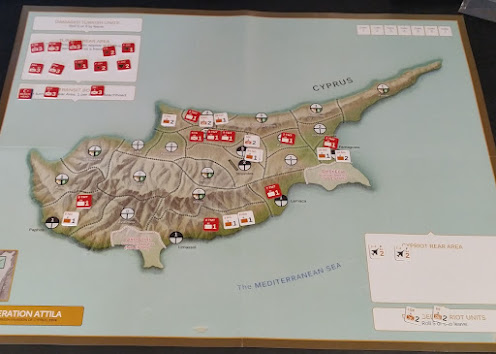
Initial set-up for Operation Atilla: the Turkish invasion of Cyprus, 1974.

In the box you’ll find one set of series rules, four sets of exclusive rules, four single-sided maps, and a deck of 54 cards (good quality, but since you’’ go through the entire deck every game, they probably warrant sleeving), as well as counters and two dice. The production values on all the components are very good. The maps are heavy, matt-finish paper. I’ve tended to play under a plexi-sheet, but they lay flat enough that you don’t need a cover if you prefer the naked surface. I’ll come back to the cards later, but I would like to take a moment to talk about the dice, because it’ my one fundamental issue with the came as it comes. I’m not the first to bring this up, but in a single round of combat it’s not unheard of for both players to be rolling ten or more dice. And the box offers two, one black and one white. These days, ten-sided dice are readily available from hobby stores and online. My advice would be, before you try to play any of the battles in Brief Border Wars, secure a handful of ten-siders – at least eight or ten of them, more if you prefer each player to have their own set. Nine or ten dice will cover most of your combat actions, though occasionally you may need to re-roll a couple of the unsuccessful dice to make up your quota.

The four maps are presented as topographical of the contested area; these may be actual photographs or doctored illustrations based on photographs of each contested area. Each map is divided into areas, usually with a national border segregating one country’s sovereign territory from another’s (with the exception of Operation: Atilla, the Turkish invasion of Cyprus in 1974). The game comes with a single sheet of counters for all four games. There are some administrative counters shared between the four games, and each side fields around sixteen to twenty-something units, depending on the battle.
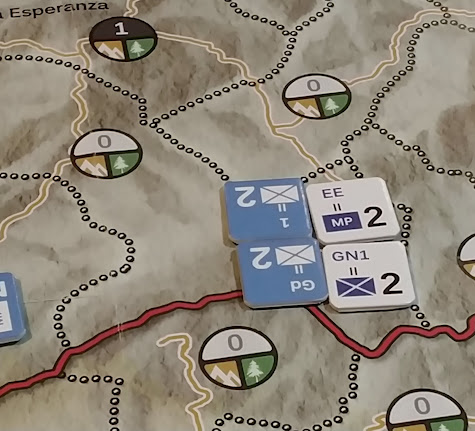
Honduran forces meet Venezuelan units inside the Honduran border, (the Football War, 1969).
The bold red line is the national border, the dotted lines define areas for movement, while
the golden lines are roads, which may facilitate swifter movement for motorised units.

The base rules-set is a mere four pages – I mentioned its simplicity – printed on bi-fold cardstock, like a PAC.’ At first, I thought it was a curious choice, but with so short a rules-set it makes sense. The first couple of times we played, I found myself referring to the rules a lot, so it was really easy to find what I needed.  The exclusive rules are also presented the same way. Each set of exclusive rules included a Sequence of play on the back page, so they double as a PAC.


Play

Brief Border Wars, like many quad games before it, uses a set of series rules, which in this case amount to a mere four pages, and some exclusive rules (usually another four pages, five in the case of the Second Lebanon War). The rules are clearly prepared and easy to comprehend. My brother-in-law, coming to the game with very little background in hex-and-counter wargaming picked it up very quickly, and was holding his own by the second game (I’d be remiss if I didn’t mention absolutely crushing T in our first game together, the Third Indochina War, but I maintain losing a game is the best way to learn a game).

Play is card driven. The card-deck is two matching suits of cards, each twenty-one-card suit identified on the back with a grey or white stripe. Each faction is delegated one or the other suit in the scenario instructions. In the Card Selection Phase, one of the players draws six cards off the top of the deck, and divvies-up the white and grey-striped cards. This random distribution means that there will often be a disproportionate number of cads going to one or the other player. Whichever player holds the higher number of cards goes first, and the players take turns playing their cards until the last card has been played. Sometimes this will mean a player is playing two or more cards consecutively to end the turn. This may lend a temporary advantage to the player in question, but given the nature of the decks, the advantage of numbers will swing to the other player in consecutive turns.
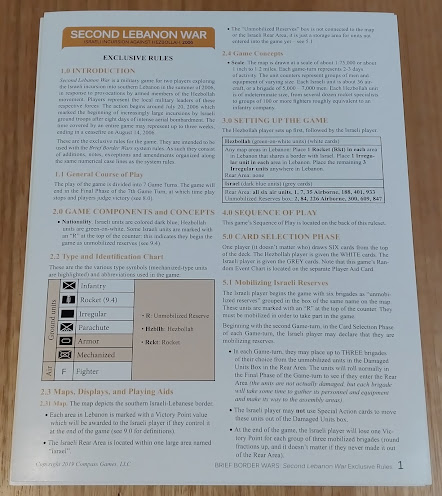
Exclusive rules folio for the Second Lebanon War.

The twenty of the cards in each suit have two values, Combat and Movement, and each card may be used for one or another of these. The numbers on a card dictate how many units may be activated by that play, either to engage in combat (with an enemy unit or units in the same area) or it the card is used for Movement activation, the number that can be ordered to move. As a rule, units activated for movement can move from their current area to an adjacent area. In some cases, mechanised units can move through one area and into a second in a single activation if a single road links the traversed areas. A unit entering an area with an undisrupted enemy unit must stop, nor can it leave that area so long as an undisrupted enemy unit is present (this can be useful for anchoring your opponent’s units in place). Units sharing an area with enemy units aren’t compelled to fight, but until all the units on one side are disrupted or have been forced to retreat, nobody is leaving that area.

Combat is simultaneous; both sides roll and establish the number of hits against the other. The units in Brief Border Wars have one big numeral (usually value 1-3) in the bottom-left corner. This is the unit’s Combat Value, and it equates the number of dice it will roll in combat. The instigator declares which units are participating (and they may be able to call in air support to add to their number, while the defender in the space can add the defensive value of the terrain in the area (as marked on the map; +1 die each for forest or mountains (these stack if both are present) plus another two if the area sports a city). The respective buckets of dice are rolled, and hits are garnered on results of 5 or 6. Distribution of hits on the units involved is decided by the side dealing the violence.

The Combat Value of a unit does double-duty. If a unit receives less hits than it’s Combat Value, it is flipped to its disrupted side, which shows a lower CV. While disrupted, it can’t move or attack. But it can still defend itself without penalty. If the unit received more than it’s CV, it’s removed from the area and placed in the faction’s Damaged Units box. It’s possible to get them back in the fight (rebuilding the unit), but you must spend your limited card resources activating it for movement, then roll a on a single die to move the damaged unit from the Damaged Units box to the Rear Area box, then another activation to get them back onto the map. While not a permanent loss, units sent to the Damaged Box may never see action again before game’s end. This can lead to some difficult decisions around force maintenance for both sides.
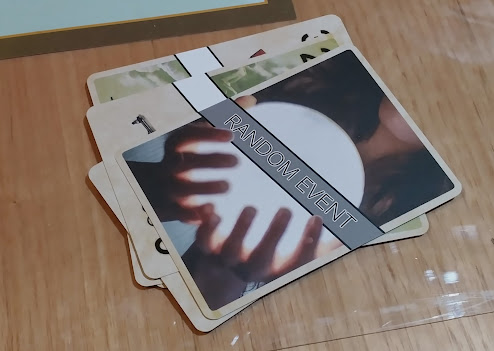
Who can tell what the future holds (beyond more uncertainty): Random Event Card.

The remaining card in each suit is a Random Event card. A random event table features in the exclusive rules for each game. When the Random even cart is played the drawing player rolls a d6 and consults the table. The random events add some uncertainty to the play and may affect one or both sides.

Each player also holds six Special Action cards. The player may choose to use one of these cards in lieu of an activation card. A Special Action card may be used to un-disrupt all the disrupted units in a single area (kind of a field refit and consolidation action) or all the disrupted units in the Rear Area. Like all nice things in Brief Border Wars, these are a limited resource and should be used selectively.
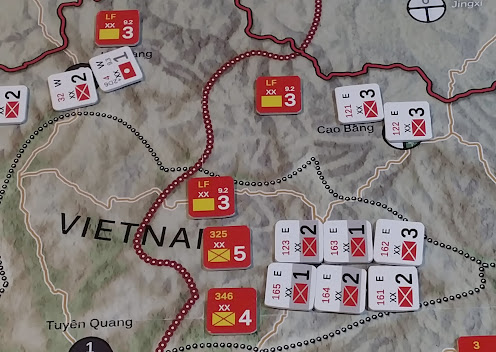
Vietnamese units (red) desperately try to stem the tide of Chinese forces streaming
over the border in the Eastern near the line of delineation (the red dotted line) between
the Eastern and Western Fronts.

The forces are asymmetrical, as was the situation in each historical case, and there is a definite sense of aggressor and aggrieved in each situation (in the context of the battle). As a rule, the aggressor has the upper hand in forces and materiel, but the defenders usually have the home ground advantage.

The game ends with the completion of the seventh turn (occasionally at the end of the sixth turn due to political pressures (a possible random event). Assessing victory is simple. The aggressor accrues Victory Points for holding locations – usually cities – with unchallenged, non-disrupted forces (i.e., areas with at least one functioning unit and no undisrupted enemy units present).


Appraisal

Brief Border Wars lives up to its name. The four conflicts represented ran from a few days to a couple of months in duration, and the consequence for each influenced relations between the antagonists for years or decades after.
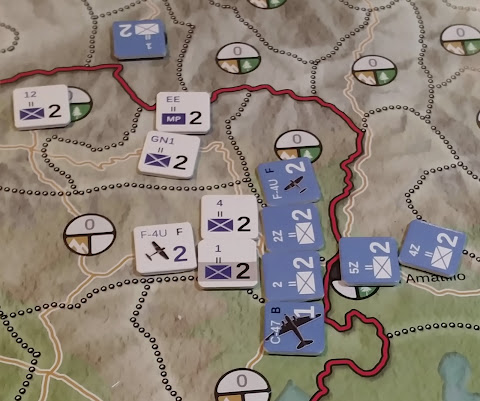
Venezuelans and Hondurans both call in air support.
(Please forgive the sloppy unit placement.)

This game ticks a lot of boxes for me. One of the things I love about these situations is the low counter density. On a 17” by 22’ map (the game is not at all a space-hog) it can look a little busy, but the counters are manageable. This is one of the factors that make the game an excellent introductory wargame for newcomers.

Having said that, there is a lot of strategic depth to the game. As the antagonist, it’s a simple thing to see what you need to do; there is some flexibility in your approach, but you essentially have to take and hold a certain point-value real-estate to win any kind of victory. But you’re not only playing against your opponent; you’re also playing against the clock. You may have seven rounds in which to achieve your mission, but you can only count on six of them. And with twenty action cards in the deck, if you get an early run of your own cards, you know that is going to come back and bite you later in the game. Any of the scenarios in Brief Border Wars shouldn’t take much more than ninety minutes to play. Once you’re familiar with the dynamics and the, for want of a better word, the nature of the game, You should be able to get a complete game played inside of seventy minutes, including set-up time.
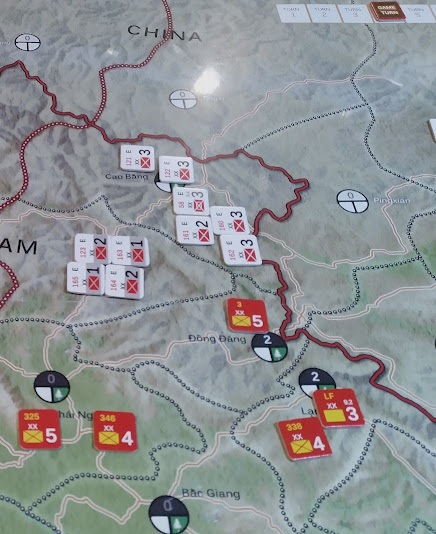
The situation in the Third Indochina War at the end of Turn Four.
(Please forgive the plexi-flare).

The battles are remarkably well-balanced. While the contesting forces are uneven (one side always has the advantage in men or materiel on paper, but the smaller force always has the home-ground advantage and can often run a mostly defensive response to the aggressor’s incursion and have a good chance at denying them their victory conditions. This and the intuitive rules (combined with the low counter density, and a healthy level of randomness in the combat and the twice-visited Events Table), all contribute to making Brief Border Wars my go-to game for introducing really green players to the nuances of wargaming.

Another aspect of the game is its awareness-raising value. Brief Border Wars presents four seriously under-represented battles. With each one, Mr Train offers a brief historical context, painting the broader geopolitical context of the particular conflict. A bibliography for each battle would have been nice, but I can appreciate that being left out for the sake of maintaining the brevity of the rules.

Brief Border Wars is still available for order through your FLGS, and can be purchased directly from the publisher (at time of writing, at a discounted price during the Compass Annual Catalogue Sale). There will be a Brief Border Wars 2 (Compass Games, ~2025) coming – probably as early as the first half of next year – promising more of the same, but with a difference; the battles featured in the second volume will date from 1913 through to the beginning of the Second World War, including the Italo-Greek War and the Battle of Khalkin Gul. For a challenging and satisfying wargame that’s playable in a shortish time, I can’t recommend Brief Border Wars highly enough. That it’s actually four games in one is almost gilding the lily.


Sunday, 10 March 2024

State of Play: Brief Border Wars (2/6): Third Indochina War


Our second run at Brief Border Wars (Compass Games, 2020) took us to the north of Vietnam in early 1979 for the Third Indochina War. After the French and American Wars, the national government of the newly reunited Vietnam were resistant to any foreign power trying to exert influence over their country. Erstwhile ally and material supporter of the North Vietnamese in their American War, the Chinese Communist Party were of the opinion that the uppity Vietnamese government needed to be taught to know their place. The limited engagement took twenty-one days to resolve, at which time the Chinese forces withdrew, claiming victory and insisting their objectives had all been accomplished.

Situation at start. The  two artillery units on the East/West Front border and the infantry
 unit on the Tongmianzhen/Dongxing border (South-East end of the border) are free
placement  units for the Chinese player. The two Vietnamese units in the Damaged
box were actually mobilised from further south; this reflects the time it took for them
to to reach the front.

Taking a lesson from our last game, T took the Chinese aggressors, while I played the defending Vietnamese forces. The Chinese have superior numbers and this on its own could spell victory, but the Vietnamese units tend to be a little tougher, and they have the home-ground advantage the terrain bonus in defensive combat). Still, the numbers can play to the necessary Chinese aggression strategy. Remember, victory is determined by the points-value of the provinces controlled by the aggressor nation at the end of the final turn, and control is defined by at least one undisrupted friendly unit in the area with no undisrupted defending units in that area. BBW rules dictate that the Attacker in a combat situation can dictate which units participate in that combat on both sides. This way, they can single out individual Vietnamese units for targeting, while managing the risk to their forces more effectively. The Chinese player doesn’t need to place every Vietnamese unit out of action, but merely to either disrupt or force a retreat on each enemy unit.

That said, it’s still going to be a hard task. The Chinese are also impeded by an arbitrary partition in the battle-scape; the PLA forces are split in two and restricted to operating in either the Western or Eastern area of the border region. Units from one sector cannot cross the dotted line to support their comrades in the other sector.

Unprovoked Chinese aggression (West front).
Note on unit orientation: because of the smaller 17" x 22"  map, it was easier
 for both of us to sit at the corner of the table instead of on opposite sides.

The Vietnamese have an inverse advantage; roughly a third of their overall strength is invested in Local Forces (LF). While the rules prohibit regular professional army units from leaving an area with undisrupted enemy forces present, the LF units can ignore this rule. Not only that, LF units can be moved from the Vietnamese Rear Area directly to any province bordering China. This came in very handy in the last round.

T came out swinging in the first turn. The card distribution of the first draw was four Chinese (white band) activation cards to two Vietnamese (grey band). The cards, have two values – movement and combat, and can be played for one or the other value. The value tells you how many units you can activate to commit to the chosen action on that card-play; if you have a card with a Combat value of 3 and a Movement value of 8. You can commit three units to engage in combat for that card-play, or you can choose to move units to the value of eight points (units can move from one area to an adjacent area each card-play; road movement costs a unit one point, while off-road movement will cost two points). In the first turn, T mobilised nearly all of his forces, pushing into nearly every province bordering China. I played coy, and in the Eastern Front, began to withdraw units in the northern provinces, hoping to lure T into following, so I could encircle his units and put them out of supply. Alas, he didn’t fall for it, instead choosing to fight some of the units still occupying border provinces in the Western Front, singling out the more powerful Regulars.

Unprovoked Chinese aggression (East front).

In Turn 2 we drew an equal number of cards, but the grey Random Event card came up, effectively robbing me of another opportunity; this was to be the pattern for the whole game. I rolled a 4 – Rear Area Chaos. Another roll was required: on a 1-3 the Chinese would be affected; on a 4-6, the Vietnamese. On the subsequent roll (a 2), it was the Chinese who couldn’t move anything up from their Rear Area for that turn. As it turned out, this was a small sacrifice for T as he’d moved all but three of his reserve units forward already.

Brief Border Wars is a game of skill and of chance. I wouldn’t say in equal portions, but both play their part in a given outcome. Turn three saw a 4-2 break in the cards in T’s favour again. I mostly concentrated on conservation of my units while T cherry-picked the most valuable provinces to try to take and hold. I could have told him that, in this scenario in particular, it probably matters less what you do in the first three or so turns, because of the room for reversal in the subsequent turns.

Random Event Card (not always a good thing).

Turn 4 saw the white band Random Event card drawn, and T rolled a 5 on the table: Diplomatic pressure for cease-fire. The game would now finish on turn 6, and to ensure this, the next six cards are drawn from the activation deck and discarded. These happened to be five grey-band cards (Vietnamese) to one white-band. That hurt me a little, but not too much since I’d avoided initiating combat for the last two hands after putting up a show of resistance in the first turn.

I had taken hits on some units rather than choosing retreat to soak a hit, gambling on bringing them back into action at full strength. T had been doing the same thing, I think, and we had both been using our Special Action cards for this purpose. T had burned through his in the last round. T lead each turn because he held the majority of cards (and the Aggressor faction leads in ties). Coming into the last round, I had one Special Action card left, which gave us both an equal number of playable cards.

The situation looks desperate.

With his last card played, I think T was feeling confident of at least a minor victory. On my last card play, I had 8 movement points available. I had two LF units in my Rear area. I moved one each into Hi Giang and Cao Bang, two provinces previously devoid of Vietnamese troops, and managed to move a couple of regular infantry units into other areas T was sure he’d had sown up. In the final analysis, only one of the occupied provinces was secured by non-disrupted Chinese forces, a major victory for the Vietnamese (though I’m sure the outcome would have been spun differently in Beijing).

My final gambit felt a little gamey and I’m not proud of winning on what felt like a technicality. If I hadn’t garnered Cao Bang and Hi Giang (either side of the demarcation line between West and East Fronts), T would have finished the game five points up instead of one, which still would have only been a draw. There is an element of gaminess inherent in BBW due to the limitations imposed on the system. It was always intended to be a fast-playing, small footprint game, and the area movement and simple, handful-of-dice combat resolution lend an element of RISK (Parker Brothers, 1959) to the feel of play.

Final game state, end of Turn 6.

Upon deeper consideration, I don’t feel like that’s fair to the game. The simplicity of the rules (four pages, plus special rules for each scenario) bely what is really a deep strategy game. Like a lot of wargames, BBW gives both sides a complete and unhindered view of the battle-space, which itself is unrealistic. Allowing the Local Forces to move quickly and with impunity from the Rear Area to the frontier is reflective of the fact that by 1979, the Vietnamese army and irregulars had gained thirty-odd years of experience fighting a better equipped invading force, and had taken to heart everything they learned. On reflection, I can’t help but think that Ho Chi Minh himself may have smiled at my dog-move at the very end of the game.

COIN isn’t the only system that models asymmetric warfare really well.


Wednesday, 14 February 2024

State of Play: Brief Border Wars (1/6): The Football War


I’ve been keen to get Brian Train’s Brief Border Wars (Compass Games, 2020) to the table for over a year now. It’s a classic four game box-set in the tradition of SPI’s quad-games; four situations using the same set of series rules, with a couple of pages of exclusive rules to add more flavour to the individual conflicts. It was one of the first games I chose for my 6x6 personal challenge last year. Last year didn’t happen quite the way I hoped, but I’m still keen to finish what I started, and so on Monday night I introduced T to the Football War, which was fought between El Salvador and Honduras.

Train offers a short but informative precis of the war in his designer’s notes for this conflict – and I’d recommend reading his notes for each of the situations, but in short, El Salvador briefly invaded Honduras in 1969 for a perceived short-term political gain. In the end, nothing was gained, many more civilians were killed than soldiers, and under pressure from the US and the Organization of American States (OAS), a cease-fire was reached in less and a week.

Opening set-up (apologies for the plexi-flare).

The game is an interesting puzzle. El Salvador is the aggressor. They have the larger forces at their disposal and enjoy the element of surprise, the majority of their forces setting up on the border, while much of the Honduran army available is still barracked near the capital. But the onus is on them to push out and in many directions to cover more territory than the Hondurans can protect, capture cities, then hold them against a limited but fully mobilised Honduran force. The terrain is working against them. If no roads links territories – which is the case along nearly the whole of the Salvadorian/Honduran border – the movement cost to each unit is two points (double the normal movement cost).

This is probably a good point to break the narrative and talk about mechanics. This is a game that takes seemingly clunky mechanics and works them into a relatively seamless narrative. Play is driven by cards, and there are two suits, white and grey, which are shuffled together and dealt out six cards at a time. Of those six cards, the white-striped ones go to the Designated player (the instigator of hostilities) and the grey-stripped cards go to the other player. Whoever has the most cards in their hand goes first that round, and card-play goes back and forth until both hands are depleted, or until both layers pass their turn. In that case, any cards not played are discarded, the turn marker forwarded one place, and the next six cards are dealt.

Access to the road network is crucial to success in The Football War.

Each deck has 20 action cards, and each action card has two values, Movement and Combat. Each card can be used for one or the other – you can’t move and engage in combat in the same card-play. The Movement number is normally how many units you can move in that activation; one point will get one unit from one area to an adjacent area. As mentioned earlier, the Football War, any non-road movement costs two points per unit.

Combat is handled simply, with one die allocated to each side for their participating units' combat value (CV – the single bold number on the unit markers). Like with movement, the number on the card played dictates how many units can be committed to fights in that round (the points can be split over several areas, and points can also be allocated to air support at a rate of one air unit per ground unit participating. The Attacker calls the shots. He declare which units from BOTH sides will participate in the action (he can gang up on a single enemy unit if he wishes, ignoring other units present in the area), but the defender gets the terrain advantage, up to two extra dice, as well as their own air support. A successful hit will flip an attacker to its Disrupted side, while the defender has the option of staying put and becoming disrupted, or to retreating to a neighbouring area but maintaining its cohesion (essentially an orderly retreat). More hits will lead to more serious results. As mentioned, terrain always favours the defender, and in The Football War, much of the play area is both mountainous and thickly forested. In most situations, a defender is going to get an extra die for each of these for their rolls.

Air support can be a deciding factor *it just wasn't in this case - no hits for both sides).

Each deck also has a random event card, which is declared and played as soon as it comes out. Each game comes with it’s on exclusive rules, and the exclusive rules include a table of random events; when the card come out, you roll a d6 and check the table. Every game runs through 7 turns, so each player will play through their 21 card-deck completely through the course of the game.

At the end of the seventh round, victory is determined. In The Football War, various Honduran cities are allocated values of one or two Victory Points, and any of these locations held uncontested by the Salvadorians go to their score. Being T’s first game, and my first in more than seven or eight months, after playing through the Operation: Attila and the Third Indochina War two handed, I think I can safely say that neither of us had a coherent strategy going in. After some jockeying in the first three rounds, I managed to distract T in the south, where his long-suffering Hondurans had made an incursion into Salvadorian territory, near the coast, tying up some of his limited resources while I made a late break through the northern part of the map, occupying a few unprotected cities at enough distance from his nearest forces to make interception unlikely. The presence of Salvadorian forces in an area is enough to establish control, but if there is also a Honduran unit or units in the space, it becomes contested, and the Salvadorian player can’t claim that point.

At the bottom of the seventh.

At the end of the seventh turn the Salvadorians held cities to the value of 5 points, a draw. Seeing how things played out, we both made a lot of mistakes, but that’s why I always approach a first game out of the gate as a learning game and try to be more invested in the how the mechanics function alongside each other rather than what I need to do, or stop the other guy from doing, to win. I think we both learned a lot, though I don’t think T will be able to curb his “all in:” instinct enough to take advantage of all the benefits offered to the defending player and set up situations to invite the aggressor to declare a fight; or at least, not straight away. With five more games to be played and only four in the box, I think I’d like to come back to the Football War with what I learn from playing the others.


Sunday, 12 February 2023

The fresh contenders; or Churchill’s replacement


As mentioned in an earlier post, I’ve been wanting to swap out Churchill from my original 6x6 list of games for 2023. I was excited at the prospect of a game-related challenge, and have been keen to get Churchill to the table since my P500 copy of the latest print run arrived. I knew it was a three player, but that it can be played as a two player with a Stalin-bot, but from earlier experience with under-player-ing Versailles 1919 (GMT, 2020), I really think I owe it to the game to have a three-player experience.

So, having decided to put aside Churchill for now, I needed to come up with a suitable replacement for that slot in my 6x6 endeavour. Going through my shelves, I picked out a stack of possible candidates. After some consideration of my shelves, I managed to whittle the list down to four likely contenders which, I am embarrassed to say, I still haven’t got around to playing for one reason or another. These are:

The oldest of these, in terms of ownership, is Colonial Twilight. I bought it during GMT’s 2021 Summer Sale (along with a truckload of other games), and was very excited about it when it arrived. I read the rules, flattened out the mounted board under some other weighty game-boxes, set the game up and played through handful of turns, two-handed. By the end of that I felt like I was getting the game. I was impressed by the new mechanics for this first two-player COIN game and the simple actions - complex ramifications nature of the play. It was an elegant game and I couldn’t wait to play it with an opponent.


And then I didn’t. Looking back, I don’t know what pushed it off my radar; it may have been another game I was even more eager to try out, or it might have been some aspect of my Life Outside Games that fought for my attention. I would have put away Colonial Twilight with the best of intentions of pulling it out again soon and getting back to it, but it hasn’t happened yet.

The problem with Colonial Twilight is the fact that is breaks one of the informal guidelines I set myself for the 6x6 challenge; it would be a second game designed by Brian Train, who is responsible for Brief Border Wars and the upcoming Brief Border Wars 2 (Compass Games, slated for release this year). Brian’s games are always interesting and challenging, but it would feel wrong to privilege one designer over all the others whose work I really like and respect. If I do this again next year, though, I think I have my first pick.

Richard III is a classic Columbia Games block game. They make a lot, and by all reports, nearly all are at least very good, and some are exceptional (Crusader Rex (2005) gets mentioned a lot around the forums). This would be an easy choice is I didn’t already have three block games (This War Without an Enemy, The French and Indian War, and Napoleon 1806) on my list already. I’ll still try to introduce T to the joys of Columbia’s block game style sometime soon, but It’s not going on the list.


Verdun 1916, while technically a block game (it uses rectangular wooden pieces to represent formations and thinner, matchstick-sized ones for trenches), the style of play is so radically different from anything else I possess that I would be happy to pick it. There are two things that are stopping me from going with Verdun for my 6x6 challenge; firstly, I’ve tried to select games from different conflicts. World War I is already represented by Hexasim’s Great War Commander.

Which brings me to my second reason for its exclusion. Three of the five remaining games on the list are from French publishers – Nuts!, Shakos, and Hexasim. This shouldn’t be at all surprising; companies all across Europe are producing excellent, thoughtful, and challenging games. In good conscience, wanting Great War Commander on the list precluded me adding The Fate of the Reiters (Hexasim, 2019). Nonetheless, I hope to get in a few games of Verdun sometime this year, and report back accordingly.

It would seem that the last man standing will be Undaunted: Normandy. This is a fairly recent acquisition, having arrived a little before Christmas. I’ve owned Undaunted: North Africa (Osprey, 2020) for maybe a year, and have managed to get it to the table – at least for two-handed solo play – several times.

When U:N first arrived on the scene, I was sceptical. I owned a handful of Osprey games and loved all of them.  But it seemed to me, on the face of it to be too much of a crossover game, a self-conscious attempt to make a wargame that would appeal to non-wargamers to “trick” them into wargaming. When U:NA came out, I was a little more familiar with the work of co-designer David Thompson, and, having only recently read Gavin Mortimer’s The Men Who Made the SAS (Little, Brown; 2016), I was intrigued by the historical background of the game, and – frankly- it was pretty good value for money.

Reader, I bought it. And it’s a purchase I haven’t had cause to regret. I was really surprised to see how well the deckbuilding mechanics worked in the context of the game. It’s definitely at the “game” end of the game-simulation continuum, but it’s a lot of fun, and, as rules familiarity increases, quite a fast-moving game, but it still offers challenges and decision-points enough to feel like a satisfying and worthwhile experience.

As I understand it, the scale of Undaunted: Normandy differs from U:NA – the units are squads and support weapon teams rather than individual combatants, and vehicles were only introduced to the game in the second offering (although, I believe, vehicle options for U:N scenarios feature in the Undaunted: Reinforcements (Osprey, 2021) deep box).

I think Undaunted: Normandy will also be the right level of complexity for my primary opponent, T. T is by no means stupid – he’s a senior medical specialist – but he has a serious job that comes with equally serious responsibilities, and as such, has a limited capacity for processing new information, like game rules. After a couple of plays he’s usually picked up the basics, and after half-a-dozen or so games he’s usually giving me a run for my money (we're pretty evenly matched at all of the games we're most familiar with), but as we catch up at best once a week, a lot of table time will be spent in revision for the first few runs at a new rules-set.

But for now, we will be concentrating on Napoleon 1806.  This week we’ll be graduating to the Rules for the Conscript. I think I’ve assimilated the extra rules and am ready to make six or seven mistakes in the first half-hour of play, but that’s how we learn, right?


Blog Note: a recent arrival

   I’ve been a little quiet on A Fast Game of late due to a combination of circumstances; my wife’s aunt and uncle are over from England at ...