Showing posts with label GBACW. Show all posts

Monday, 9 June 2025

Stripped Down for Parts: By Swords and Bayonets


The Great Battles of the American Civil War (GBACW) series is my White Whale. Or one of them. I circled around the game for years. I heard it was difficult, that the rules were hard to digest, that understanding of line-of-sight was conferred only on the worthy by some greater power. Okay, I’m exaggerating. But everything I read suggested GBACW was tough to start with but incredibly rewarding if you push through and grok it.

So, in a rash moment, I dove in. I bought Death Valley: Battles for the Shenandoah (GMT Games, 2019), and Into the Woods: The Battle of Shiloh, April 6-7, 1862 (GMT Games, 2022) in quick succession. I started reading the common rulebook, and while not something you’ll breeze through, the rules – was reading the latest (2022) version from Into the Woods – seemed clear, sensible, and understandable.

I’ve mentioned previously in A Fast Game that I’m keen to get into GCBACW and was planning to get a couple of the smaller scenarios from Into the Woods to the table (more pushing counters around to get a feel for the game and the line-of-sight rules, rather than diving in like a damned fool). Circumstance and my own conflicts of interest had kept this from happening, but as it was, when GMT announced the inclusion of By Swords & Bayonets in its P500 roster, I decided to put those ambitions on the backburner and wait for this one to come out. Like a lot of other people, I’ve been eagerly awaiting its release since.

Normally I try to bring a little a clarity to the components in my unboxing narrations, but I don’t think I cold bring anything this that hasn’t already been covered in Gary Mengle’s unboxing video over on his YouTube channel, Ardwulf’s Lair (subscribe and thank me later), with the game’s designer, Allen Dickerson.* I recommend taking the time watch the video in its entirety (it comes in under three-quarters of an hour), especially if you’re unfamiliar with the system. Instead, I’ll mostly just offer quick run through of everything that comes in the box, with some comments on the physical qualities of the components, and a few historical notes.  


The cover illustration for a game will usually the tone for the game. The choice of a Currier and Ives lithograph depicting the Battle of Mill Springs,1862. I’ve written about another print company that made a specialty out of American Civil War prints, Kurtz and Allison, in a previous post. The notable difference here is that, while it could be argued that Kurtz and Allison’s output was technically of better quality and more fully realised (certainly richer in detail), Currier and Ives were producing their prints contemporaneously with the events depicted. A copy of the Mill Springs print was submitted to the Library of Congress in the same year the battle was fought.

The back of the box: so full of promise.

Overall, the box shell is of the solid quality that GMT has been housing everything lately.I've heard that the box is the single most expensive component to produce for a new game. For what it's worth, I'm happy to pay a  couple of bucks extra for a sturdy enclosure.

While some games in the GBACW series have presented multiple battles in a set, these have been interconnected, often parts of a greater campaign, or single day scenarios of a longer battle. By Swords and Bayonets goes the full SPI-style quad-game experience, with geographically and chronologically disparate battles, each using the GBACW series rules, with some situational tinkering for each battle. This is a first for this series, but Mr Dickerson has alluded to a second four-battle pack  already in the works (or at least in the research stage).

The box back offers a teaser of what’s to come. Four maps (in miniature, overlapping), some representative counters, shown at about actual size, and some brief paragraphs setting out the scope of the game. The inset details I’ve come to think of as the Scope Box (though I doubt that will catch on) declares that the game is intended for 1-2 players (though I doubt Mr Dickerson agrees), that each battle will likely take four or more hours to resolve (so probably not appropriate for a school night), and the game is intended for players fourteen and up.

The game’s complexity is rated at 7 out of 9. I think this is probably true of anyone’s first game using the GBACW rules; if you’re familiar with the system, I’d wager this would go down a notch or two, though there will be things to integrate with each new situation (but in that richness is much of the appeal), and Solitaire Suitability also comes in at a 7 out of 9. Regarding the game, the map scale is 140 yards per hex, with altitude graduation 20’each, each unit stands at roughly fifty men per Strength Point (or a single cannon), and each turn represents an hour of battle time.

GBACW series rulebook.

The GBACW Series Rulebook is the next evolution of the series rules from the 2022 edition featured in Into the Woods. All significant changes to the 2024 edition rules are indicated throughout by a Minie ball icon in the margin. The rulebook itself runs to 44 pages. Of these, the cover page offers a detailed Table of Contents, the back cover presents the credits for the broader GBACW system. A through Index takes up the next two pages inside the back cover. In all, the rules amass 38 pages, with another two devoted to an optional Fatigue rule that, according to many trusted commentators familiar with the system, shouldn’t be considered optional at all.

The rules are both well laid out and are augmented with edifying illustrations where appropriate. This is a series that has been in near constant development since maybe the early eighties, and it has been honed by many minds. Nothing made by the hands of man is ever perfect, but by now the GBACW system rules must be polished to a high sheen.

All three books share the qualities of being printed on a nice weight of matte-finish paper, in – if I’m not mistaken – a very readable Garamond-family type. The books are staple bound, which is perfectly fine for presentations of this length. I tend to mistreat my rulebooks, rolling the pages back over themselves when I’m learning a game, but comparable length booklets from GMT have stood up to this abuse admirably.


BS&B Battle Book. Let's get this party started.

The Battle book is adorned with another Currier and Ives lithograph, this one the Battle of Newbern [sic] N.C. March 26th 1862. A better rendering of the print is available from the Huntington Digital Library and is worth a look. The slight differentiation in colouring between the Huntington print and the one used for the Battle Book is that each print, after being pressed on a limestone block for the black and white image, was hand-coloured by in-house artists, so some variation was inevitable.

The cover also features a Table of Contents, from which we can glean that three of the battles featured in BS&B are single-scenario ventures, while an alternative scenario is offered for the Battle of 2nd Rappahannock Station. The next two and a half pages outline general principles for the playing of the four battles – each scenario will have its own particular rules as well. Special note should be taken of rule 17.0 Fatigue, which states “In all By Swords and Bayonets battles, Fatigue is not optional,” (emphasis in the original, but thankfully it isn’t presented in bold).

Each scenario is laid out in the manner as in previous entries into the GBACW line. One of the things that make BS&B such great value is that, while most of the scenarios are single situation games, the situations of the four games are quite radically different, each bringing its own qualities and flavour to the table.

The Battle Book also includes a two-page Designer’s Notes that should be required reading for anyone embarking on the game. It closes with a reproduction of the counter sheets (which we will get to shortly), and an exhaustive set of credits for the game on the back cover.

Examples of Play Book. Chock-full of demonstrative goodness.

Also included in this set is a third booklet given over to an extended example of play that the designer has put together using images from the VASSAL module created for playtesting the game. The booklet runs to 32 pages, with a one-page forward, and a very detailed thirty-page of detailed and thoroughly illustrated play-through of the Battle of Big Bethel. This book alone is worth the cost of the game for someone new to the system and keen to learn. The Example of Play is replete with fully annotated set-piece examples of how the rules of the game function in an actual game situation. This might be the resource that nobody realised the series was lacking.

Terrain Effects Charts for the battles of Big Bethel and Mill Springs.
Terrain (and elevation) play a big role in GBACW.

The game comes with a handful of various manners of cards, ten in all. All of the cards are printed on a familiar weight of cardstock, with a light sheen rather than a full gloss finish, making them much more readable under lights.

The 2nd Disorder Table. Clauses and consequences.

Of these, for are Terrain Effects Cards, one for each battle, and each with the common Second Disorder Chart on the verso. These are 8½” by 11” cards. If an already disordered unit receives a second Disorder result (as can happen in a multitude of circumstances) the owning player must refer to this chart and follow the instructions for the appropriate case. This chart is very well laid out and easy to follow.

Confederate and Union Organisational Cards for the Battle of Big Bethel. The others
share roughly the same configuration, but are tailored too each battle.

Four back-printed Organizational Cards – also 8½” by 11” – are also included, two for each side. Each card has two sets of tracking aids on either side, each face covering the for battles of the game. These are used by each layer to track turns and collected victory points, as well as various administrative functions in the game, such as routed/regrouping and eliminated units.

Player Aid Pard, external panels (back (left) and front).


And the same PAC inside the fold.

Finally, two bi-fold 11’ by 17” Player Aid Cards provide the tables and charts needed for the most common functions in the game. This is a well laid-out PAC, with each panel dealing with its own set of game circumstances. The front face offers tables for Rallying, Brigade Coordination and Order changes, and notes on the Loose Cannon result from an unfortunate Brigade Orders Change roll. The inside-fold deals with Fire combat, offering the Range effects and Fire results tables, as well as notes on Stacking limits and non-phasing fire eligibility. The back face covers Shock combat, with the Shock Resolution Table, and supporting guides and tables.

Battle of Big Bethel map.

Battle of Mill Springs map. The poor lighting really doesn't do justice
to these map sheets.

Battle of New Bern map. Tough fighting with all that forest.


Battle of Rappahannock Station map. Two scenarios, no waiting.

From a presentation point – in my view, at least – the maps are where BS&B really shines (though the work done on the unit counters has really paid off as well). These were prepared by GBACW stalwart Charles Kibler. The four maps are back-printed on two 17” by 22” sheets. These are also printed on a good weight paper-stock, the same quality as those included in Into the Woods and Death Valley. The maps hit that sweet spot between attractiveness and playability. I don’t think I have much more to offer regarding these, except that they are one more reason to get some B&SB to the table.

Counter sheet 1 - mostly fighting units and leaders.

The game comes with just two sheets of counters. The counters are all ½”, which can sometimes make for some difficulty for me personally, but I don’t think these should be troublesome at all. 

A sample of Confederate and Union leader and unit counters. Like I said, a lot
of information in a small space, but still eminently readable.

The unit counters carry a lot of information, but it is clearly organised and presented, with blue and butternut backgrounds for the opposing Union and Confederate forces, a colour-bar to mark each unit’s command affiliation, and numbers representing the unit’s Strength, Cohesion, and Movement allowance.

Counter sheet 2 - mostly admin markers, but also included are two errata counters
 for the Death Valley expansion, Battles of the Shenandoah (Bottom-right).

About half of the counter mix is made up of administrative markers, including numbered counters to keep track of casualties taken by units, mnemonic devices for unit orders and various states such as low ammunition and fatigue. Overall, the counter registration is very good across both sheets, and the die-cutting is so good that, I dare say, clipping may not be required.

An unexpected boon. A counter tray (stray tray?). Dice are also included
(though not pictured, but you've all seen ten-siders before).

As an unexpected bonus, a counter tray has been included in the package. I don’t know if that’s just for the first hundred lucky prize-winners, or if all copies will come with one. I think a single tray should accommodate the leaders and troops, though some of the shared administrative counters will probably need to reside in Ziploc baggies. Which may actually be more desirable in the long run. The game also comes with two appropriately coloured ten-sided dice, one blue, one grey. These feel like good rolling dice, but I’m already stealing myself to their sudden but inevitable betrayal.

-----

Realistically, I'm not sure when I'll be able to get By Swords and Bayonets to the table. It is on my Ten Game Challenge list (as a reserve title), so I have an excuse to pull it out, one game at least. If anyone else has played it, I'd appreciate any advice you can offer on which battle would be best to start with. Leave a comment if you have a firm view on this, and thanks for reading this far.


* Since posting this, GMT Games has posted a video of Allen Dickerson in conversation with Rachel and Luke Billingsley on the GMT Games YouTube Channel, discussing BS&B and the future of  GBACW generally. I've heard elsewhere there's a appetite  at GMT for another quad battle game on the back of BS&B's apparent success, but our intrepid designer isn't interested. In the interview, Mr Dickerson stated he's weighing up a big-box Death Valley-style campaign game covering the McClellan's Peninsula Campaign of 1862. We can only hope.


Monday, 23 December 2024

Stripped Down for Parts: Glory III


I understand the collector's motivation – I’m a completist myself; if I like a game and there are others in the series, I want own them all – but I’ve been trying to curb that side of my personality (at least so far as gaming goes) and play, or at least get to know, the games I own. That extends to the games I buy these days. Of course, I haven’t played all the games I own, but it’s like Umberto Eco’s reply (to those he liked) when questioned if he’d read all of the books in his 30,000 volume library; “Why would I want a library full of books I’d already read?”

Still. I’m always a little surprised when I stumble across a second-hand game for sale that’s still in its shrink-wrap (I cite Fallen Eagles II: Waterloo 1815 (Hexasim, 2022); you can read my unboxing post here). Glory III: Battles of Antietam and Cedar Creek (GMT Games, 2007), wasn’t shrouded in shrink, and the rules had at least been read, but whoever the previous owner was, they’d obviously taken care of their their games, but had never got around to punching this one's counters and pushing them around. I find it a little sad, but maybe they found some joy in other games they owned, and never quite got around to this one.

As I understand it, Richard Berg’s Glory system was designed as a lighter and faster-playing alternative to the Great Battles of the American Civil War series. This piqued my interest, as did it’s use of a chit-pull activation system for ordering formations, making it a good candidate for two-handed solo play. Here at A Fast Game, we’re all about games that don’t outstay their welcome, and if a system is easier to convey to new folks, all the better.

The over is a classic Rodger B. McGowan design and sets the tone for the game. the illustration taken from an etching – no doubt prepared after the fact – baring the caption “North of the Dunker Church, a Union charge through the cornfield,” referring to the infamous cornfield at the battle of Antietam. The original illustration is from a volume called, Battles and Leaders of the Civil War, Volume 1: Being for the Most Part Contributions by Union and Confederate Officers, drawn from the pages, and prepared by the editorial staff of the Century Magazine, New York, 1884 – in living memory of the events of the time. Alas, the illustration is uncredited.

The box-back description of Glory III reintroduces the (assumed) already familiar Glory rules-set, and briefly outlines the two battles covered in the game. As the third volume of the Glory series, the game needed less of an introduction. The description on the back does stress that this volume further “clarifies the revised system of the Glory rules introduced with Glory II: Across the Rappahannock (GMT Games, 2002).

The box back also advises that the game is suitable for 1-2 players (no age suitability suggested here), and that the game scale is brigade-sized units, 15 game minutes to a turn, and an oddly specific 21.5 yards to a hex. The complexity is rated four out of nine, with a solitaire suitability of seven out of nine, which feels about right, given what I’ve read of the rules thus far.

The Rulebook. Why is it in wargames, Rulebook is always one word,
but Play Book is always two?

 The rulebook is typical of GMT’s production values of the time for straight hex-and-counter wargames. It’s printed on good matte paper stock that hasn’t shown any signs of discolouration with age (I know it’s less than twenty years old, but I’ve seen five-year-old rulebooks starting to discolour, so this is a testament to GMT’s consistency in using good-quality materials in their production all the way through).

The Rulebook itself is just sixteen pages, of which only twelve are actually devoted to the rules of the game. The cover features a brief Table of Contents, pages 2 through 13 make up the general rules for the game (exclusive scenario rules feature in the Play Book), while two pages are given over to “Refitting Glory I,” clarifying some rules, offering about a page and a half of errata for the original game. Owners of Glory: The Battles of First & Second Manassas and Chickamauga, 1861-63 (GMT Games, 1995) are advised to use the Artillery chart from Glory II: Across the Rappahannock, with replacement counters included with the current game. I’ll come back to this in a minute. The back page includes a detailed Sequence of Play, Line of sight rules, and notes on Disordered Units and Rallying Units, all handily in one place.

Battle Book.

The Battle Book weighs in at 24 pages. Again, the title page features a Table of Contents. A page and a half offer an introductory note and some advice on counter and terrain. The roughly ten pages dealing with Antietam include two scenarios – a shorter Final Attack as well as the Full Battle – as well as rules covering both scenarios and some special rules for the Full Battle scenario. The Cedar Creek gets the same treatment over eight pages – only the Historical Battle scenario is included here – but also gets some Advanced Rules covering Fog, Looting and the lull in the fighting due to Sheridan’s hesitation upon his return.

I wanted to note the inclusion of a paragraph or two on both games regarding balance in the games. Regular readers will be aware of my thoughts on balance in historical simulation games, but I just wanted to share my appreciation for Mr Berg’s acknowledgement and acceptance that sometimes the odds were just against one side. I don’t have all that many Richard Berg games – the Men of Iron Tri-Pack (GMT, 2020) springs to mind – but I’m always appreciative of these notes.

Two pages are devoted to a reduced image of the two counter sheets, front and back. I’ve found these invaluable in the past for checking inventory of counters in punched second-hand games. Like the Rulebook, the back cover of the Ply Book is given over to useful charts, specifically pertaining to the Cedar Creek game, as well as some notes toward an Alternative History scenario for the Cedar Creek game involving the removal of Custer’s and Merril’s cavalry forces for a more evenly matched game.

PACs, front and back.

Glory III comes with two Player Aid Cards. It's a small thing, but I'm always grateful when two PACs are included in a game. It's not that big a deal to run off an extra copy, and it wouldn't be an issue at all for folks who regularly or solely play their games double-handed, but a second PAC says to me that the publisher understands table requirements and is willing to go to a little more effort to make a more perfect gaming experience. 

The PAC is all about contact with the enemy. The front offers the tables needed for  Artillery Fire Resolution and range effects on arty, an Odds Ratio DRM chart, and Charge Resolution and Defensive Fire Resolution tables. The verso presents a Terrain Effects Chart with two set of columns, covering movement on the left (although it hasn't been marked as such), and Combat effects of various terrain types on Arty fire, Defensive fire and Charge attacks. All useful stuff.

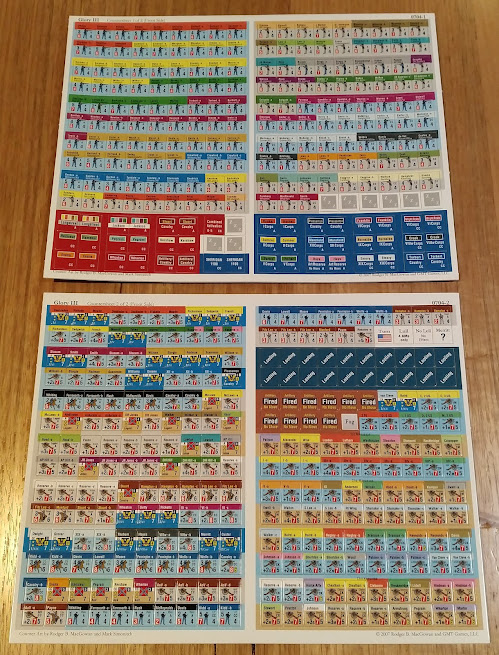
Two counter sheets, slightly curled with age and a little damp, but still serviceable.

The game comes with two sheets of counters; a forgiving 5/8” (15mm in new money) for most of the foot units, and 1/2” (12.5mm) for the cavalry and artillery units, and leaders. All the unit counters are identified with an A or CC (right-hand side, middle counter) to mark their provenance, and each is roughly a regiment in strength. One to two infantry regiments make a brigade (the top-most name is the Brigade Commander, a number of brigades, usually around three, will make up a division. Divisions are identified by the Divisional Commander (the name below the Brigade Commander’s name, and several divisions will make up a Corps. Each corps is colour-coded with a stripe highlighting the brigade and divisional commanders’ names. As Glory uses a chit-pull activation system, units are ordered at the corps level. This should keep things simple and ticking along nicely.

Counter sample. The -a and -b after the Brigade commanders name indicates the
assigned regiment identifier. The numbers on the left are Combat Strength (top)
and Cohesion (red box) and on the right, Movement Points.

As mentioned previously, about a quarter of the second counter sheet is devoted to replacement artillery counters for the first Glory set. It seems the artillery was rated understrength for both sides, and the replacement counters address this. Which brings me to a bit of an impasse. Do I keep these in anticipation of one day finding a copy of Glory to acquire, or do solicit interest from the readership? I’m inclined to hang on to them for now, at lease until I’ve played Glory III and got a feel for the game, but feel free to contact me if you have a copy sans replacement counters and desperately wish to play it as the designer (eventually) intended.

Antietam map.

The two maps are printed on a single, low-gloss sheet of paper. The map sheet is a nice weight, I’d guess about 200gsm, and both look very attractive and eminently playable on the table, though I think I’ll be laying them under plexi, just to lose the puckering at the fold nexuses.

The maps are clear, well-drawn and easily navigable, and bear some resemblance to the GBACW series maps of the same era. The Antietam map features the town of Sharpsburg nearly in its centre, with a meandering Potomac River and the accompanying Chesapeake and  Ohio Railway (C&O) navigation (transport) canal making appearances to the left side of the display, and the Antietam Creek making its way through the full length of the play area.

Cedar Creek map.

The Cedar Creek map is bisected top to bottom by Medow Brook, a shallow waterway that runs past Middletown and into Cedar Creek in the bottom half of the map. To be honest, I know next to nothing about the battle of Cedar Creek, so this is one I’m particularly looking forward to. In both instances, the undulating terrain is clearly defined with the use of progressively darker-hued beige colourings, which promise to make for an interesting fighting situation.

Each map contains its own terrain key, as well as holding boxes for each side for Withdrawn and Reserve units, and a turn track is printed on both maps (this is always a delight, to not have to find room for a separate Turn Track PAC).

Dice, baggies and a packing slip, harking back to a simpler time.

The game comes with two ten-sided dice, fittingly one in blue and one in grey, and a roll of Ziploc baggies. Amazingly, the baggies that came with this game haven’t been repurposed (I don’t know if I would have been so diligent). Also included is one of those notes of thanks the GMT warehouse folks used to always put in a box to say it had been prepared by another human, in this case, half-way around the world. A small point of connection, and a little marker of satisfaction in bringing a little joy into another person’s life.

----- 

Which brings us to the end of our look at Glory III. Thanks for staying to the end. 

Now, the game will return to its shelf, in all probability to sit for another couple of months or a year, until I get around to punching and clipping it, laying out a map and pushing some counters around myself. But what would be the point of a library full of games that I’ve already played?


Tuesday, 23 January 2024

By the Numbers: Thinking about Wargaming Goals for 2024


January is the time people choose to make decisions about changes in their lives. I’m certain most people make these declarations – or unspoken determinations – with sincerity of spirit, but the fact remains, any kind of change is hard, and behavioural change is an order of magnitude more difficult again. Most New Year’s resolutions are abandoned – forgotten or ignored – withing the first eight or ten weeks of the year,

I’m no stranger to unfulfilled self-promises and commitments to being or doing better. But, at the beginning of 2023, I wanted to change one behaviour that I noticed in myself. I’d shifted from being a wargamer to being a wargame collector. I’ve talked about this before; collecting games is a valid hobby in and of itself, there is a special joy in owning some artifacts, and I would never try to fat-collection-shame anybody, but I’ve always identified as a player of games (more recently, nearly exclusively board wargames), but my actions were not reflecting my self-identity. So, I set about doing something about it.

Here I Stand (GMT , 2006)

As a veteran of failed change attempts, I knew I had to plan something manageable, and settled on playing six games I owned hadn’t got around to playing, and playing those games six times each before the end of the year, to get to know them better than if I’d just played each one the once, with all the rules  mistakes and tactical errors that are inevitable in first runs at a new game.

As I’ve also mentioned here, I didn’t complete the task I set myself. But I tried to. And in the trying, some interesting things happened. I played a lot more than six new games – I just didn’t play them al with other people, one of the stipulations I set myself in my 6x6 challenge – and a lot of those were games I’d had in my collection for some time, but now had the desire and confidence to try out on my own.

A Fast Game (this blog) was an unforeseen side-effect of my desire to play more of the games I already owned. I wanted a way to keep myself accountable for the project. I could pose AARs on Facebook – there is a very supportive group based in my adopted home-town – but I’ve always been a writer, and I thought keeping a written record of the games I played and my responses to them would make me think more deeply about the games in question and about why I played what I played or chose this game over that (or just chose both).

WWII Commander: Battle of the Bulge (Compass Games, 2020)

I’ve been making some notes in my planner (which might hint at how old I am) on what I might set as my gaming goals for 2024.Nothing is carved in stone as yet, but here are some of my thoughts:

➤ Complete my 2023 6x6 Challenge I feel like I owe it to myself to see it through, so it’s not just one more incomplete effort. I’ve talked about this before; I don’t see it as an overall failure because the process of committing to it and writing about it has made me both more conscious about the games I play, and more eager to play new and different games off-list. Before 2023, I could have counted the number of solitaire games I’d played on one hand. Looking over my records for 2023, I recorded 52 separate solo games played (some of those were two-handed solo learning games, but I’m still counting those). For the year, I had 122 gaming incidents listed, so all up, around 150 individual games (a full third of those alone, but that’s okay too). Planning to play games has lead to more games being played, unplanned. Which is kind of cool, and kind of why I started planning to play games in the first place.

Siege of Syracuse (Worthington Publishing, 2022)

At time of writing, I have made some headway on this, having last week played my sixth game of Napoléon 1806 (Shakos, 2017) and my first run at Great War Commander (Hexasim, 2018) on the same day. There are a couple of things vying for my attention at the moment, but I’m hoping to finish the three outstanding games on my list by the end of March, and I should have a review for Napoléon 1806 in the next week or two.

➤ Commit to something like a 6x6 for 2024 This is a tough one. At the end of January last year, I thought that a slate of 36 games – six games, six plays each, against another actual face-to-face human would be tight but doable (I even set myself a stretch goal of another six games of 1960: the Making of a President (GMT Games, 20##). I think it’s a valuable exercise, and I wouldn’t be heartbroken if I didn’t complete it again, but I’d like a better chance of getting it done. If I do commit to a scheduled program like that, it might include solitaire games, for a little more flexibility, and maybe even online games (using VASSAL or Rally the Troops!).

➤ Learn to play the Great Battles of the American Civil War (GBACW) rules-set I have no excuses for this one; I managed to land my White Whale game, Death Valley: Battles for the Shenandoah (GMT Games, 2019), after a year-and-a -half of near-misses and second-hand but lovingly clipped and tray-sorted,  and I have Into the Woods: the Battle of Shiloh, April 6-7, 1862 (GMT Games, 2022) tucked away and as yet unpunched, waiting to be played. GBACW has a reputation for being a difficult system to grok, but I’m prepared to put the time and effort into it.

Regardless of what other goals I settle on, I intend to pursue another year of A Fast Game. The only item I had on my list relating to the blog was to try to raise the number of game reviews posted from 12 in 2023 to 20+ (I remember when I wrote out my notes that I thought about declaring 25 reviews – roughly two a month – but I lost my nerve and lowballed it a little to keep it manageable). Reviews are where everything I’ve learnt about a game, thought about it and through it, and taken from it gets wrung out into a fifteen hundred-of-so words, and it rarely conveys everything I mean it to. I like to think I’m getting better at it, though.

Aces of Valor (Legion Wargames, 2022)

The reviews are often the hardest part of the blog to write, but also the most probably the most satisfying as well. I’ve never accepted a copy of a game for review (I’ve never been offered one either), so I’m in the lucky position of being able to spend that energy on games that I think deserve a spotlight for whatever reason. That won’t change. But I’ll still be posting game reports and unboxings (State of Play and Stripped Down for Parts posts in A Fast Game parlance), and the odd, meandering prose-poem about some esoteric facet of our shared hobby (Overthinking It).

The end of January will mark the first anniversary of A Fast Game, and my first year of blogging about games. Writing A Fast Game has been very rewarding personally – a separate joy from the actual playing of the games I write about – and some folks seem to enjoy reading it. So, whatever I end up settling on for the year, people will still be able to read me babbling on about it for another twelve months at least.

Great War Commander (Hexasim, 2018)


Blog note: A long absence and another milestone

      It’s been a week – strike that; it’s been ten days since I last posted. I try to get something up at least weekly (I aim for six or se...