Q. How many D-Day
games does a man really need? A. Just one more. (They’re called truisms for a
reason.)
The Dark Summer: Normandy, 1944 (GMT Games, 2021) isn’t that new a game, but it’s on GMT’s 500
list for a second printing, so I thought it might be worth stripping down for
parts, so people can see what they’re getting for their buck, should they
decide to order it. I did have it on order myself, until I had the opportunity to
nab a copy still in its shrink wrap. The new printing is a straight reprint (“with
any known errata corrected”), so I thought, why wait? And now you, the reader,
get to benefit from my lucky find. This is my first DARK series game, but I've heard and read a lot of good things about the system and the games, so I'm looking froward to diving into this one.

The Dark
Summer is the third – no, fourth – game by designer Ted Raicer using his DARK
system, first seen in his now classic The Dark Valley: the East Front Campaign,
1941-1945 (GMT Games, 2013), Which, incidentally, is now also on the P500 list
for a reprint of the Deluxe edition (which, of course, having missed out on the
last printing, I have pre-ordered; how many Eastern Front campaign games does a
man really need...).
Subtitled “The
Battle for Normandy, June 6 to August 21,” This game covers the invasion and
establishment of the beachhead, through to the breakout by allied forces.
The box is a
solid 1½ incher; the quality of GMT boxes has generally improved over the
last five or six years I think, with the sturdier boxes being used for every
release, not just the bigger, higher-profile ones. The back of the box tells us that it's a regiment/brigade-level game (some battalions also, which makes sense, given the subject), and that each turn is roughly a week. It's a two player game, but has a reasonably high solitaire suitability (no dedicated bot, but being a chit-pull system, is eminently solo-able, playing both sides to their best effect). At four-plus hours, it's probably not a game for a school-night, but definitely doable in an afternoon.

The game
comes with two counter-sheets, the majority of which are unit and combat
support counters. For a chit-pull activation game, The Dark Summer seems to have very few admin counters (maybe 60 or so?). The forces appear in traditional colours; Americans in olive drab, British and Canadians in khaki, German regulars in light grey, SS in black. The counters use mostly NATO symbols with some silhouettes for unusual units. All the information is clearly presented. I haven't stopped to check, but I think they're nine-sixteenths of an inch in size.
 |
I couldn't take a decent photo of the map to save my life, but there's
a full-sized image on BGG, courtesy of Jay Townsend. |
The map covers the region of the
French coast essential to the story it’s telling. The map’s scale it 2¼ miles
to a hex, to the landing coast runs from about ten miles north-west from UTAH
to the port town of Deauville about twenty miles east of SWORD. The Cotentin Peninsula has been lobbed off, with
Cherbourg being represented by a Cherbourg Box at the edge of the map top
left-hand edge of the map.
The rulebook and playbook are printed
on a good weight of the familiar glossy paper we sometimes get from GMT. I don’t
really understand how it’s decided which games get the glossy paper and which
get the slightly lighter-weight matt finish paper. It’s one of life’s
mysteries, but I’ve reconciled myself to this.
.jpg) |
| Rulebook (above) and Playbook sample pages. |
The rule book runs to twenty-four
pages (twenty-two if you subtract the cover and contents pages). The rules are
sensibly laid out and seem clear to read – I’m only part-way through them, but
no complaints so far. The back-of-the-box tells us that the good folks at GMT want us to know they think it's a medium weight brain-load of game (5 out of 9 in Complexity). I'd question the rating on some games, but that feels about right for this one; I think I'd want to do a second-read-through and do a couple of turns solo before I sat down with another actual person to teach them the game, but the rules are simply presented and nothing I've seen so far seems brain-breakingly difficult.
The game also includes a playbook, which is comprised of
a twelve-page, thoroughly-illustrated Extended Example of Play, an interesting and worthwhile two-page
Designer’s Notes essay, front and back pics of the two counter sheets, and a pretty
thorough three-page rules index. This is particularly handy, not being stuck on
the end of the rule book, as you can have the index open in front of you while
you scour through the rulebook. The references are to the rule numbers rather
than page numbers, so it should be easier to get to that rule you need to check
mid-turn.
 |
| Player's Aid Cards 1 (above) and 2. |
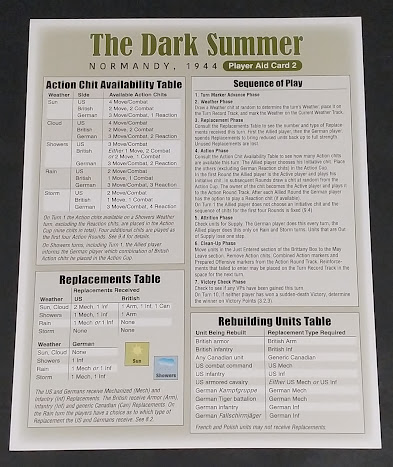
For the most part, though, you should only need to refer to the Player's Aid Cards (PACs). PAC 1 offers the CRT and a separate Cherbourg Combat Table, Weather Effects on Movement and Combat, and on the reverse side, the Terrain Effects Chart; there are two of these. PAC 2 has a concise Sequence of Play, an Action Chit Availability Table and Replacements Table (both of these functions are dependent on the weather for a given turn, which is interesting), and a Rebuilding Units Table (describing what replacement type is required for which type of unit) on the front; the reverse side offers a list of general rules reminders and the Victory terms for the two sides. There's only one of these. If you don't like that, they have photocopiers now.
.jpg)
Needless to say, The Dark Summer comes
with a single six-sided die – which is all you need for the game – couched in
the narrowest box insert gutter I have ever seen in a game box. During my
research for this piece, I came across a great idea from Chad Egbert on BGG; he
inverted the game insert in his copy, so that the gutter was raised, leaving plenty of room for
counter baggies. If you’re more of a chit-tray user, you’ll probably just be
ripping it out and popping it in the recycling. I’ll probably do that
eventually (I’m out of spare trays at the moment), but in the meantime, this
neat little fix gets my endorsement.
I hope this has been interesting or helpful, of just distracting for a few minutes. If you'd like to see more games stripped down for parts, let me know in the comments.


.jpg)
.jpg)


.jpg)


