Showing posts with label Vuca Simulations. Show all posts

Monday, 4 December 2023

By the Numbers: Wargame Collection by Publisher


I’ve been delving into the stats of my game collection. I keep a spreadsheet of what games we have, which has come in useful lately; I’ve been selling off a bunch of family games that we’ve either never played or are unlikely to go back to. My wife comes from a gaming family, and she has her old favourites (like Win, Place & Show (Avalon Hill, 1977, but originally part of the 3M Sports Game series), seriously, the best horse-racing game ever made, and Rail Baron (Avalon Hill, 1977)), as well as a few we’ve discovered since we’ve been married (like Dominion (Rio Grande Games, 2008) and Alhambra: the Card Game (Queen Games, 1992), so there’s no point hanging on to stuff that isn’t going to get played. I suppose this is another aspect of my wanting to get more games generally – and wargames in particular – to the table.

I’ve been using the information in my game spreadsheet to keep track of may progress in working through my collection. I wrote about this in a previous post. Here I thought it would be interesting to look at the publisher breakdown of my current collection. Here’s an annoying pie-chart with a hard-to-make-out colour legend.


Again, this just covers the base games in the collection. It comes as no surprise to me that the largest chunk of games in my collection comes from GMT Games (44% of core titles). I’ll point out again that these are just the base games; adding the expansions for Commands and Colors: Ancients (2006), C&C: Napoleonics (2010), Combat Commander (2006), Tank Duel (2019), and Wing Leader (2015) would add another 28 titles to that count (I do have a completist tendency that sometimes gets the better of me; it’s one of the reasons I’ve never got into Warfighter (Dan Verssen Games. 2014). I tend to show brand loyalty when it comes to publishers. I was a huge fan of SPI back in the day – their games made up nearly all of my adolescent collection  and I was heartbroken when the company was absorbed (FitA) by TSR. When I started playing and buying wargames again, GMT seemed to be everywhere, and everyone I talked to recommended one or another of their games.

When I was less committed to wargames (spending more time and resources on RPGs), I bought a not inconsiderable number of GMT one-off games quite cheaply as package fillers when buying things from US sellers (damn, but I miss the days of dollar-dollar parity. I’ve got GMT games that I bought from game stores to make up the difference to get free shipping, like Halls of Montezuma (GMT, 2009) and Mike Nagel’s Sun of York (GMT, 2005) but never actually got to the table (though I expect to get to them eventually). This has artificially bloated GMT’s share of my collection.

That brand loyalty has extended to Worthington Publishing (previously Worthington Games) whose games make up over a quarter of the collection. I think I can confidently say I’ve never been disappointed by a Worthington game. A lot of them seem to be on the simpler end of the wargame complexity continuum, and I get why that might put some folks off, but if it's just snobbery, it's misplaced. In my experience, every Worthington game I’ve played, starting with Boots on the Ground (2010), has presented a rich narrative experience with a lot of decision points throughout the play. I’ve played a higher proportion of Worthington titles owned than any other publisher, 18 out of 26 games - nearly 70% - probably because they tend to be easy games to teach and learn. Of the eleven reviews I’ve posted on the blog thus far, five of them have been for Worthington games.

The title of fastest-growing publisher representation in my collection goes to Compass Games. Roughly two thirds of the fifteen games on my core list (plus the French expansion for Commands and Colors: Tricorne) I’ve bought in the last two years, and I've got a bead on a couple more. Compass’s production quality is, in my experience, excellent (and they’re very responsive when they screw something up, like sending out free errata counters out to every customer that bought a game directly from them, free of (extra) charge. I’ve liked all the games; my only complaint would be that sometimes the choices around the rulebook layout (mostly background colour or colour graduation, like in No Peace Without Spain (Compass Games, 2011) make the rules a little difficult to read (Barbarians at the Gate (Compass, 2023) falls into this category as well). Well, I find them harder to read. But I’m old and should remember to use my reading glasses more often. Compass is one of the most prolific publishers in the wargaming space, and they make a lot of winners. Expect to see some Compass game reviews over the coming months.

Something worth pointing out is a full 17% of my collection is made up of games from European publishers (okay, I’m including Osprey and PSC in this number, but everything else in my collection is from North American publishers). For a long time. Wargaming publishing was the domain of a handful of prolific publishers (Avalon Hill, SPI) and a couple of smaller operations, like The Chaosium (and Warhammer, across the pond). In the last twelve or fifteen years we’ve been seeing a lot more really good games coming out of Continental Europe. That is to say, there have been European designers creating fun, thoughtful and innovative wargames and European publishers printing them for a lot longer than that, but they’re now making their way outside of Europe, and with rules translated into English. It might be an artefact of the rise in popularity of Eurogames like Settlers of Catan (KOSMOS, 2008) in the English-speaking world. Frankly, I could care less. If it means I easier for me to access games like Verdun, 1916: Steel Inferno (Fellowship of Simulation), Great War Commander (Hexasim, 2018), and Chase of the Bismarck (Vuca Simulations, 2023), then let a thousand Euros bloom, let the children play Power Grid (2F-Spiele, 2004).

The rest of my collection is a scattered mix, though Legion Wargames is nearly into double digits. Some games I’ve bought because the subject interested me, or I wanted to see how the designer approached a particular situation. Some were recommended by people whose judgement I respect.

And some acquisitions were the result of a confluence of factors. I read recently an interview with John Poniske (if I ever do a post of designers represented in my collection, he’ll be up near the top), and he mentioned his favourite of his own designs was Lincoln’s War (Multi-Man Publishing, 2013), because he felt it achieved what he set out to do with it. About the same time, I was ordering some games from Noble Knight Games for shipping to a friend visiting the states. I needed to make up another $10.00 to qualify for free shipping (the shipping would have cost a tenner, but it’s the principle), and NKG had a second-hand copy of Lincoln’s War for $10.45. Like it was meant to be. When it arrived, not only was it unpunched, but it included a complete set of pieces crafted at about 160% larger size on craft board. I suspect the previous owner was a play-tester for the game, for John had written a really nice thank-you message inside the box cover.

A couple of the titles represented here are miniatures or miniature-adjacent games. While I really enjoy playing miniatures games, I’m not a big minis guy, I possess no real talent for painting, nor do I have the time, patience or space to acquire that particular hobby. B, our Wednesday-night host, lives in a house with a whole second floor dedicated to gaming, and much of that space is taken up with immaculately painted lead and resin figures; I live in an inner-city apartment, and I’m looking at having to introduce a one-in/one-out policy for boxed games. I’ll save talking about those games for another post.


Tuesday, 24 October 2023

State of Play: Task Force: Carrier Battles in the Pacific, Scenario 1 (Solo tutorial)


I had to run some errands today, but I managed to do something I’ve been meaning to since it arrived in May; I finally got Task Force: Carrier Battles in the Pacific (Vuca Simulations, 2023) to the table. If you’d like a better look at the whole game, Task Force was the first game I “stripped down for parts,” and my effusive commentary and component photos of questionable quality can be found here.

The first three scenarios are single-player tutorials, introducing the concepts and rules gradually. I’m somewhat a novice when it comes to modern-era naval games so I appreciate the approach. There are some excellent materials available on YouTube; Ruff at Rough Swordsman and Michael at Boardgames Chronicle both have good playthrough videos, and I’m not embarrassed to say I’ve been checking both out. Thanks, fellas.

Helpful scenario set-up board, populated,

The first scenario is the Attack on Pearl Harbor by the Imperial Japanese Navy (IJN). The intention is to introduce how the air-to-surface combat and air-defence rules work (a crucial part of carrier operations), before moving on fleet movement and conducting search operations. I always appreciate the opportunity to learn new games with unusual concepts or mechanics in bite-sized chunks rather than the sink-or-swim approach. I’m not saying it’s the best way to teach and learn, but it works for me.

The set-up took a little longer than it might have if I’d used counter trays; there is so much in the box that there was no way the three GMT trays I’d need to accommodate everything were going to go in it (one would have been snug). I bagged up the ships for each side by class, except for the carriers, which each got their own bag to accommodate their air assets. While some of the planes were generic land-base planes, three-quarters of them were from the carriers involved in the actual Pearl Harbor raid, so I had to go fishing through extra zip-loc baggies to make up their numbers.

Once the helpful scenario template was filled, setting up the game map was a simple task and quickly done. The Scenario 1 map is printed on paper; it’s the only one in the whole box not mounted, I’m guessing because the scenario was written specifically as a teaching exercise, and not meant to be repeated more than a time or two.

Initial set-up (the calm before the storm).

The attacking IJN planes are a mixture of high-altitude bombers (B), dive-bombers (D) and modified Torpedo bombers (T). To make it a bit more of a challenge each wave completely, then rolled, so as not to be able to cherry-pick weakened targets. Well, that’s not entirely true; the scenario rules allow the first four planes attacking to strike without dealing with AA fire from their targets. These were straight runs, so I set these up first. I went straight for Battleship Row, and the two closest to the mouth of the harbour channel, the USS Oklahoma and USS West Virginia. I paired a much weaker B-Kate unit with a T-Kate unit from Yamamoto’s flagship, the Akagi. The West Virginia got a full-strength unit of T-Kates from the Akagi and the half-strength T-Kate unit from the Kaga.

Remainder of the First Wave; they'll have to deal with AA fire.

In air-to-surface combat in Task Force, a low roll is a good roll. The attacker also gains a -2 modifier when the target is stationery (e.g., a land-base or a docked ship). Reader, I rolled ones on the Air-to-Surface Chart, sending the Oklahoma to the bottom of the harbour and falling just one point of damage short of sinking the West Virginia as well. Big ship damage is handled quite well in Task Force. A battleship can shake off repeated hits of a few points (it’s a battleship, after all), but each one has a rating on the lower left corner, usually a 7 or higher. Let’s talk about the Oklahoma (7-rating). Meet or exceed that number in a single attack, and that puts a Minor Damage marker on the ship. But it doesn’t stop there; one more point of damage takes that marker off and flips the counter to its Reduced side. The Oklahoma has a 7 on this side as well. If the result you rolled was ten (7 + 1 + 2), it would end there; the big old battleship would shake off those last few points. If the result was a fifteen though (7 + 1 + 7), that would tear through that extra seven points and put a Critical Damage marker on the ship. A critically damaged ship can’t manoeuvre or defend itself, and just one more point of damage will end it. The Kates hit the Oklahoma for nineteen points.

The USS Arizona sustaining damage.

The West Virginia was a younger ship, and structural improvements had been incorporated from the laying of her keel. Her initial integrity factor was 9, with another 7 on her reverse side. Her initial attack fell just one point short of sinking her outright.

The Second Wave attacks.

I could go and on with stories of the glory my brave pilots brought to the Emperor, and of the sheer tonnage of metal sent to the bottom of Oahu harbour, but suffice it to say five ships were sunk,  four battleships (the West Virginia among them) and the light cruiser Honolulu with another two battleships damaged (the Arizona significantly, the Maryland only lightly – probably operational again within days) and a cruiser, the San Francisco, for a total of 30 scenario points, a full battleship short of the prize. To “win” the scenario, 35 points would be required to reach a major tactical victory, 40 for a decisive tactical victory.

The USS Maryland, takes 9 points damage; one more would have flipped her.

I could run though it again, see if I can sink even more ships, but I don’t think so. This was meant to be a learning scenario, and I think I’d like to take the lessons and move on to Scenario 2: Sinking off the Prince of Wales and the Repulse.


Casualties of war.


Tuesday, 11 July 2023

Stripped down for parts: The Chase of the Bismarck


Vuca Simulations have gained a reputation for producing games of exceptional quality in regard to both in components and play. Many of their games, such as Task Force: Carrier Battles in the Pacific (Vuca Simulations, 2023), and Traces of War (Vuca, 2023), have been reprints of classic Japanese games from the eighties and nineties that have never had the exposure in the West that they deserved. But Vuca isn’t simply a European language reprint company. In-house developed games like 1914: Nach Paris (Vuca, 2022), Operation Theseus: Gazala 1942 (Vuca, 2022), and Donnerschlag: Escape from Stalingrad (Vuca, 2022), and have been gaining plaudits from reviewers and players across the hobby.

The Chase of the Bismarck: Operation Rheinübung 1941 (Vuca, 2022), designed by Jack Greene and is another original publication by Vuca, is a simulation of the Kriegsmarine’s attempt to disrupt shipping to the United Kingdom with surface taskforces headed by the battleship Bismarck. This is a big production; a two-board game incorporating a novel hidden movement, search and discovery system, with a separate battle board for the almost inevitable confrontation between capital ships. I scored a copy of The Chase for the Bismarck and Task Force (you can get a look inside the Task Force box here). This is something I’ve been meaning to get to since getting the game. There is a lot packed into this box, let’s dive right in.

The components

The cover-art style will be familiar with anyone who has had experience with Vuca games. Personally, I like the spare, almost lino-cut quality. It’s a severe look that declares right off the bat that this is a serious game, not for the faint of heart.

The rulebook is a little confronting with its white-on-black cover, until you open it. The interior is lush, full colour, with lots of illustrative explanations, and all printed on good paper stock. It has obviously been put together with a view to assisting rather than challenging the new player, easing them the concepts of the game. The Rulebook runs to 28 pages, but only eighteen of these are actual rules. These are clearly written and laid out, in a sequence that makes sense. 

Sample page from the Rulebook. Helpfully illustrated.

I always enjoy reading historical and designer notes, especially for situations that I am less versed in. Jack Greene provides a short (single page) but very informative Designer’s Notes essay, which Patrick Gerhardt adding some further notes, and a bibliography for those of us who like to dig into the history behind the game. This is followed by a thorough Glossary of terms used in the game (another two pages), some size-comparison charts of the ships involved, and silhouettes of the planes used in search and interception role by both sides. This sort of thing, I think, is always a nice addition, and adds to the sense of history being played out on the boards in front of you.

The Allied Operational Tracking board.

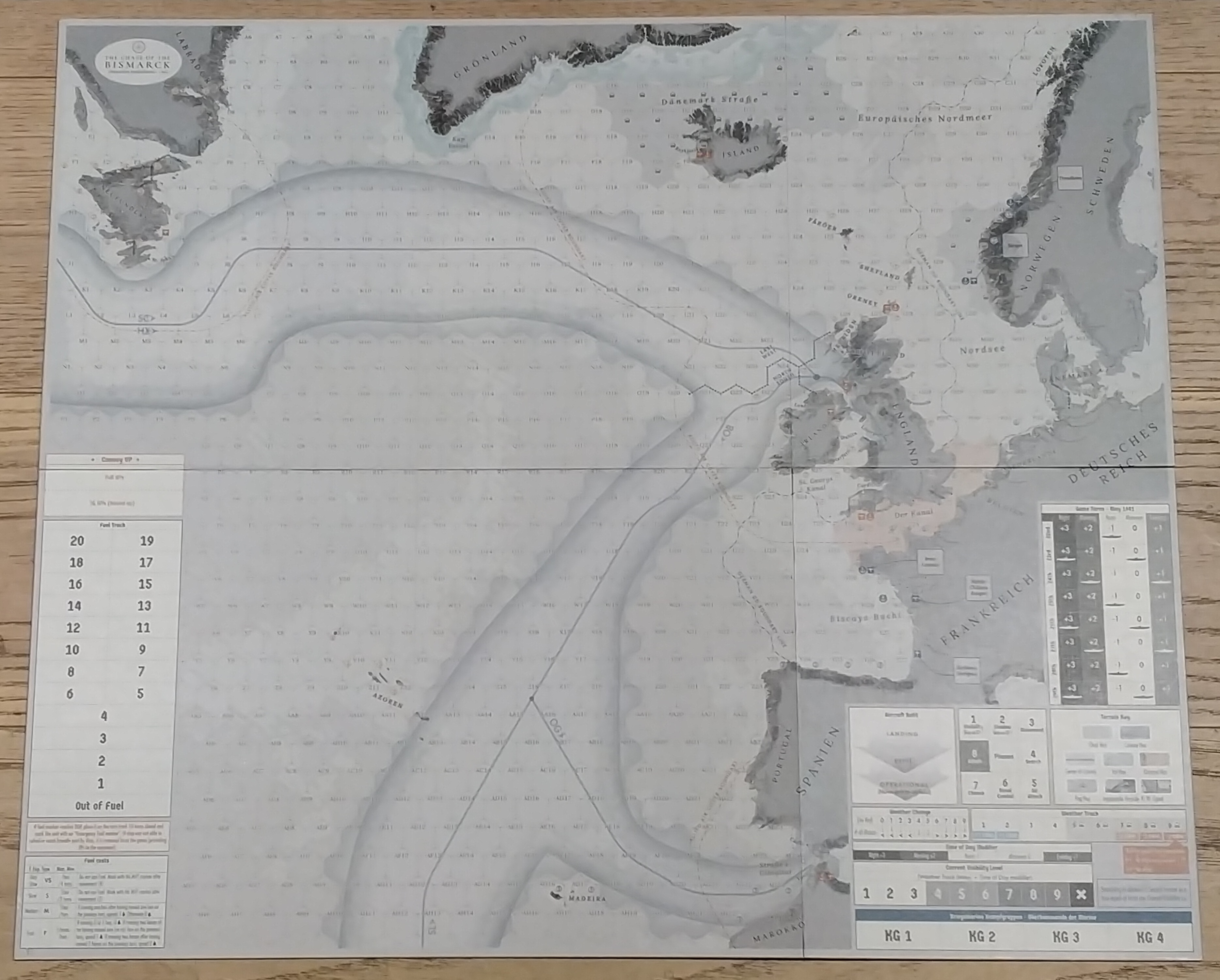
The game features two near-identical maps, one each for the British and the German player. These are the Operational Tracking boards and they are used to accurately track the location and movement of your assets in play, and to make educated guesses and record provisional and confirmed contacts with the enemy. The maps are on good board-stock and, while monochromatic, are nonetheless very attractive, with the feel of actual navigation charts.

Der deutsche Operational Tracking board

The scale of the board is about 74 nautical miles (137 km) to a hex, so acquiring a sighting of an enemy ship is no guarantee of being able to find it when your ship gets there. The map detail is very close, but in a nice touch, the Kriegsmarine board features German names for all identified positions and locations on the map, with the British Navy map reflecting the English names. Each board also features tracks and other graphical aids to assist with play.

A top-right panel comparison.

The boards are each screened from the opposing player’s view with by identical, rather high screens. On the player-facing side of the screen is a wealth of useful information and tables, including a detailed turn sequence, as well as concealing your assets’ locations and dispositions.

Screen (above) and Tactical Battle board.

The majority of the play-time of The Chase of the Bismarck will be spent for the Allied player on the cat-and-mouse search for the Kriegsmarine Kampfgruppe (if the mouse was a 41,000 long ton-displacement battleship bristling with armaments) and the German player's search for shipping convoys to target. Actual confrontations play out on the Tactical Battle board, which is actually two slim ladder-maps, mounted on the same weight board as the tactical maps, designed to be placed together to form essentially a measurable distance between the antagonists, and allow a simple, representation of their disposition (broadside or end-on). The distance is broken up into a series of sea-zones to regulate combat distances (establishing range for for gun and torpedo attacks between ships).

Player Aid Card (front and back).

German set-up card.

Allied set-up card.

The game includes two matching Player Aid cards, which pick up much of the detail not presented on the board screens, and a set up card each for the German and Allied players. Each player also has his own set-up card for the game. These are all printed on the same thicker cardstock used for the counters.

Six counter sheets, all pre-rounded and easy-punch (apologies for the glare).

This is a game with lots of counters (582, in fact). The good news is, like the PACs and the Set-Up cards, the counters are (to these old, squinty eyes) perfectly readable. The come in three sizes. The majority of the counters are informational markers (search or ship status). It’s worth noting here that you’ll need a couple of opaque cups for drawing evasion markers (for when you’ve been spotted), and damage types (for when you take a hit). I like this two-factor randomness in both cases; the skill of the observer or the hand guiding the gun accounts for some measure of success, but the chit-pull for the success of an evasion manoeuvre or the dumb luck of where that successful hit connected captures some of the vicissitudes of war.

British ship tokens, small ship markers (orange) and various markers.

There are also markers to designate search and interceptor aircraft (either land- or carrier-based), Milchkühe (Milk cows; the tankers used by the Kriegsmarine to refuel their vessels), and Task Force markers to reduce the number of tokens needed on the board. Most of the counters are 15mm in size (a touch under 9/16”).

Bismarck? Fount it!

The ship counters for use on the Tactical Battle board are gorgeous; at 45mm long, a little shy of two full inches, with a 15mm beam, and sporting a quite detailed birds-eye view of the individual ships or destroyer flotillas represented.

There are also quite small (12mm) counters representing. indicating individual ships, one for each of the individual ships represented in the game. These are presumably for marking Which ships are in which task force on the Operational Tracking board, or to account for ships not assigned to a task force. (I’m taking a leap here because I’m still working through the rules myself).

Ship cards (bundled), red and blue wooden cubes,
and six (count 'em) d10s.

Each capital ship has its own representative card for recording damage, fuel expenditure and the general disposition of the ship. Smaller ships (destroyers, etc.) share a card between two, to minimise the space requirement.

Damage and Fuel use are recorded on tracks on a card with the use of wooden cube markers (the game includes 100 of these, in red and blue). These are placed on tracks on the ship status cards singly to indicate that function’s current level. Cardboard markers are used to indicate specific conditions, such as propeller, rudder, or radar damage.

One thing I found disappointing with this game was the misrepresentation on the box back of the number of dice included in the game. The box declares two ten-sided dice are included with the game. Imagine my surprise when, upon opening the box, I was confronted with no less than six ten-siders; three in black and three in red. In Vuca’s defence, I would point out that this is the only mistake I have come across in my exhaustive look at the materials included, but I will say that I hope it doesn’t indicate the company's adopting a more cavalier attitude toward meeting the customer’s expectations. 

I am, however, happy to note that I managed to fit the superior number of dice into the box provided.

Chase of the Bismarck footprint

The Set-up

That covers the contents. I’ll admit, when I first opened the box, I was a little overwhelmed. This is a lot of game. What’s more, when set up, Chase of the Bismarck has a big footprint. I wouldn’t normally indulge in a set-up, preferring to depict the components and make some helpful comments, but Chase fort the Bismarck deserves an exception to this.


Long Battle Board - short battles.

This is not a game for the faint-hearted, but at the same time you shouldn’t let the sheer size and scope of it put you off. But you will need some table real-estate to accommodate Bismarck. There is a lot going on, but it’s manageable, and Greene and Gebhardt have done a lot of work aimed at smoothing your entry into the game.

My wife and I live in an apartment that is probably a tad smaller than would be ideal. We do however have a nice, big eight-seater, Tasmanian oak dining table. This is where the magic happens. Our dining table is 2,400mm by 1,200mm (pretty damn close to exactly 8’ by 4’). I did a practice set-up of Chase of the Bismarck just to make sure the two stations (German and Allied) and the Tactical Battle board would fit. It does, just, but it does take up about three fifths of the dining table (not a game I’ll be able to leave set up overnight).

Kriegsmarine tactical station (note the ship cards to the left).

Still, I regret nothing. This is a really beautiful game; every detail has been considered and refined. The production value is top-notch (as one would expect form Vuca Simulations), and just taking out the components, examining and shooting them for this essay, I got a sense of the narrative of the game unfolding. I know how wishy-washy that sounds, but it’s the best way I can think of to describe it. I saw Sink the Bismarck with Kenneth Moore when I was barely in double-digits, and I have a vague sense of how the story played out, but just looking at the Operations maps lends a sense of the enormity of the task before both the British and the German forces. 

This is going to be one hell of a game.


Thursday, 25 May 2023

Stripped down for parts: Task Force: Carrier Battles in the Pacific (Vuca Simulations)


I like YouTube for the wargame content that’s available these days. I don’t aspire have my own YouTube channel. I’ll leave that up to the extroverts. I am, however, really grateful for the unboxings, rules tutorials and playthroughs you find there.

So, here I want to try something different; a new article type that looks at the materiel of games. Kind of like an unboxing, but without the misguided commentary that sometimes accompanies an unboxing video. Just the best pictures I can manage with my cheap-ass phone, and maybe a few words about the quality of the components and such. If it works, I might even invest in a better camera.

So, without further ado, let’s take a look at Vuca Simulations’ Task Force: Carrier Battles in the Pacific (2023).

Now, that's some really lovely cover art.

Task Force is a reprint of a Japanese naval battle game designed by Ginichiro Suzuki and first published in that country in 1982. Vuca is starting to demonstrate that there is a strong market for updated versions of older games that haven’t necessarily had their moment in the sun for Western audiences.

I love the Vuca era-scale that features on all their games. 

Task Force comes in a three-inch box and it needs every bit of that space. With the exception of the map for the first Scenario, Attack on Pearl Harbor, all the map-boards are mounted (double-sided), as are the two player task force displays, and the land base display; even the player’s aids are printed on pretty solid card-stock. The game also comes with six counter sheets, all on thick card-stock (and all pre-rounded).


Lots of ships, lots of planes.

The ship counters are elongated rectangles boasting a bird’s eye view of the ship with its name in Roman and Kanji scripts, surrounded by its numerical values and letter-designation (BB for battleship, CV for Carrier, CL for heavy cruiser, etc.). A coloured corner swatch on the top right corner indicates the ship’s nationality. Along with the ships of the United States Navy (USN) and Imperial Japanese Navy (IJN), a respectable showing of vessels from the United Kingdom, the Netherlands, and Australia are presented.

The game comes with two books; the 20-page rulebook and a 28-page scenario book. Following what is (I think) best practice in games with innovative rules or novel ideas, the first three scenarios are solo teaching scenarios with the fourth being a two-player rules-teaching match.

Scenario 1 – Attack on Pearl Harbor, is basically a snapshot of the attack on the ships anchored by or near Ford Island, and serves to demonstrate in an instructive way how the air attack rules work. Because you’re unlikely to place this more than twice, the Vuca folks made the sensible choice to put this map on (very good quality) paper.

Attack on Pearl Harbor (obviously).

The remaining seven scenarios are a mix of historical and speculative situations, increasing in complexity. The Scenario book also has advice and tables for creating your own balanced scenarios using the available components.

Battle of the Java Sea


Combined Fleets scenario (kind of a speculative naval Battle Royale).

Sinking of the Prince of Wales and Repulse (Solitaire scenario).

The remaining maps are mounted on sturdy board-stock, one 11” by 17”, and two 17” by 22”. These are where the tactical game plays out. The scale of the ocean maps is 75 miles to a hex, and the task forces appearing in a scenario are represented on the board by a TF marker. The fog of war is represented by other dummy TF markers. Part of the fun of the game is trying to identify your opponent’s real task forces before they can identify yours.

Battle of the Eastern Solomons

Battle of the Coral Sea

Battle of Midway

The maps are beautifully presented. The colour chosen for the ocean looks right for the Pacific, a richly dark, green-tinged blue that evokes the deep, deep water of the open sea.

There are five double-sided scenario set-up charts to help you identify the ships. Planes and markers you’ll need for each scenario.


This isn’t a new thing, but I’m always happier to see it in a new game. While it’s double handling, I find it actually cuts down the prep time by a significant factor.


You set out all the units before transferring them to the Task Force Display boards. Turns are tracked on a slender two-day mounted turn-track.

From the top: USN TF display; IJN TF display; Turn tracker (eight day turns,
four night turns - most scenarios don't run more than a day or two)..

Land base display.

The counters have a shiny linen finish that make them pop on the board,
but they're terrible to try to photograph,

But the heart of the game is the PACs. These are, again, mounted on good, firm card-stock. They are double sided, easy to read, and the contain everything you’ll mee dot play the game. Once you get the hang of the rules, you should only have to refer to the PAC in the regular course of play.

Seriously, one of the most well-designed PACs I've ever seen.

These photos don’t do justice to the quality of the materials in Task Force. A lot of attention has been given to every aspect of the game’s presentation. The rules are well laid out, presented in a sensible order, and with only a little duplication. The same with the scenarios, which all come with brief historical notes and sensible advice. The only thing I could possibly gripe about would be the size of the font; it's a blocky serif font that is perfectly readable in the maybe nine-point it's been printed in, but I tend to complain like a restaurant critic if I have to reach for my reading glasses, so that one’s on me.

The ship counters are lush, with the battleships cruisers and carriers all getting their own individual representations. The destroyer counters all look the same but that is perfectly forgivable. The plane counters are a tad more functional, but the little silhouettes of the aircraft are clearly representative of the plane in question – you can tell a Zero from a Kate from a Val by the image alone. The markers are functional as well, but all have some small flourish that adds to the charm of the game. It’s a spectacularly gorgeous package.

The artwork on the box-lid and the two booklet covers also warrants a mention. The simple, screen-printed style evokes a poster style from the era. It’s becoming something of a trademark look for Vuca Simulations, and I think it really works for WWII games generally, certainly in this case.

I hope this has been an interesting tour through the contents of Task Force: Carrier Battles in the Pacific. It’s not something I intend to do with every game that passes through my hands, but I already have the next one or two in mind for this treatment.

Thanks for reading all the way to the end.


Blog Note: a recent arrival

   I’ve been a little quiet on A Fast Game of late due to a combination of circumstances; my wife’s aunt and uncle are over from England at ...