Note: this was originally going to be a single post about
various types of block wargames. But as sometimes happens, the further down the
rabbit-hole I went, the more I found I had to add. Rather than try to trim it
down excessively, I’m going to write this as a short series.
I know Commands & Colors is an odd place to start, but of
all the block wargames available, it’s the one I have the most familiarity
with, so it seemed like a good launchpad.
I don’t have a schedule for this series, but I anticipate
maybe one post a month or so until I run
out of things to talk about.
 |
| C&C: Napoleonics - EPIC Napoleonics: Austerlitz |
This post – or post-series – was prompted by a comment on Facebook. When I posted my first Ten Game Challenge AAR on the Tac-UP group, Napoléon 1807 (Shakos, 2020), a fellow group member commented that the game looked interesting and mentioned that they had never played a block game. This got me to thinking about block games and their place in the hobby.
The
term “Block wargame” seems to conjure different pictures for different people;
everyone can agree that Columbia’s Julius Caesar (Columbia Games, 2010)
and Hammer of the Scots (Columbia Games, 2002) are definitely block games,
but can the same be said for Churchill (GMT Games, 2015). Are games from
the Commands & Colors family block games? Wooden blocks make up
nearly all the moving parts of the game, but they don’t function like the
blocks in a traditional block game, like Julius Caesar. And then there’s Atlantic Chase (GMT Games, 2021).
Setting the parameters
For the
sake of this rabbit-hole-dive, I’m going to cast the net particularly wide,
taking in pretty much anything that uses wooden blocks within the game’s
parameters. From the get-go, I should also define what I mean by blocks. I’ll
be specifically looking at games that use wooden pieces to convey meaning beyond
the merely being a marker for a presence (like the Control discs in WWII Commander: Battle of the Bulge (Compass Games, 2020), or numerical
superiority (as in COIN games, or Academy Game’s Birth of America series).
This isn’t a criticism or dismissal of these games – it’s just not what I’m
interested in here. The wooden components in these instances could easily be
replaced with punchboard counters or another kind of marker (like the little resin
cubes in Pandemic (Z-Man Games, 2008)) without the game suffering any
playability issues.
To try to head off some of the arguments at the pass, I’m going to apply a broad but simple definition of what I’ll go into here. For the sake of this discussion, a block game is a game that uses wooden components (regardless of precise shape) that present information further to their placement on the board. All the games for consideration will feature individual blocks as units or several blocks comprising units. The blocks tend to be of a uniform size, but not always. It is rather broad in scope, but I wanted the opportunity to talk about block games in their configurations and contrivances.
At this point, it may be useful to address what I won’t be considering in this post. I decided to disregard COIN Cames at the outset. This is not an indictment of COIN games – I’m not very good at them but I nonetheless enjoy playing them and even own a couple – but the information conveyed by the blocks in a COIN-system game is solely numerical and locational. After some deliberation, I decided to leave out Levy and Campaign games as well; There is more information conveyed by the colour and shape of the pieces, but it comes down to tiered numerical values.
I’m by
no means an expert on the subject either. I‘ve played probably a couple-dozen
block wargames of different stripes, but there are a lot I haven’t played, and still
others I probably haven’t heard of (suggestions for future exploration welcome).
This series isn’t meant to be an exhaustive survey of block wargames, or a cook’s
tour of block games I have known. What I hope to present is a broad brushstroke
look at what different styles of block game are trying to do and how they go
about it, and maybe some thoughts abo what they’ve brought to the hobby and how
they’ve influenced hex-and-counter games and vice-versa. I don’t expect
anything earth-shattering to come out of this, but maybe a post will nudge a
reader toward a type of game they haven’t tried before. As ever, comments,
criticisms and recommendations are welcome.
 |
| C&C : Ancients: Marathon, BC490 - not going so welll for the Greeks. |
Commands & Colors - basic blocks
Anyone
who’s been keeping up with A Fast Game knows that I’ve played a LOT of Commands
& Colors in a number of flavours. When I started thinking about this as a
post subject series was in two minds about including C&C, but it does fill
the requirements of the earlier stated definition, and it seemed like a good – if
chronologically unsound – place to start.
My
first experience with Commands & Colors was an introductory game of Commands
& Colors: Ancients (GMT Games, 2006), with two guys from my
long-standing Wednesday group. I wasn’t aware of the game’s lineage, sharing
the DNA of Battle Cry (Avalon Hill, 1999) and Memoir ’44 (Days of
Wonder, 2004), but my initial reaction to seeing the battle (Cannae - 216BC) set
up was “This is a minis game without the minis. That’s so cool!”
Commands
& Colors is something of an aberration in the world of block games. Where most
block games use the block mechanism to ensure certain information is hidden
from the opponent, such as the current strength or even the type of unit, the units
in Commands & Colors games proclaim much of their information for all to
see. The blocks themselves have matching stickers, front and back, and the number
of blocks conveys how many steps the unit has left (how much more of a
battering it can take before losing cohesion). And if they didn’t declare
themselves, you could at least make some educated guesses at to what you faced
by the size and shape of the block.
The multiple blocks making up a unit act as hit points for the unit. When a unit takes a hit that it can’t otherwise soak, it loses a block. This is another point of separation from the traditional Columbia-style block game, which uses the individual unit to keep track of losses but tries to keep that information from the opponents. This, of course, doesn’t mean a for block unit loses a quarter of its functional strength as a fighting formation with each hit – Commands & Colors: Napoleonics (GMT Games, 2010) is the outlier here – but the loss represents a combination of reduction of troops, cohesion and morale, with the final loss representing the unit’s breakdown of cohesion and cessation of effectiveness as a fighting force.
 |
| C&C Tricorne: The American Revolution, |
So, what’s the game trying to do? The whole idea of blocks for manoeuvre units, back with the very first block wargame, Quebec 1759 (Columbia Games, 1972) was to replicate the lack of adequate intelligence on both sides regarding opposing strengths during the French and Indian War. In Quebec, movement was also simultaneous. This was accomplished through the necessity of writing orders for your troops, while trying to second-guess your opponent’s plans. This creates a sense of what is referred to as “fog of war”, the creating a facsimile of the limited intelligence all tactical commanders have had to deal with since the dawn of battle.
Commands
& Colors accomplishes something similar through the use of Command Cards. Rather
than try to hide each player’s units or intentions from their opponent, the
game system limits the ability to act on this intelligence by limiting what
actions you can take in a given turn. You can see the enemy readying to strike
on your thinly defended Left flank, but you can’t respond unless you happen to
have a card in your hand that allows you to order your units in that section. While
it’s not perfect, the mechanism offers a fair simulacrum of the confusion of battle,
with orders being misunderstood, if received at all, and in the era of Commands
& Colors: Napoleonics and Commands and Colors Tricorne: The AmericanRevolution (Compass Games, 2017), or for that matter, Battle Cry), the very
real fog of spent gunpowder, obscuring friend and foe alike.
This is
a vector for criticism of the C&C system, with folks complaining of never
being able to do what they want to do at any given time. Well, welcome to life
during wartime. This artificial limitation of options is much closer to the
realities of warfare than many hex-and-counter wargames can reflect. It’s all
well and good to prefer games that let you move all your pieces each turn without
such hinderance, but don’t tell me it’s more realistic.
No minis
For me,
a big strength of the C&C system that it allows a miniatures-style experience,
but with movement regulation (via a hex-grid) and without actual miniatures. The
truth is, if all the Commands & Colors system games had come out with minis
representing the units, I probably would never have bought into the system so
thoroughly. I know Memoir ’44, Battle Cry, and the fantasy-flavoured BattleLore (Days of Wonder, 2006) all have their fans, but it’s not for me. I don’t
need plastic laying pieces to transport my imagination, and the lack of scale
adhesion between units and such in Memoir ’44 is like fingernails on a
blackboard for me; I really find it hard to look at (this is why I was never
interested in Axis and Allies or Tide of Iron either)
 |
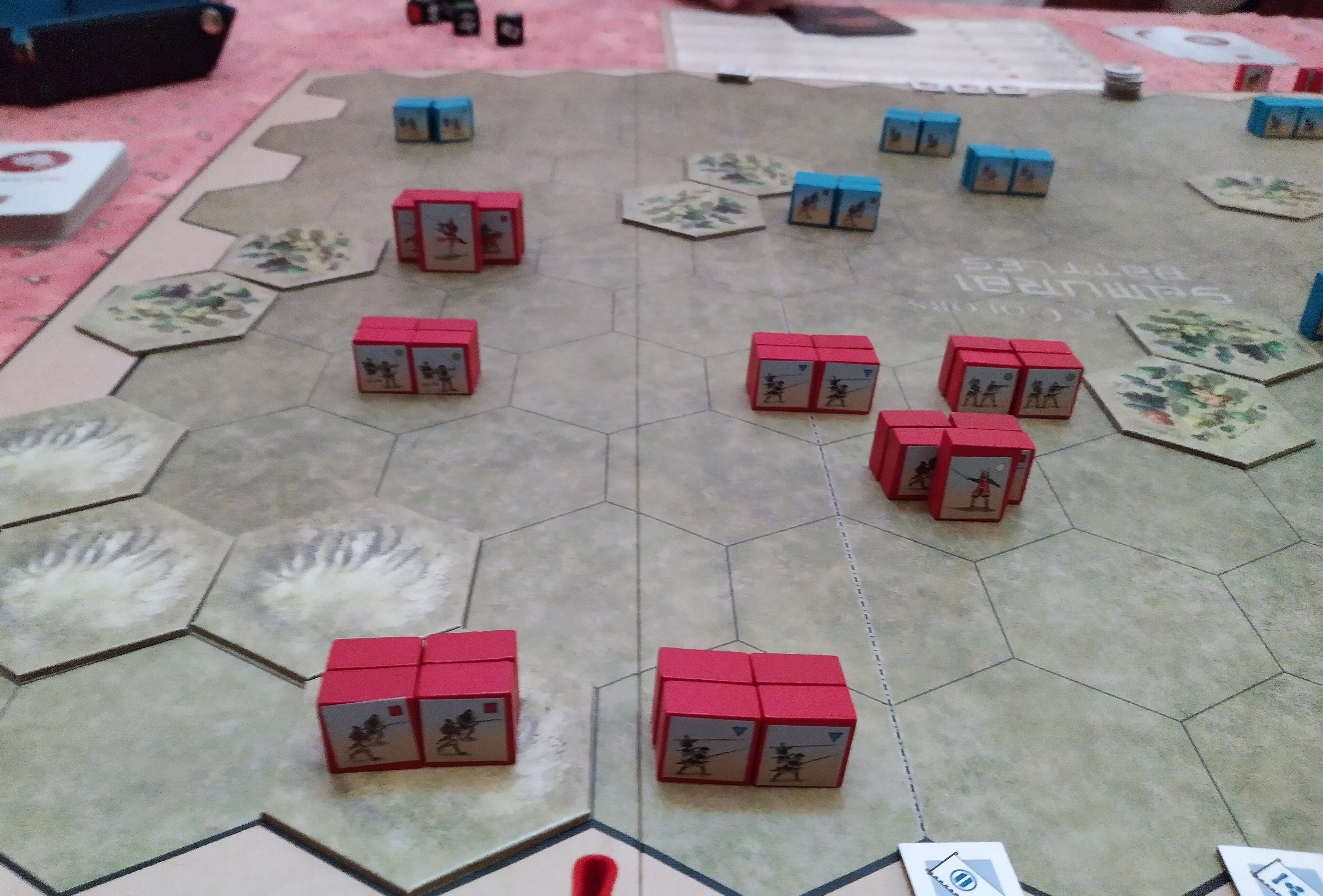
| GMT's C&C: Samurai Battles. No brittle figures to real with. |
As I’ve
said previously., I enjoy miniatures games. Our Wednesday game night host has an
impressive collection of them, and we’ve played out situations from 4th
century Britain to 1980s Africa on his big table, but I personally don’t
possess the talent or the patience (or the money, or the storage space, or
frankly, the desire) to pursue the miniatures hobby myself. I came very close at
one stage to buying Russian model and plastic figure company Zvezda’s Samurai Battles (Zvezda, 2012), which used Zvezda’s excellent 20mm (1:72 scale) feudal
Japanese warriors instead of blocks, but ultimately decided against it. Imagine
my delight when GMT re-released the game in a block version as Commands &
Colors: Samurai Battles (GMT Games, 2021). It turns out the high-impact
plastic Zvezda minis (the same quality plastic used for model planes or ships) are
prone to breakages and very difficult to store, so I dodged a bullet there.
The Romance of Loss
Which
brings me to another joy of block games generally. The pieces offer a tactile
experience in moving – and in removal – that cardboard counters can’t
replicate. This sense of weight and of loss is increased in a Commands & Colors
game by the removal of blocks with each successful hit. It makes the audacious
attack or dogged defence conducted by a reduced unit that much more valiant; it
creates a mini-narrative withing the unfolding story of the whole battle.
 |
| C&C: Medieval. This battle was from the Crusades expansion. |
I worked professionally with wood for some time – my father was a carpenter and my brother a cabinet maker, and I spent about two years as a machinist – so maybe I feel an affinity with wood. To me it feels like a natural fit for games. My earliest childhood games, draughts and dominoes, were made from wood. And in wargames especially, you can’t get away from it. Cardboard and paper are just radically transformed products made from wood. Coloured blocks with stickers applied aren’t comparable to ornate, hand-carved chess pieces, but to me they still bring a gravity and sense of connection beyond their basic function. This is probably, at least in part, what prompted me to pursue this series.
In the
next part, I’ll go back to the beginning, starting with Columbia Games and the revolution
the company began with Quebec 1759. There’s a long road ahead – I keep
stumbling across other games where the designer has chosen three dimensional blocks
instead of two-dimensional tiles to achieve some or other effect. And at least
one case of the reverse, but that will be for another post.