Showing posts with label 1759: Siege of Quebec. Show all posts

Saturday, 23 September 2023

Review: 1759: Siege of Quebec, Second Edition (solo game)


1759: Siege of Quebec (Worthington Publishing, 2022) was originally released in 2018. In 2022, a second edition of the game was released alongside two new additions to what is now Worthington’s Great Sieges series; 414BC: Siege of Syracuse (Worthington, 2022), and 1569: Siege of Malta (Worthington, 2022). Syracuse and Malta were each nominated for a Charles S. Roberts Award (in the categories of Best Medieval Wargame and Best Gunpowder Wargame respectively). I wanted to review these in chronological order, and had fully intended to review Siege of Quebec much closer to the other two. For the three people who have been waiting for this, I apologise. For anyone else who is at all curious, my earlier reviews can be found at the links below:

414BC: Siege of Syracuse review

1569: Siege of Malta review

To my shame, I didn’t back the Kickstarter for the three games (in retrospect, not supporting this and not backing Worthington’s War of 1812 Campaigns trilogy (Worthington, 2019) were among my biggest KS-related regrets; I spent a lot more money trying to track these all down piecemeal, and I have yet to find a copy of War Along the Chesapeake at a price I’m willing to pay). I managed to acquire them the old-fashioned way, over the course of about a year. I bought Siege of Quebec first, and played it a lot. And lost a lot. I bought the other two on the strength of the satisfying experience Siege of Quebec delivered; Siege of Malta came next – at the time, Siege of Syracuse proved to be the most difficult to obtain, but I’m happy to report that since those dark days, all three games have been reprinted and, at time of writing, all three are still available from the publisher.

I should add that this review is based purely on my experience playing the game in its solo mode.  Even the first edition had a two-player mode, but I haven’t yet got around to trying it out on another human. When I do, I’ll write it up and post it here, but for now I’m happy to keep it a solitary pleasure.


Appearance

Siege of Quebec set the stylistic tone for Worthington’s the Great Sieges series. The board is a 17”x22” mounted map, and is an exercise in elegant simplicity. The main geographical elements relevant to the game featured, along with positions marked out for the generic blocks used for the British, French, and native forces. It also features a Morale ladder for tracking the state of the two sides’ morale, which is important. If one side’s moral falls to zero, that marks an automatic victory for the other side. While the colour pallet is muted generally, Quebec is still the most brightly-coloured of the three games’ boards. The red of the British blocks is duplicated in the template positions of the British troops on the board, while the pale blue of the first edition has given way to a soft white for the French units. The forests from which the farms and settlements were carved is represented by little silhouettes of trees in an appropriately forest-tone green, as are the three spaces designated for the Indian units. Coloured discs represent the British and French batteries, and blocks cut with a prow at one end mark the British naval detachment sent to support the British troops. The waterway of the St Lawrence River is represented in a duck-egg blue. The whole tableau, while quite schematic at first blush is pleasant and inviting, and clearly shows the game situation at a glance.

The gameboard, set up and two turns in.

Overall, the map is austere and practical; movement is conducted between preordained positions. As their forces are depleted, each side may transfer their units via a Move order, provided their plans are not frustrated by the enemy. Ship silhouettes appear at the lower and upper St Lawrence as well as place of safe anchorage further downstream. The British ships begin the game in the lower St Lawrence, and on a given command may traverse to the upper St Lawrence position, at which time troops may be moved (again by order, either chosen by the British player or as an event in the British deck if you’re playing the French) to the plain of Abraham to engage in the battle for Quebec.

The Morale Chart.

The playing pieces are simple elongated wooden blocks, painted in the primary colour of the related force, Red for the British and White for the French. One block from each side is used to keep tally on the Morale board. The game can be won or lost here. one or both sides will take a morale loss with each unit destroyed, and through some events or as the result of an order roll. 

British and French Order Books.

French Field Order Book, ready for play.

There are two Order Books (one each for the French and the British); these are bi-fold PACs with the seven orders you may choose from each turn. Each order has a choice of four tables to roll on for the order’s effectiveness depending on how the AI responds, which is printed on the representative non-player cards. The solitaire game is driven by a deck of cards, a deck each for the British or French bot-antagonist. All the information you need to play the game can be found either in the Order Book or on the cards. Two extra card decks are also included for the two-player version of the game. I won’t be addressing that mode of play here; I am keen to try this as a two-player game, so maybe some time in the future.

An imminent British victory.

The cards are where the game comes alive. Both decks are well laid out, each card containing a wealth of information relating to the game, as well as interesting historical notes relating to the card's action. As with the other games in the series, the cards are also illustrated with evocative artwork reflecting the era. 

Play

1759: Siege of Quebec is a simple game to play and easy to learn. That’s not to say it’s an easy game to play and simple to learn; The mechanisms that drive play are straight-forward enough to minimise confusion and allow the game an easy flow. The game revolves around the interaction between your chosen orders and the response from the newly presented bot card. In a game of regular-level difficulty, you will shuffle the 33-card deck for the opposing force, deal off 24 of these cards, and set out your order book. Each turn, you choose an order, which may involve attacking a particular location, or reinforcing your own locations (moving available troops), or, if you’re playing the British, getting your ships up to the upper St Lawrence River location to facilitate troop movement to the Plain of Abraham, where they can initiate battle with the French forces at Quebec. Then you will turn over the next card on the bot-deck. The card will have three lots of information; an Event, which will be resolved before anything else takes place (these can present a positive for the player, but they are more often potentially negative, or reliant on a particular situation or state to be in play. If the requirements for the event aren’t met, it is ignored. 

Hold order chosen. With the Counterattack counter order from the card drawn,
I'll need to roll high for a favourable result.

The next piece of information is the card’s counter-order; this is the response to the order you’ve chosen, and it will correspond to one of the tables below your chosen order. Then you roll a die to determine the result of our order, make the appropriate changes to the state of the board, and choose your next order. 

No ships in upper St Lawrence yet, so the event is ignored.

This description sounds very procedural – even to me, writing it down – but the short time scale of the game and the lack of any kind of bookkeeping means the procedural steps give way to a sense of pure narrative. When you get into the rhythm of game-play, the interplay of order and counter-order become a natural story unfolding on on the map before you. The events of the months of siege transpire in the space of an hour, leading to a definite win/lose conclusion. 


Appraisal

All the games in the Great Sieges series play very smoothly. They are quick to set up (after the first time or two), and you’ll have a result in an hour or so; I can usually get the box off the shelf, set it up, make a coffee, lose a game and come achingly close to winning another, and pack up again inside of two hours. The situation of the siege lends itself well to the shorter play, small footprint style of game that the Great Sieges series embodies. 

After playing through Siege of Quebec again a few times to refresh my thinking about the game,  I suspect that I've come back to this one being my favourite of the three. Both Syracuse and Malta have their charms, they each do some things differently and offer interesting situations, and are equally difficult to - I don't want to say "master," maybe conquer is a better word (mastery suggests there is a formula you can use to win most of the time; that is not the case here). It might be because the French and Indian War is of particular interest, or it may be because this was my introduction to the Great Sieges series. It's a very good introduction. I'd go as far as to say that this and the other Great Sieges games make for an excellent introduction to the more procedural style of solo wargames, especially for players less experienced in wargames generally. 

Things aren't going so well for the British...

Siege of Quebec is a tough gig for the British; in all the games I’ve played – well past three dozen by now – I’ve only won as the French, though I’ve come damn close a couple of times as the British. The French have the advantage to a point, as they only have to run down the clock until winter sets in (the end of the deck), and the British have to withdraw to their winter quarters. I should say, I've also lost as the French a lot more often than I've won. It’s this slim margin that makes it so enticing to have another run at the town as the British, the feeling that maybe this time we’ll get it over the line.

Whichever side you choose to champion, you are battling an implacable seemingly prescient foe. There is too much chance built into the bot, with a random selection from an oversize deck, and the shuffling of said deck, for any kind of programming to be at play, but with four possible counter-orders with each turn of a card, I swear there is a higher that 25% average for the counter order revealed to be the worst possible result for the order chosen, more in the order of 35% or more. Regular readers may have noticed that I'm prone to run down statistical rabbit-holes like this, so I’ll keep a record of my next half-dozen games and report back whether this feeling actually bears out.

Much of the appeal of this game, and the others in the series, is the time-frame; it seems we're all time-poor these days. But it's not simply that. Like Tawara 1943 (Worthington, 2021) the system packs so much game experience into such a short time-frame Oscar Wilde described a cigarette as the perfect kind of pleasure; “It is exquisite, and it leaves one unsatisfied.” He could have been talking about Siege of Quebec.


Tuesday, 18 July 2023

State of Play: a few quiet weeks ahead, and the CSR winners announced!


Not much to report on the practical gaming front at the moment. No Monday games for a couple of weeks and the Wednesday group has returned to RPGs for the foreseeable. I’ll be trying to get couple of solo games in until regular programming resumes.


In other news, the Charles S. Roberts Awards winners have just been announced about twelve hours ago (at time of writing). Congratulations to the winners and to the nominees; 2022 was a really good year for wargames, and just gaining a nomination for a category is a tough gig, given the quality of games generally out there these days. You can find the full listing of the winners and nominees in their respective categories here.

Discounting the magazines and expansions for existing games, there are 58 titles represented among the fifteen game-oriented categories. Going over the lists. I realised that I own nine of these titles (and one of the expansions, but that’s a different story for another time). I’ve written reviews of two of the games (414BC: Siege of Syracuse and 1565: Siege of Malta), and shared some impressions on another three (Caesar!, Fire & Stone: Siege of Vienna 1683, and Plains Indian Wars). I’m also actively seeking out another six games, with fourteen more again on my wish-list.

Since I can’t seem to make much progress on my 6x6 list for a while, I’m going to turn my attention to some of the Charles S. Roberts Awards winners and nominees. I don’t think I’ll get through all the games I own from the list, but there are a couple I’ve been meaning to write up already, and haven’t had the time. Suddenly, I don’t have that excuse to hide behind. I’ll start with those I already own, and add to the list as I secure others. I can’t guarantee a close schedule for these reviews; I will knock them out as quickly as I can replay them and gather my thoughts, then get them down on proverbial paper. I promise I will try to present something thoughtful, readable, and at least mildly diverting. With pictures.


Saturday, 13 May 2023

Review: 1569: Siege of Malta (solo game)


2022 Charles S. Roberts Best Gunpowder Wargame Nominee


1565: Siege of Malta (Worthington Publishing, 2022) is an instalment of Worthington’s Great Sieges series. The series began with 1765: Siege of Quebec (Worthington, 2019), which received a Second Edition revision with the publication of Siege of Malta and 414BC: Siege of Syracuse (Worthington, 2022), which I reviewed recently. Much of what I had to say about the series is covered in that previous review. I intend to follow this review sometime soon with a further review of Siege of Quebec. By rights, I probably should have begun with that one, but it seemed right at the time to approach them in chronological order; that ad the fact that I have played Syracuse most recently and I’d been turning aspects of that one over in my head for a few weeks before putting metaphorical pen to paper.


Like Dan Fournie with Siege of Syracuse, Maurice Suckling has taken the basic concepts and elements of form and play from Siege of Quebec and made Siege of Syracuse a familiar but very different beast. These changes may seem superficially simple, but they radically change the experience of the game. Siege of Syracuse, I’d argue, is a departure from its progenitor, but Siege of Malta is its own journey altogether.

Starting set-up for the Turkish player

Appearance

Siege of Quebec set the parameters of style and tone of play for the series; a card driven AI which also acts as a timer for the game, simple tactical map-board (contained to a manageable 17” by 22”) with abstracted movement and combat with plain wooden blocks for various units, and a limited colour pallet. This actually helps to focus the attention on the play of the game. The board remains both attractive and functional, and uses every part of its limited area.

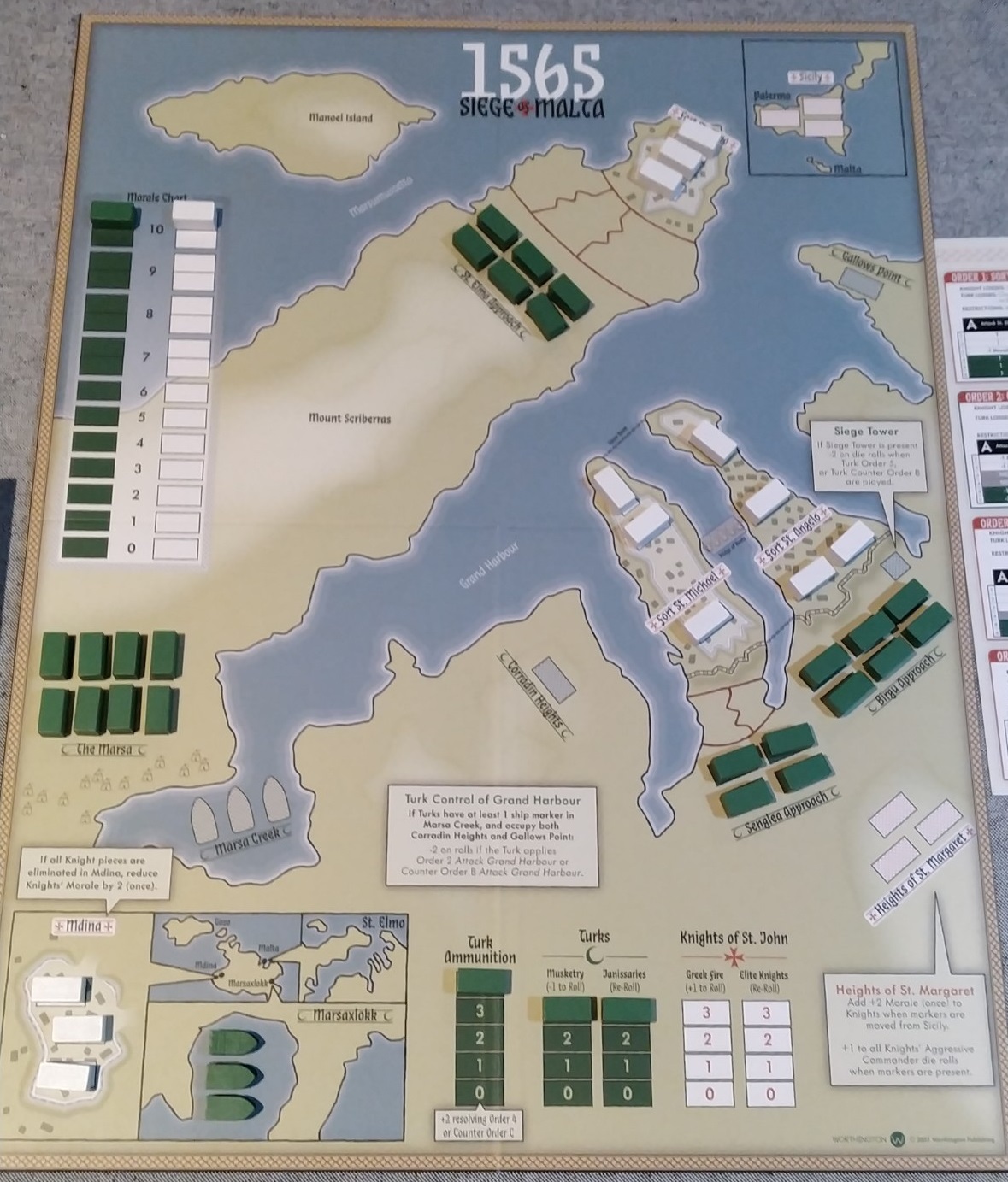
The board features a map of the main port of Malta, including the harbour fort of St Elmo and the fortified cities of Birgu and Senglea (the bastion of the knights of the Order of St John and the sites of the Turkish siege). Inset maps track troops at the Mdina fort (elsewhere on the island) and the gathering of area for the Knights’ reinforcements’ staging area in Sicily.


Battle attrition. Not a game for the faint of heart.

The board also features a Morale Track identical to the one featured in Siege of Quebec, with the double spaces for the higher reaches of the track. Also featured are several short tracks to monitor the use of various resources available to the two sides, such as the Turks Ammunition levels and other resources available to each side.

As with the other games in the series, the components are simple wooden pieces, like elongated cubes, about three-quarters of an inch long (that’s an estimate; I haven’t measured them), with the Turkish ships represented by simple, boat-shaped blocks (one end shaped like a ship’s bow). One of the Turkish blocks is used to represent the siege tower when in operation, standing on its end; functional and surprisingly effective, visually.

Siege tower in place - for now.

Play

As with French and English in Siege of Quebec, it is possible to play either the besieging Turks or the besieged Knights in Siege of Malta. Each side has its own orders chart and a corresponding bot deck to provide the actions and countervailing orders of the opposing side. One radical difference is that in the other games in the series, you cannot duplicate orders consecutively; each order must be different from the previous one selected, but you could feasibly play the same two or three orders alternately through the entire game. In Siege of Malta, you must play each order once, in any sequence you wish, but every order must be given before the chart resets. There are even a set of seven cards for the two factions to place upon each order as it is played. There is a way around this for the Knights, but it comes at the cost of a Defiant Speech (more on these later).


Cards are provided to cover each played order - no doubling-up.

Each turn, the player will choose a hereto unplayed order, then draw a card. The card will (usually) present an event that it resolved immediately, and offer a counter-order; the counter-order will tell the player which of the four results tables on which to roll. To resolve the success or not of the order.

Essentially, the Turks have to capture the fort of St Elmo, the fort of St Angelo/city of Birgu, and city of Senglea (the fort at Mdina doesn’t count to the victory, but securing it makes some actions in the game easier for the Turks), and have at least one ship in the harbour to claim victory, whereas the Knights merely have to wait out the siege until the Turks ship out for Cyprus. This makes it sound easy for the Knights, but the Turks had superiority of numbers and access to supply lines off island (as reflected in the Turkish adversary deck).


Appraisal

Siege of Malta is, to my mind, the most complex of the three Great Sieges games (so far). That’s not to say it’s more difficult, but there are more things happening on the board than in either of its stable-mates. As with the other games, the player can double down on a crucial play by playing one of four Aggressive Commander actions for the Turks or one of two for the Knights. This difference is caused by the other two Knights’ spots being reallocated for Defiant Speech actions, of which there are also only two. A Defiant Speech action can be used in two ways; to immediately reset the orders display, making all the orders once again available to the player, or to burn the Bridge of Boats running between the walled cities of Senglea and Birgu.

A lot of historical events have been built into play, like the Turkish siege tower (allowing a +1 to some rolls, though the tower can be destroyed by the Knights in certain circumstances), and the way the Knights can destroy the bridge of boats for a one-point morale boost, but can no longer move troops between Birgu and Senglea, limiting their defensive options. Then there’s the diminishing Turkish ammunition, their musketry and Janissaries options (limited resources to apply and -1 or a re-roll respectively in certain situations) and the corresponding Greek Fire and Elite Knights for the order of Saint John. With only three each of these, the player has to weigh up the benefits of using each option carefully.


Birgu and Senglea, with the Bridge of Boats still intact.


Like the other games in the series, Siege of Malta is well balanced – read difficult but winnable. Out of around seventeen solo games, fairly evenly split between the two sides, I’ve won the solo game once playing the Turks and twice as the Knights. On balance, I think it’s a little tougher to win as the Turks; they are doing the heavy lifting – the Knights will win if they can deny a Turkish victory until the deck runs down (representing the point of time in which the Turks must set sail to avoid the winter storms). But both sides provide their share of challenges (and the occasional reprieve from the opposing deck).

After playing this game so often, I’ve got the set-up time under five minutes, and the playing time for a medium challenge game (24 cards) down to under an hour. If you have a couple of hours to kill, this is the perfect distraction; after you inevitably lose the first game, you will want to immediately play a second game to save your wounded pride. Or you can play through once as the Turks and once as the Knights and make your own judgement on who has the easier time of it.

In the roughly four months since I received Siege of Malta and Siege of Syracuse, I’ve played each about a dozen-and-a half times and neither game has got stale for me. They still offer challenges and surprises, and victory is never guaranteed. I have yet to play either in the difficult mode (reduced or increased deck size, depending on whether you are the aggressor or the defender), so there is that particular joy to look forward to. All in all, 1565: Siege of Malta is an elegant game that is quick to set up and play, and has built-in replayability rewards repeated play. I think it’s a good investment.


Tuesday, 25 April 2023

Review: 414BC: Siege of Syracuse (solo game)


2022 Charles S. Roberts Best Ancients Wargame Nominee


Worthington Publishing has a proven track record for producing compelling, historically-founded, fast-playing solo games. There has always been a space for solo games in the wargaming space, and not just because of a player’s inability to find someone else with the free-time, accessibility, and desire to play the game they want to play. A lot of people have woken up to the desirability of having a solo game or two (or twelve) to fall back on since the time of lock-downs and social distancing, and more than one publisher is putting more effort into making some or most of their games at least solo-friendly. To their credit, Worthington has always been operating in that space, so it stands to reason a solo-oriented series of games from Grant and Mike Wylie and the team would bring all of that experience to bear.

In the spirit of full disclosure, I’ve been a Worthington booster for a while. When I started to get back into wargaming about a decade ago, two of my earliest game purchases were second-hand copies of Boots on the Ground (Worthington Games, 2010), and Richard Berg’s Turning Point (Worthington Games, 2009). With the advent of Kickstarter, I backed some (though certainly not all) of their campaigns. I own probably fifteen or more of their titles* and I have never been disappointed in one of their games.

That said, I didn’t back either the original Kickstarter campaign for 1759: Siege of Quebec (Worthington, 2018) or the later campaign for the three titles in the Great Sieges series. I considered backing both, but I balked. I didn’t get the order system and the static blocks. I was interested, but not enough to lay down the cash for something untried. I’ve come to these later, after they’d been in the wild for a while. I read the comments on Boardgamegeek, then took the plunge got Siege of Quebec. After playing that a half-dozen or so times I was hooked and went scrabbling for Siege of Malta and Siege of Syracuse. The later was the hardest to find, and I lucked out, finding a copy from France (happily all three are back in in stock from a second printing and available through the publisher).

414BC: Siege of Syracuse (Worthington Publishing, 2022) is designed by Dan Fournie, who also designed 1944: Battle of the Bulge (Worthington, 2020) and 1944: D-Day to the Rhine (Worthington, 2022), and who has prepared dozens of scenarios for GMT’s Great Battles of History (GBoH) series. It depicts – as it says on the box – the siege laid against the city-state of Syracuse in the year 414BCE. As with all the titles in the series, the Syracuse rules include a short but details historical note regarding the situation depicted.


Appearance

Each the Great Sieges series of games are beautifully presented, each with its own muted colour palette, simple graphical representation of the geographical situation, and a tactile sense of presence and movement with the use of wooden blocks to represent the combatant forces, support units, and in this case, the siege wall the Athenians race to construct to seal off the Syracusans from the outside world in an effort to shorten the siege. The wooden pieces are one of the truly charming elements of all of these games. There are no detailed resin figures of battle-grizzled soldiers and triremes; most of the pieces are simple elongated cubes, used to represent the troops fielded in various positions with one from each side serving as that nation’s Morale marker, the ship pieces have one end shaped to represent a ship’s bow, and the most ornamental feature is the crenulations of the two side’s wall pieces. It might be a cheap psychological trick, but placing and moving solid wooden forms with a little weight to them and that grainy texture beneath the coat of paint lends a more intimate sense of involvement in the action of the game.


Overall, the game is the complete package. The board is mounted, 22’ by 17’ – in my opinion, an ideal size for a solo game of this duration. Positions for the starting units are marked with each side’s colour in bold print on the map, with other manoeuvring and reinforcement positions marked in a muted shade of that colour.


Play

Fournie’s design has been informed by the overall design of Siege of Quebec, the first game in the series; the board, pieces, event cards, order matrix and order of play all share the family resemblance. If you’ve played one of the games, the others will feel familiar, but each is its own beast and offers its own unique set of challenges.

The Bot-deck is divided into two stages; the Syracusan stage and the Spartan stage. There is some programming involved with the events; the Spartan reinforcements are shuffled into the three earliest cards in the Spartan deck, then the Athenian reinforcements are shuffled into the next three, so you know these events will occur roughly in the middle of the game. Between them, the decks contains thirty-nine cards, but for a game with the Normal level of difficulty, you only deal off twelve cards for each half of the deck (technically ten plus the two proscribed cards for the Spartan deck), so you won’t see every event come up in every game.

"We'll build a wall, and we'll make the Syracusans pay for it."


With each turn, the player will choose an order to try to execute from a selection of seven options, then draw a card from the deck. The event is played first (the Bot’s turn, if you will, though it sometimes will come out in favour of the player). Then the counter-order is checked; this will tell the player which of four tables to roll on for the chosen order. If your order was to build the lowland wall, you’ll have a harder time of it if the Syracusans are defending the lowlands, or an easier time if they are instead defending the harbour.

The Syracusans will try to dismantle your siege wall, build their own counter-wall to block your progress, meet you out on the field of battle to thin your ranks, and damage your ships so you can’t interdict the city by sea. The enemy is cany and has many tricks up their sleeve. You can counter their provocations, but only one at a time, and each time at the cost of precious time, as dictated by the deck, in its role as game timer. Meanwhile, every loss you take, and every supply ship that gets turned away reduces your morale.

The solo game can end in two ways; either with the completion of the siege wall and enforcement of the sea blockade by the Athenians (victory), or by the Syracusan/Spartan deck running out before the player manages to accomplish these goals (failure, and a long journey back to Athens), the or by one side reaching a morale level of zero.


Appraisal

I really like the Great Sieges series. Each game offers a different experience but in a familiar way. Siege of Syracuse has unique aspects in the preloading of some events, and the more convoluted manner in which victory must be achieved. Like the others in the series, each time I get it to the table, it offers an evolving challenge that doesn’t outstay its welcome.

In preparation of this review, I played Siege of Syracuse again.  I haven’t played it in a couple of months – since January, and of the eighteen or twenty times I’ve played it, I’ve never beaten the Bot opponent. This time the start aligned; After pulling three Athenian leaders in the first half-dozen card-draws, things went remarkably smoothly. I completed the lowlands siege wall with nearly no resistance, though my navy was mauled early on and I struggled to get my ships repaired. Victory was attained with the final wall position filled and single ship managing to stay on blockade, with a mere two cards left. I’ll cherish this win because I don’t think I’ll see another one for a good ten or fifteen games.

My first victory

While the States of Siege series games all come with a two-player variant, I think I’m satisfied to keep them for solo play. They feel like solo games first and foremost, but that’s just my feeling. I’ve read reports from others who prefer them as two-player games.

One of the things I love about Worthington’s games is that they consistently live up to the playing time given on the game. If the box declares “Victory within an hour,” you can bet that – once you’re familiar with it – you’ll be done inside of an hour. Fifty minutes is my average for all three of these games now, with another seven or eight for set-up and repack. Victory isn’t guaranteed, but it’s often tantalisingly close, and you’ll probably have enough time left to set up and go again.


* After writing this, I went and checked the inventory and found I actually have no less than twenty-eight games from Worthington Publishing and their forerunner, Worthington Games. In all those, no disappointments.


Blog Note: a recent arrival

   I’ve been a little quiet on A Fast Game of late due to a combination of circumstances; my wife’s aunt and uncle are over from England at ...