Showing posts with label Commands and Colors: Medieval. Show all posts

Thursday, 31 July 2025

State of Play: The Battle of Ascalon - 14 August 1099 (Commands and Colors: Medieval – Crusades Exp.)


All in all, not a good day for the Fatimid defenders.


Just a quick report this time. I was to get In the Shadows (GMT Games, 2025) to the table this week, but T has a conference in San Fransisco and asked if I could come to his for a quick game before he left. I gave him carte blanche to set up whatever he liked (I owed him that, since he’s bringing some stuff back from the States), so T chose Commands andColors: Medieval – Crusades expansion (GMT Games, 2024), a set that has seen a lot of milage this year.

T had nearly set up the Ascalon - 14 August, 1099 scenario, just putting out the last pieces for his Crusaders. Given the choice, T will always play the Crusaders in C&C Crusades, the French in Commands & Colors: Napoleonics (GMT Games, 2010), and the British in C&C Tricorne: the American Revolution (Compass Games, 2017).

At first glance, the Fatamids seem to have an advantage of numbers (twenty units on the board to the Crusaders fourteen), but as past experience has shown, the Crusaders can never be underestimated. Historically the Christians had the element of surprise and managed to roll up the Fatimids from their flank, pushing the infantry back into the still forming-up cavalry.

About five rounds in, and the ranks are thinning. Normally I'd have a photo of the
 initial set-up; I thought I did this time, but I didn't check at the time, and nothing
had been saved. A bit like my Fatimids.

Art imitated life for the first three or so rounds, as Godfrey (on T’s Left) came forward to engage my weak right flank, supported by Crossbows and conventional archers. I countered with some Light Cavalry under an unrecorded leader. It took some chipping away and lucky rolls, but over four or five rounds I was able to dispatch Godfrey and his Mounted Knights with those Light Cavalry, though it cost me two units. That was to be the Fatimids' high watermark.

Crusader casualties, mostly piecemeal, but Godfrey may be ransomed back,
so not a total loss.

T meanwhile had been dressing his ranks for a major push in the centre. When readied, his Heavy and Medium Infantry, supported by ever more Mounted Knights and brandishing consecutive Leadership cards, fell like an avalanche on my unsupported front line, quickly breaking its cohesion and forcing some to flee, others to fight and die.

Ascalon is another scenario that some may point to and cry “unbalanced”, but I could see ways to defang the Crusader onslaught. I was hampered by a bad opening hand; well, but really bad, but nothing that gave me an advantage out of the gate. If I’d had a Darken the Sky card, or anything that allowed me to Order Units Center, I may have been able to thin the Crusader ranks with my Auxilia Bow; I’ve had great success – and suffered playing the other side of the board – from Light and Auxilia Bow managing to whittle units down before they get a chance to engage in melee. But that's the beauty of the C&C system - it insists you make the best of what you have available (troops, orders), and sometimes you'll surprise yourself. Just not every time. 

End state. Camps defended, but at what cost? (Final score: 7-3 for a Crusader victory.)

As it was, my opening hand offered three Flank unit orders and a Counterattack, which may have been useful if T had done more than tinkering at the flanks himself in those first couple of rounds. I’m proud to say I didn’t lose any points to real estate grabs. The Crusaders would gain a Victory Banner for each Camp hex they managed to hold until the beginning of their next turn, but they didn’t need to. In a small act of defiance, the anonymous Fatimid Leader and the remnant of his Light Cavalry responsible for Godfrey’s ahistorical capture, survived to the end, albeit with a mere vestige (a single block) of his original unit. And the gates of Ascalon held firm.


Tuesday, 15 April 2025

State of Play: Commands and Colors: Medieval – Crusades Expansion: Lake Antioch, 9 February 1098


After T had to cancel our Tuesday game due to work commitments, we managed to squeeze a game in last night (Thursday) at late notice. I arranged to go to T’s place and gave him carte blanche to set up whatever he liked.

When I got there, I learned we’d be playing the Lake Antioch scenario from the Commands & Colors: Medieval – Crusades expansion (GMT Games, 2024 – you can read my review of the expansion here). A slight delay ensued as T had set up the Persians from the C&C: Ancients – Greece and the Eastern Kingdoms expansion (GMT Games, 2006); to be fair, they are similar in block colouring, and T hasn’t labelled his army cases yet. This went a long way to explaining why there weren’t enough Medium Cavalry for the Seljuq to field (the leader illustration should have been a giveaway, but T hasn’t spent as much time with the Medieval blocks as me).


T has two cats, Claude and Eustace. Claude sits close whenever I visit. Eustace only
comes by stealth to attack the unwary. I've become quite wary. 

After we sorted out the Seljuq forces, T poured coffee while I shuffled. Based on straight numbers, the Lake Antioch scenario looks a little one-sided. The Crusaders have just six units on the board to the Seljuq player’s fifteen. T, who has only ever played the Crusaders, probably thought he was letting me win as a salve for coming to his place, but I’ve played enough C&C: Medieval now to recognise a difficult situation. For starters, if you have to have reduced numbers, it’s always a help to have Mounted Knights, the absolute tanks of the age. Five or the complement of Crusader units were thus, accompanied by a single formation of Medium Cavalry (no doubt mostly third and fourth sons, minstrels and poets, there to record for posterity the valour of their compatriots, but no slouches in a fight, either) – and they have a disproportionate number of leaders, three in all.

The corrected set-up (using the correct blocks).

Secondly, they hold the high ground. A hill doesn’t provide as much of a benefit as in other flavours of Commands & Colors, but this range is located in the narrow neck of land between the Orontes River and the Lake Antioch of the scenario title (to the Seljuk right – the river tiles mark out the shores of the lake), blocking any kind of enveloping action by the Turks.

Finally, there are the cards. The Crusader player receives six cards while the Seljuk gets just four. Any player can still win a game with a smaller hand than his opponent, even if some of those cards are sub-optimal, but I’d managed to deal myself two flank leadership order cards when   my sole leader was in the dead centre of the heard.

In my initial hand, the only useful cards I held was an Attack Center (three units ordered). But in this scenario, the Crusaders have the initiative, making the first move. Of course, when dealing the two hands, I managed to give T a Mounted Charge. Three of his Mounted Knight formations descended upon my Light Cavalry like the Hand of Judgement, driving all before them. On the T’s left, two retreats rolled saw one Light Bow unit flee off the board for a victory banner, then with their advance, the Crusaders halved the strength of the next Light Cavalry unit. The other two units took a banner each for three banners on the very first card of the game. Did I mention this was a five-banner scenario?

The situation after the first card play. T likes a big opening number.

I brought up my medium cavalry to counter the onslaught on my first card play. This handed T his fourth banner for the night when his untroubled knights slew an entire Seljuq formation in a reactive strike.

After nearly winning in the first round, we settled in for a slog. Total victory alluded T for a few rounds, and I managed to finally win my single banner for the game on my third card play. My fourth card of the game proved to be my undoing, however. I played Foot Onslaught*, bringing up my Medium Infantry to spoil the Crusaders’ advance, but their strikes were like lances against the storm. With his fifth card, Leadership - Center Section, T delivered the killing blow, wiping out a complement of infantry with a roll of two crossed swords, two blue triangles and a superfluous retreat.

My single moment of glory. One banner for the whole game. At least I made
his general flee like a frightened donkey.

T was humble in victory. He genuinely thought I would take the field with superior numbers, but I could tell he was chuffed with his win, and he deserved it. I did what I could with what I had, but sometimes the cards don’t fall in your favour. A short but nonetheless satisfying game.


* One of the small joys of Commands & Colors Medieval is how so many of the order card titles sound like tag-lines for a Cecil B. DeMille epic.


Thursday, 13 February 2025

Review: Commands & Colors: Medieval, Expansion 1: Crusades Mid-Eastern Battles 1


Commands and Colors: Medieval (GMT Games, 2019) offered a new theatre of war to be viewed through the lens of the Commands & Colors system. There was some discontent expressed in the usual forums regarding the decision to begin the series at the beginning of the medieval period, at the decline of the Eastern Roman Empire. Eventually, however, the unique qualities of the game and the strengths of the system shone through, leading to a second printing, and, eventually, the product we’re addressing here, Commands & Colors: Medieval, Expansion 1: Crusades Mid-Eastern Battles 1 (GMT Games, 2024). As we’re told on the back-of-the-box description, this set of twenty (yes, that’s “20”) scenarios, spanning ninety years, through the First and Second Crusades and the intervening years, up to the Battle of Hattin in 1187. The course of the scenarios is a journey through history, with the rise and waning of successive Arab and Turkish powers challenging the European knights over control of the Holy Land.

Let me be clear (again) that this is an expansion for Commands & Colors: Medieval game. That is to say, you need the base game to be able to play Crusades. I would also not right now, that given the unwieldy name of the expansion, I will hereon refer to it as either Crusades, or the expansion, mostly for the sake of my own sanity.

Antioch set-up, from the Crusaders' edge. Note the sneaky (if ultimately unsuccessful)
counterattack from behind by the Seljuq Turks. Also worth noting is the Auxilia Infantry
unit carrying a piece of the True Cross, or maybe a finger of St Andrew (lower right).
In Crusades, relics have power.

Appearance

I’m not going to spend too much time on the look or the component quality of the Crusades expansion; I’ve already posted an unboxing of the set, and anything else I added would simply be repeating myself, something I try not to do (though sometimes, I just can’t help it). Everything will look familiar to those who have played C&C Medieval, with the exception of new units introduced in this expansion. The Crusades leverages the existing blocks form C&C Medieval. Some have complained that this lessens the distinctive flavour of the expansion, but I would have to disagree. I’m truly grateful for the designers and panners of this expansion not insisting on a completely new set of blocks for two full armies, with all the extra cost in materials and shipping that would entail, let alone the hours of stickering, and the need to house a full second army. I can live with anachronistic uniforms or armour (if they are really that radically different) for the sake of these savings alone.


New units included in the Crusades expansion, Left to right: Mid-Eastern Auxilia Bow
Infantry, Turcopole Light Bow Cavalry, Medium Crossbow Infantry,
Heavy Knight Cavalry, and Foot Knight Infantry.

As it is, you’re still going to put some time into preparing new forces and augmenting existing ones with this expansion. Five new categories of fighting units have been introduced in Crusades, and these are mostly on the side of the Crusaders. The only new Mid-Eastern unit is the Auxilia Bow Infantry. Like their regular Auxilia brethren, they fire at range and fight in close combat with two dice, and in melee will hit on sword results. Unlike the spear-throwing auxilia, they have a firing range of four hexes.

The only Light unit joining the Crusader ranks is the Turcopole Light Bow Cavalry. Turcapole cavalry were local men who had converted to Christianity from Islam, and who hired themselves out as mercenaries to the Crusaders. As converts who had departed from Islam, if they were caught by the enemy, they would be executed immediately under the code of law. These, like all mounted units, may momentum advance and engage in a second round of close combat.

Arguably the greatest man-portable technological advance in the years between C&C: Medieval’s Late Roman Empire and the world of Crusades was the crossbow. Crusades introduces Medium Crossbow Infantry (four units in all). Like all bow-capable units in C&C: Medieval, the Crossbow infantry roll two dice in ranged combat. Unlike other bow units, they cannot engage in ranged combat after movement. They fight with two dice in melee as well, but can ignore a sword from lower ranked units, and, truth be told, there is a psychological aspect to having crossbow-armed soldiers on the field of battle, especially when playing the Mid-Eastern faction.

The Poor Fellow-Soldiers of Christ and of the Temple of Solomon (Knights Templar -
white blocks), and Order of Knights of the Hospital of Saint John of Jerusalem 
(Knights Hospitaller - red blocks) may appear mounted or unmounted.

Finally, the Crusades saw the Super-Heavy Cavalry of the base game fade from view to be replaced by European Knights, fearsome warriors whether mounted or unmounted. Crusades offers both options; Foot Knight Infantry, identified by crossed swords transecting the white-bordered Red-square unit indicator and by the look of grim determination on the figures in the illustration, fight with four dice, but they may ignore one flag and ignore the first Sword hit from a lower-ranked unit. They may momentum advance over the corpses of their vanquished enemies and fight on for a second round of melee. These units are formidable.

They are even more formidable in the saddle. Well, as formidable, but a tad more impetuous. Heavy Knight Cavalry share the same fighting parameters as their unmounted brothers, but unlike regular Heavy Cavalry, the Knights are “motivated” (the term used in the rules) by their training, sense of honour, and a goodly measure of bloodlust, and may advance a second space to engage the enemy in their second round of close combat.

Then there are the Knights Orders. Crusades introduces branded crusaders in the form of Knights Templar and Knights Hospitaller, one unit each of Infantry and Cavalry (representing the cohort as mounted or unmounted, as the scenario dictates). These units function very much as their regular Knight-unit collieries, except that these guys always hit on Leader symbols, whether a leader is present or not. Meaning they will have a four in six chance of delivering a result on each die in every fight.

Now we’ve met the new guys, let’s have a look at how Crusades plays out on the table.

I don't want to spend column inches waxing eloquent on it, but the quality of the art in
the terrain tiles really should be noted. For me, it lifts the experience of play a notch.

Play

Commands & Colors games all use essentially the same system; this is how we know a game is a Commands & Colors game. If you’ve played a couple of C&C Games before and you come across a new one, you shouldn’t run into any problems getting your head around the new game. But the beauty of the system is in its flexibility. You’ll never achieve anything close to a true historical a simulation with a C&C game of any stripe – it’s worth noting that this is true of many wargames, no matter how granular you get – but each flavour of Commands & Colors brings a lot of situational verisimilitude of the battle type to the table, no small thing for a single rules set; the only comparable system I can think of off hand would probably be Great Battles of History (GBoH), covering battles from 500 BCE to the Early Modern period.

Crusades is no exception to this, except in that the departure from its original game seems more radical than most expansions achieve. C&C: Medieval was very much its own creature compared to its closest analogue, Commands & Colors: Ancients (GMT Games,2006). I really enjoy playing C&C: Ancients, but playing Expansion 2: Rome and the Barbarians (GMT, 2007) or Expansion 3: the Roman Civil Wars (GMT Games, 20070, while interesting situations and improving learning experiences, don’t really feel like a departure from the play style of the core game   By contrast, Crusades has a feel and a flavour all its own.

The unique qualities Crusades brings to the table are achieved by a combination of novel and interesting scenario design, and the introduction of some new, expansion-specific rules. The big system innovation with C&C: Medieval was the introduction of the Inspired Leadership Action economy. This bears some similarities to the Tactics cards introduced to Commands & Colors: Napoleonics (GMT Games, 2010) in the General, Marshals and Tacticians expansion (GMT Games, 2015), except that instead of choosing from a selection of generic cards that could potentially be used by either side, each player begins with a number of tokens (and my earn more through card play, which they may spend in an action to give one unit some advantage in the execution of their activation (these are referred to as Battlefield Actions), or, if actioned during and Inspired Leadership order, maybe used to unlock one of a selection of special orders, these being mostly unique to one or the other side of the conflict. In the core set there was one set of Inspired Actions for the “Romans” and one for the Huns.

Inspired Action options for the Seljuq and Artuqid Turks.

With Crusades, the stops have been pulled out, and while the Crusaders set of options remains static, the opposing Mid-Eastern forces’ options change depending on their ethnicity. The three different sets of Inspired actions reflect the differences in fighting styles between the Ayyubids, the Fatimids, and the Seljuq and Artuqid Turks.

Another new rule involves the Feigned Retreat; after a medium of heavy Crusader cavalry unit declares an attack on an enemy light cavalry unit, if the unit is in a position to evade, it may instead declare a feigned retreat, before retreating the full four-space distance. Here the Crusader player first rolls for damage, hitting only on green circles (not swords, retreats or helmets, if otherwise appropriate). Then, if any of the light cavalry unit hasn't been eliminated, it retreat its full distance (four spaces), then will the Crusader player rolls two dice; if the roll results in at least one crossed swords symbol, the attacking unit will follow the “retreating” unit, ideally ending up deep among the enemy forces. In their very next turn, provided their hand facilitates such an action, the Mid-Eastern payer may be able to destroy a prize Crusader unit with repeated bow attacks – death by a thousand cuts – or with a handy until of comparable strength, especially if the Crusader cavalry’s retreat has been blocked.

Another shockingly effective manoeuvre introduced in the Crusades expansion is the Light Infantry Swarm attack, available to some Mid-Eastern factions as a Battlefield Action (at the cost of an inspired action point). After any movement from a played order card, the Mid-Eastern player may attack a single opponent’s unit with up to four ordered light cavalry units in either ranged or close combat, with all the dice being rolled effectively simultaneously (the defending unit doesn’t get to retaliate to each attack in turn). Moreover, if a unit in Close Combat rolls a sword result, ALL sword results count as hits, and if a Close-Combat engaged unit has an attached leader, all Leader symbols are considered hits also. If all this hasn’t finished the defending unit, and it was forced to retreat, a single Close-engaged unit may momentum advance and have another shot.
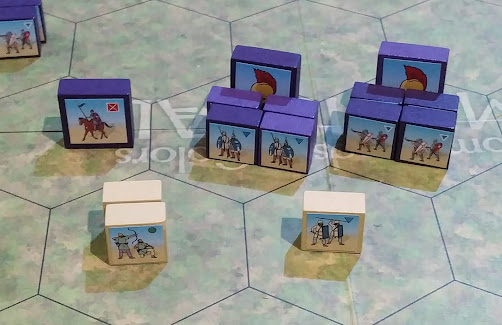
A disproportionate use of force; or, picking the low-hanging fruit.

Between the Crusaders new units and the Mid-eastern factions’ new tactics, Medieval warfare has got a whole lot more interesting. Added to these are the curious set-ups for the scenarios.

One of the virtues of Commands and Colors is the scenario set-up. This is always relatively straight-forward; lay out the terrain tiles, then the two sides’ units, as per the helpful map. With C&C Medieval you may also have to declare whether some cavalry units carry bows and mark them with a Bow marker. When the set-up is complete, the players will often launch straight into aggressive actions. There may be some jockeying for better positions in the first round or two, but you feel like you’re getting straight into the action, This is because the set-ups are designed to pick up the story just at the moment the two sides are about to engage one another.

Set-up map for the first of the four Hattin scenarios. The Crusader army was strung
out over several miles and Saladin sought to fight the Europeans piecemeal through
envelopment manoeuvres. The noose tightens with each scenario.

But in Crusades, the set-ups are in themselves are often more interesting than in the core set. It’s rarely a matter or two sides lining up to slug it out, By the time the game starts, there has already been some serious manoeuvring underway. Maybe a quarter of the scenarios included in Crusades are envelopment situations. This was a tactic the Mid-Eastern armies preferred and excelled at, kind of a Light Cavalry Swarm attack but on a whole-of-battlefield scale. In these scenarios, the Crusaders are hardly lambs to the slaughter, and there are often additional rules to allow the Crusader player to gain an extra Victory Banner or two in a way that requires some planning and luck, rather than the annihilation of yet one more opposing unit.

For the seeming one-sidedness of some of the scenarios, they are quite well balanced. If there is a distinct preferred side on paper, the vagaries of the Command Card draw will often level the playing field somewhat. I would not call myself an expert in tactical warfare in the middle-ages, or in C&C: Medieval for that matter – I’ve accrued far more losses than victories playing this expansion thus far – but I’m beginning to see how some actions or tactics may pay off in a given situation. This is something that, with in the region of five hundred plays under my belt, comes as second nature in Commands & Colors: Napoleonics, but I have more games and more losses ahead of me before I can get to that stage with this game. So, it’s a good thing it’s such a fun and challenging game to play.

At the table with my Monday night gaming buddy (and brother-in-law), T. Note
the mass of Crusader casualties I've inflicted on my adversary (lower left corner),
yet he still managed a pretty convincing win.

Appraisal

I already liked Commands & Colors: Medieval a lot, right from the get-go. Either side of this game, chronologically, the antagonists on the two sides feel a little samey, with similar army make ups (though often with radically different Orders of Battle or disproportionate strengths), Commands & Colors: Ancients and Commands & Colors: Samurai Battles (GMT Games, 2022), In fact, the armies in Samurai Battles are each a mirror image of the other. With C&C: Medieval, we were introduced the concept of the Inspired Leadership counters, a currency the player can spend to gain a slither of advantage in a given situation from a table of possible tactical improvements. These have been doubled-down upon in Crusades, particularly for the Mid-Eastern factions.

For me, there was an element of Might is Right to C&C: Medieval (this can be a thing in C&C: Ancients as well, perhaps more so, where you don’t have the game-changing (well, game-modifying) Inspired Leadership currency to weight a given situation on your side a little), where if you can get your heavy units into play, you’ll have a better chance of a win. I don’t know if this is entirely fair to either system, but it was an instinctual response to seeing the action play out in early games, and it’s a tendency I’ve noticed all my opponents I’ve ever played at either game. The new options in Crusades have, I think, broken me of this unconscious preference. I’m keen to go back to the core C&C: Medieval scenarios and apply what I’ve gleaned from Crusades to those.

Nobel prize-winner Issac Bashevis Singer said he chose to write his stories in Yiddish, then translate them himself into English because Yiddish had "vitamins" that other languages didn't possess. As I've already mentioned here and elsewhere, each form of the Commands & Colors system has its own flavour, its own vitamins. This could be why some people adore one stripe of C&C and loathe another. As a first expansion, Crusades offers a lot. Pound for pound, I think there’s (for me at least) a deeper challenge and more thorough enjoyment in these scenarios than in the core box. This isn’t to disparage C&C: Medieval; like I said at the beginning of this post, that is a great game in itself that I’ve gleaned many hours of enjoyment (and moments of frustration) out of. Crusades just brings a little more intrigue into the mix. Okay, I’m going to say it; Crusades is The Godfather, Part II to C&C: Medieval’s The Godfather. The core game is fantastic, but the sequel is, beyond expectations, just a little bit better. But (to torture the analogy just a little more) You really need to have enjoyed the original before you can truly appreciate the follow-up.


Saturday, 11 January 2025

State of Play: First Cab off the Rank - Commands and Colors: Ancients (Akragas, 406 BC )


The first couple of weeks of the year are always tougher to squeeze a game into. But T and I managed to catch up last Monday night for a quick and dirty Battle of Akragas, 406 BC from the Commands & Colors: Ancients (GMT Games, 2006) core game. I’d suggested stickering up T’s copy of Commands & Colors: Medieval Expansion 1: Crusades - Mid-Eastern Battles 1 (GMT Games, 2024), but T’s wife would have none of it. We spent our last Monday game-night of the year filling and labelling sample bottles of gin for Christmas gratuities – Mrs T (Jess's eldest sister) said I deserved an actual game.

Set-up from the Carthaginian Left. Note the over-stacked Cavalry (four blocks instead
of three); The last C&C game we played was Medieval, which does have four-block
cavalry, so the oversight is forgivable, and I was two beat to notice.

So, T set up a quick, no terrain, five-banner game to start off our year, which suited me as we were both kind of beat from the Christmas season and everything that entails. The siege of Akragas, a Greek settlement on the south-west coast of Sicily, was conducted by the Carthaginians in retaliation for raids on Punic settlements. The historical battle took place between a relief force of Syracusans under Daphnaeus and part of the Carthaginian forces (mostly mercenaries) while the main force maintained the siege. The Syracusan attack was historically successful, but that wasn’t to be the case here.

About four rounds in; some losses on both sides, but no banners changing hands yet.

The game opened as to be expected. T (playing the Syracusans) brought his extreme units up to try to bedevil my flanks. This was probably an artefact of his hand; in the opening deal, we both seemed to get a preponderance of Left and Right flank manoeuvre cards. The Syracusan strength was all in his Center – a full four Heavy Infantry, which, if he could have mobilised them, would have torn into my mishmash of units like a wolverine.

I met T’s flanking moves with Slingers and Chariots. We both took our lumps, but it wasn’t until the fifth or sixth round that the first banner was taken, when the Medium Cavalry on T’s Right fell to my blooded Chariots. T countered with an attack on the same flank which whittled down my slingers to half-strength but cost his reduced Medium Cavalry on that flank – who should probably have had a better chance than the bones offered to finish off my reduced Chariots – and his second-in-command, Dionysius, to an unsuccessful single-die Leader saving throw.

First blood. Strictly, we should have been using the Roman eagle banner blocks,
but the roosters came to hand sooner.

With just two banners between the Carthaginians and a reversal of historical fortune, I brought up the line I’d built on my Right flank with an Inspired Leader order, giving everyone engaging one extra die in combat. I secured the final two banners needed in short order; history was rewritten as Himilco prevailed on the field, while Daphnaeus withdrew in good order with the fighting core of his troops intact. The whole action took about a dozen rounds.

A 5-0 result wasn’t an auspicious beginning for T, but over the years I’ve learnt not to dismiss him lightly, especially at Command & Colors. Next week will probably be C&C: Medieval (GMT Games, 2019), breaking in the new expansion, which I’ve been looking forward to since well before Christmas.

Final state, after the dust had settled. A fairly convincing win.


Sunday, 24 November 2024

Stripped Down for Parts: Commands & Colors: Medieval – Expansion #1 Crusades Mid-Eastern Battles I


Someone recently pointed out in a Facebook groups that the wait to see an expansion for Commands and Colors: Medieval (GMT Games, 2019) was the longest of any of the Commands and Colors games from GMT. The Spanish Army (GMT Games, 2011) came out the year following the release of the Commands and Colors: Napoleonics (GMT Games, 2010 core game’s release, while Greece and the Eastern Kingdoms (GMT Games, 2006, the first expansion for Commands and Colors: Ancients (GMT Games, 2006), arrived in the same calendar year as the base set.

If C&C: Medieval was a movie it’s what would be referred to as a slow burn (or maybe today, a cult classic). It took longer to win people over than other games in the family, and there was some open ill-feeling toward the game (I touch on this in my review, which you can find here). I haven’t done any hard research in this regard, but I’d wager the most popular historical periods for wargamers would be World War II, Napoleonic, American Civil War and Ancients (and within that broad category, mostly Roman Republic/Empire), which have been covered already in the Commands and Colors umbrella, the second and fourth by the above mentioned games, the first and  third by Memoir ‛44 (Days of Wonder, 2004) and Battle Cry (Avalon Hill, 1999). In light of this, it’s to be expected that the good folks at GMT would want to be sure of an audience before committing to an expansion. C&C Medieval eventually sold well enough to warrant a second printing (earned it’s place in the queue through the P500 process like most other reprints), and now, we have in our hot little hands Expansion #1 Crusades Mid-Eastern Battles I. This is an unboxing article, not a review or an AAR, so I’ll try not to slip too much into gushing over the promise of twenty new scenarios, with new unit types and new tactical choices, but let it stand as read that I’m even more excited about this having opened the box than I was when it arrived.

Before I go on, I want to make it clear that this isn’t a self-contained game. Well, duh!, I hear you say, but enough people have proven to not read the fine print when it comes to this kind of thing that I didn’t want to leave any room for confusion.

Please don't ask me why there is an umlaut over the 's' in Crusades;
I don't know either.

I may be in the minority here, but to me, the cover image may be the least inspiring part of the whole package. I’m not sure why, maybe I’ve just been spoilt of late with cover illustrations like the Duke of Normandy painting on the cover of Norman Conquests (GMT Games, 2023) or the illustration for Justin Fassino’s upcoming Levy and Campaign game, Seljuk (GMT Games, ~2025 – available for preorder here). It’s a break from tradition for the Medieval line, the core-box cover taking its cues from Rodger McGowan’s C&C: Ancients series covers. It’s not a deal-breaker, it just feels a little like a missed opportunity.

The box back (please note the cards pictured are from
the core box; no cards here, folks).

The box itself is a typical three-inch GMT box with the sturdy grey-board construction and firm seal we’ve all come to expect from GMT releases. I was a little surprised to see an absence of any detail, product highlights or historical notes, on the side panels of the inner box-half. This isn’t a criticism, merely an observation; they’ve been a feature of I think every GMT game I’ve ever opened – it was just a little jarring, like being hearing a familiar album with one of the songs out of sequence.

The back of the box advises that this is a two-player game, taking roughly an hour per scenario, and appropriate for ages fourteen and up. I’d agree with all of this, though I’d mention that I’ve played Epic Napoleonics (GMT Games, 2016) with a smart thirteen-year-old (for the record, I beat him, but it was a close-run thing). Like all Commands and Colors games, C&C: Medieval is designed first and foremost as a two-player game, though a workaround is available with the CDG Solo System Pack 2 (GMT Games, 2023, but also downloadable for free as a print-and -play kit from the GMT website).

Expansions for other C&C family games typically introduce some new units and some new rules. But the sheer scope of new stuff on offer here is dazzling, reflecting five centuries of evolution in the arts and sciences of war. The box-back blurb hints at these, mentioning seven new unit types and seven new concepts to embolden and bedevil attacker and defender alike.

Being an expansion to an existing game, the box lacks a board and cards, but it makes up for it in a hefty combined rulebook/scenario book, new unit reference cards, Two sheets of terrain tiles, a small sheet of victory banners and other markers, three sheets of stickers (one about ¾ size, 170 blocks in four colours to accommodate the stickers, six (three sets of) Inspired Leadership action PACs, and another set of battle dice, which are always welcome

The book: combination rulebook, stickering guide and scenario booklet.


The rulebook for this expansion comes in at 36 pages, 20 of which are, of course, devoted to the twenty scenarios featured with the game. Five pages are given over to a brief introduction, a run-down of what’s included I the box, new Inspired Leadership Actions, and some clarifications to the original ones. Another seven pages offer the typical breakdown of the units introduced in the expansion, along with a survey of all of the units old and new, which will feature in the current set’s scenarios. New units include (in order of appearance) Auxilia Bow Infantry, Medium Crossbow Infantry, Foot Knight Infantry, Military Order Foot Knight Infantry, Turcopole Light Bow Crusader-Allied Cavalry, Heavy Knight Cavalry, and Heavy Military Order Knight Cavalry.

Heavy Military Order Knight Cavalry, one of the new unit types
introduced in this expansion.

The scenarios offer a range of diverse and challenging situations. Not all appear balanced, and that’s okay; as I’ve often said, if you want a perfectly balanced game, go play chess. Military history is messy, full of ill-judgement, hubris, and plain bad luck. The majority, however, look reasonably balanced if you look past the simple numbers of units and more closely at their capabilities. I’ll save closer analysis for a review post but suffice it to say this expansion presents plenty of evenings’ diversions.

Sticker sheets 1 & 2. Stickering is an unavoidable part of the C&C experience.

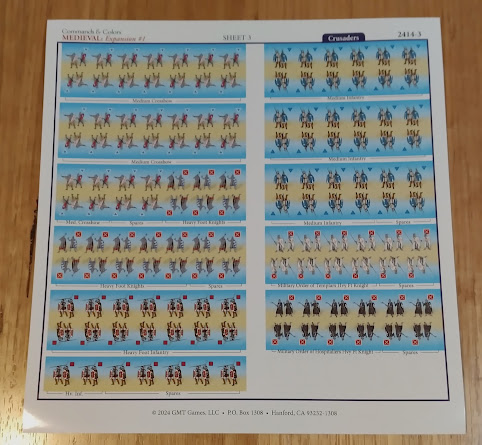
Sticker sheet 3. I particularly like the troop and cavalry illustrations for C&C: Medieval.

The new units nearly all fall on the Crusaders’ side, with – in ascending order – four units of Crossbow Infantry (Medium), four units of Foot Knight Infantry (Heavy) with an additional unit each of Templar and Hospitaller Knights, three units of Turcopole Light Bow Cavalry, and seven units of Heavy Knight Cavalry, as well as one additional unit each Templar and Hospitaller Mounted knights. They are rounded out with some additional Medium and Heavy Infantry units.

The Mid-Eastern forces also get some love, with additional Auxilia and Medium Infantry, Light, Light bow and Medium cavalry, as well as a full five units of Auxilia Bow Infantry. Each side also gains an additional Leader block.

The big bag o' blocks, The white and red blocks are for the Knights Templar
and Hospitaller units respectively.

All of these stickers have to be applied to the accompanying blocks before you can play anything. Some people hate this part of any C&C game; personally, I find it kind of meditative. That’s not to say I’m glad when it’s done, but being an expansion box, it will be around half the number of what you had to sticker in the core box, so there’s that.

Terrain tile sheets (the boring side - sorry).

The two terrain tile sheets (punchboards in game production parlance) offer more forest and hill terrain on the obverse side. On the revers, things ger a little more interesting.

On the reverse of the forest sheet are swampy regions, as well as bridges and fordable river sections. On the reverse of the hills sheet the tiles are a mix of city walls, broken ground, and no less than five camp tiles. Why so many camp tiles? I’ll have to have another look over the scenarios.

Victory Banners, Bow markers, and Inspired Action tokens. And a holy relic.

The third punchboard is a counter sheet with new Victory Banners to reflect the emblematic heritage of the time, more bow-equipped/bowless cavalry markers, and more round Inspired Leadership chits. Also included is one intriguing counter that relates to one of the rules introduced with this expansion: a Holy Relic counter. In some scenarios, one of the crusader units will be entrusted with a relic of significance to the church (and to the unit carrying it, as you’ll see). During the game, the unit to which the relic has been entrusted gains a block (five instead of four – essentially an extra hit point), will fight with one extra battle die, and while defending they, as well as any adjacent unit, may ignore one flag (retreat) result. Potent stuff.

Unit Reference Cards (front and back).

The Crusades expansion comes with two Unit Reference Cards, similar in layout to those from the core set, but, of course, incorporating the new unit types. Foot units are represented on one side, cavalry units on the reverse. The Terrain Effects Charts from the base game still apply here, so there’s no duplication of those.

Inspired Action PACs for the Crusaders (above) and the Fatimids.

One of the stand-out innovations of the C&C Medieval series, for my money, is the Inspired Action mechanic, which can be introduced when a Leadership card is played by spending a token from a number they started with at the start of the match, and selecting an order from a chart of Inspired Actions offered. This can give the active player a slight edge at a crucial moment in the game, increasing the drama and excitement of the play. In the base game, the Byzantines and the Sassanid Persians each had a set of orders, similar but subtly different between the two sides.

The three Mid-Eastern Inspired Actions selections. Lots of options on hand.

In the Crusades expansion, this has been changed up somewhat. The crusaders have a stock set of inspired orders that remains unchanged through the century of fighting represented in the scenarios. They in turn were not fighting a similarly monolithic foe, but a patchwork of rival caliphates and nations joined in the goal of vanquishing a common enemy. This expansion offers no less than six – three sets – of Inspired Orders cards, reflecting the differences in fighting tactics of the Fatamids, the Artuqid and Seljuq Turks, and Ayyubids. I am often blown away by the level of research that goes into the scenario development of these games. It’s the inclusion details like this that refutes those who maintain Commands and Colors games lack depth or authenticity.

More dice. You can never have too many.

Lastly, as I mentioned earlier, this expansion comes with a second set of eight battle dice. I’m not sure who’s idea this was, but I’m very grateful. My regular C&C playing buddy has an annoying habit of hording the unrolled dice on his side of the table whenever we have to share a set, leading to vocal recriminations and some questioning of parental legitimacy. A second set of dice allays this kind of tension, keeping the fighting to the gameboard.

Inside the box (insert, blocks and dice).

It has been a long wait between the initial release of Commands and Colors: Medieval and this first expansion. I made the bold claim that I thought the game-buying public would see a second Medieval expansion making it’s P500 threshold within two years of The Crusades’ release. After going through what is on offer hear, I hope I’m right.

Commands and Colors has been a staple of our Monday night games for the last fourteen years, and I expect we’ll start working through The Crusades pretty smartly. Look out for some initial thoughts on this expansion soon and a review likely before year’s end.


Addendum: if you enjoyed this post and want to know more about the C&C: Medieval Crusades expansion, you can find my review here. And thanks for reading this far.


Blog Note: a recent arrival

   I’ve been a little quiet on A Fast Game of late due to a combination of circumstances; my wife’s aunt and uncle are over from England at ...