Showing posts with label Avalon Hill. Show all posts

Monday, 30 March 2026

Stripped Down for Parts: War & Peace, Seventh Edition


Mark McLaughlin’s War & Peace (Avalon Hill, 1980) is something of a legend in the wargaming world. It’s one of those titles that has stood the test of time, being reborn in successive editions over the last forty-five years, each time maturing, streamlining, and growing a little in its scope. I really thought when it came out that War and Peace: Game of theNapoleonic Wars (One Small Step, 2020), with its gorgeous presentation and mounted boards, was going to be the final word on the game. This was the sixth edition of a really well-regarded game, and with a single print-run, that edition became a collector’s item really quickly, and the price went up accordingly.

At 4 1/4" deep, it's nearly as thick as its namesake novel.

I was hunting around for a copy of the One Small Step version for a couple of years when a War & Peace, Seventh Edition (Avalon Digital, was announced. Avalon Digital released a computer version of W&P, which they had to name Napoleon’s Eagles, which is pretty much a straight port of the One Small Step game to the online environment. To be honest, I was a bit sceptical about a computer game company producing a print version, but some early pics assuaged any fears. So, when a FLGS (one state over) had about a dozen boxes arrive, I knew I had to grab a copy.


Before we get to the cover illustration, I have to talk about the box.  Have a growing collection of the 12” square boxes favoured by European publishers (the Conquerors series from Shakos and the recent Second Edition of Unhappy King Charles (Phalanx, 2024) feature this size of box, but Compass has also gone this way with Burning Banners (Compass Games, 2024) and Engine Thieves (Compass Games, 2025). I don’t have anything square boxes in principle, but they have proven to be a little more difficult to shelve. Now I have more than two or three, I can probably devote a single bottom shelf to elephantine boxes and just let them stick out an extra inch or so.

This is the deepest 12” square box I’ve bought, coming in at a tad over four inches in depth. In truth, an inch could have been shaved off this depth and it would still accommodate its contents, though thinking about it, the extra height may be to allow for the punched counters in their baggies, but we’ll swing back around to these later. The box itself is of solid construction, with a nice seal between the two shells, but so tight at to be difficult to open, but not given to slippage either.

The box cover features a painting called Bataille de Friedland, 14 juin 1807, by French artist Émile Jean-Horace Vernet in 1835 (the same illustration adorns the cover of the Rulebook). Vernet, a noted painter of martial scenes and patronised by Napoleon III, would have been about eighteen when news of the battle filtered back to France. You can see the original if ever you visit Paris; for the inconvenience of a half-hour train ride, and another hour or two queuing, you can glimpse the painting hanging in the Galerie des Batailles in the Palace of Versailles.


The box back offers a capsule history of War & Peace, along with a component list and some sample cards and counters. The complexity of the game is rated in the low region of High (about a seven out of nine on the familiar GMT scale), and solitaire suitability is rated at low Medium (about a four out of nine). I think I’d quibble with both of these; While I haven’t gone through the entire rules thus far, from what I’ve seen, I’d place the game at a solid five (a little lower perhaps if you ignore all the optional rules), and I can see the game playing quite sell in a two-handed solitaire mode (not ideal, but practicable. Player count is advised to be 2-5 and appropriate age is 14+, which sounds about right, and playing time is given as 2+ hours (dependent on the scenario chosen).

The Rulebook.

The rule book comes in at twenty well-illustrated pages, though not all of these have been utilised. The cover incorporates an easily navigable Table of Contents, and the basic rules come to barely more than fifteen pages. The game’s optional rules (which I’d be reluctant to leave out except in games teaching complete novices), come to barely another two pages.

The Rulebook - sample pages.

All the booklets included in the game are printed on a nice weight of gloss paper – not so glossy as to be difficult to read under overhead lights – and are presented in about a nine-point Garamond font, facilitating ease of reading and comprehension. All are set in a two-column format, and the light buff background colour also adds to the readability.

The Standard Game Scenario Book.

The Standard Game Scenarios booklet offers the details of the games thirteen stand-alone scenarios. The booklet shares the same production properties as the Rulebook and comes in at twenty-four pages.

The Standard Game Scenario Book - sample page.

Presentation of the scenario information is standardised and each includes a historical introduction, a list of required game equipment, Victory Conditions, Special Rules pertaining to the given scenario, Initial deployment of forces, a schedule of Reinforcements and Replacements, and other scenario noted (provided by that scenario’s designer).

The Grand Campaign Scenario booklet.

The Grand Campaign Scenario gets its own booklet, which is only appropriate given the scope of this particular undertaking. Covering the duration of the war from 1805 to 1815, this will not be seen out over an afternoon, or likely even a weekend. To be honest, I doubt I will ever attempt the Grand Campaign, but one should never say never.*

The Grand Campaign allows for the involvement of two to five players, though I’m not sure I’m convinced the player controlling Russia would have as rich a game experience as the other players in a five-player game. But I haven’t played War& Peace in any iteration yet, so perhaps I shouldn’t be too quick to judge. This booklet is the longest of the quartet, running to twenty-eight pages.

A Soul for War & Peace booklet.

The One Small Step edition of War & Peace (the 6th Edition) was the benchmark for the game when it arrived, and many of the same people have been involved in the further deluxe-ification of the 7th Edition. This edition introduces two new components to the game; a deck of Event Cards (which we’ll come back to) and an extra booklet, A Soul for War & Peace.

A Soul for War & Peace - sample pages.

Also twenty-four pages in length, the booklet offers the optional rules for the use of the Event cards in both the scenarios and the Grand Campaign, and a brief catalogue of each card’s properties. This takes up the first eight pages of the booklet.

The remaining sixteen pages offer no less than eleven new scenarios, including a couple of pre-Napoleonic scenarios covering the early conflicts of the revolution and the Polish Russian War of 1792. This makes for a total of twenty-four scenarios, mostly playable in an evening or afternoon. For me, that alone justifies the price on the sticker.

The Operation Methods pamphlet. Good reading (don't show your opponent;
better he learns by example).

The last of the paper items in the manifest (and first out of the box) is the Operational Methods pamphlet. This is a small, four-page leaflet outlining Le Bataillion Carré, an operational formation that can be replicated in the game to good purpose. The pamphlet outlines the uses and benefits of this manoeuvre in play.

The shrink-wrapped counter sheet set. Ten sheets in all.

The Seventh Edition boasts ten sheets of counters. All of the game’s counters and markers are pre-rounded counters. The count comes to 1,210; there are no blanks, so I assume there is some redundancy built in. Come to think of it, this may be the reason for the extra space inside the box.

Sample counter sheets. You get the idea.

The counters are very nice, printed on a heavier weight white-core cardstock than I would have expected, given there are ten sheets of them. The unit counters represent various Infantry, Cavalry, Naval Squadrons and Transport fleets of the combatant nations. The background colour denotes the unit’s country of origin (some smaller principalities, seventeen in all, are tied to larger nations; these are referred to as Satellite Powers and are identified by a one- or two-letter initials on the counter, e.g., H for Holland, Pm for Piedmont, Sw for Sweden). For a grand tactical level game, War & Peace offers an extraordinary level of detail. Cavalry units are divided into three types – Regular, Guard and Cossack – and across the various nations’ infantry, no less than five types are identified. The named infantry types are all essentially militia-grade units (exhibiting lower Morale ratings), but it's a nice historical detail that adds a touch of jouissance to the proceedings.

Sample Infantry, Cavalry and Naval counters. The yellow stripe indicates these
are troops related to Minor Powers.

As mentioned, the counters are pre-rounded, and about 9/16” (roughly 14mm) in size. Each unit counter has a Morale rating represented in pips above the national flag (top-left of the counter), an initial to confirm its type (I for infantry, C for cavalry, etc.) and a prominent digit in the bottom right corner identifying the unit’s strength. This may be 1, 2 or 5, and larger units can be broken down to multiple smaller units as need be.

A sample of French Leader counters. The Portraits are remarkably effective.

Leaders are represented by separate counters. These counters feature a portrait (remarkably recognisable for the size in many cases), the Leader’s name across the top of the counter, and a numeral that represents the Leader’s Command Value. This number will modify roll results on the Combat Results Table.

The game map (taking up one end of my 8' by 4' dining table) a slightly better picture
of the map can be found here (picture courtesy of Robert Carrol).

The original Avalon Hill release of War & Peace included four mounted map sections covering (roughly) Spain, France and Italy, Prussia and Austria, and Imperial Russia (incorporating Poland). This allowed for shorter campaign scenarios to be played out on just one or two maps (though its debatable if this was intentional of merely a happy accident; Avalon Hill games of the time all came with sectional mounted maps). With the One Small Step edition of the game, the map was redrawn for a more thorough and geographically accurate representation of the European theatre, with a mor familiar (less elongated) view of the Continent.

The Seventh Edition map is close to the Sixth Edition, but with a couple of differences. The map proper appears to be generally rendered a little lighter in hue compared to the Sixth Edition, making it a tad more readable at a glance. Looking at pictures of the Sixth Ed. map on BGG, there seems to have been some minor changes made to the non-cartographic elements on the board, but the map has been essentially retained, which is a good thing; it’s a really gorgeous map.  The map board also incorporates the Year and Month Turn Tracks (turns in War & Peace represent a calendar month), a Production Track, two Combat Boxes, check-boxes for Foreign Wars, Current Weather Chart, Naval Economic Warfare (by percentage of impact), and an Alliance Display for easy identification of pro-, anti- and neutral nations. These are all tucked up in the top left-hand corner of the board. Elsewhere located on the board are a track for the state of progress of the Spanish War, an inset map of Egypt and Palestine – covering the range of Napoleon’s early Oriental adventures – and a map of the world marking the centres of overseas trade and sea routes for the Naval component of the Grand Campaign Scenario.

Player's Aid Card - front.

Player's Aid Card - verso.

War & Peace, Seventh Edition comes with a single Player’s Aid. This is a three-panel PAC offering an abbreviated Turn Sequence (front panel), an Expanded Sequence of Play and a Campaign Turn Sequence (inside the first fold), complete Combat related tables – Combat Sequence, Combat Results and Combat Loss charts, and Optional Tactical Matrix charts (for use with the optional Tactical markers). Naval Battle and Damage tables, a Weather table, Attrition Table and Terrain Effects Chart also feature. Two would be nice, but the game is already loaded for bear, and the decision to go with a single PAC may have been related to weight as much production cost.

Allies Leader Display.
   
French Alliance Leaders Display (left) and French Allies Leader Display.

There are two sets of Leader tracking displays, an elongated (one and a half panel) card for the Allies Leader Display and two single-panel cards for le joueur français; the French Alliance Leader Display for the permanent French Leaders, and the French Allies Leader Display, representing those Austrian, Prussian and Spanish generals who may, through the course of the game, be serving under one of the various alliances France managed to force upon their conquests through the extended war. These are used in the Grand Campaign Scenario.

The Force Pool Display; handy for acquainting yourself with the minor powers
and their affiliations. Also crucial to the Grand Campaign Scenario.

The Force Pool Display is also used exclusively in the Grand Campaign game. This is a pity, because it’s packed with really useful information, listing all of the vassal principalities of the various powers (i.e., the Western, French, Prussian, Austrian and Russian Minor States}. If you never play the Grand Campaign – and to be honest, I think I’m unlikely to ever experience that particular pleasure – it would be useful to consult this chart as a PAC for keeping track of all of the lesser allies.

The optional Card Deck (use of the card deck in the game is optional;
the cards come with the game regardless).

The Random Events Deck has been introduced in this edition, and its use is purely optional. While you don’t have to play using them, the deck will offer some extra frisson and unexpectedness to the conventional game. Presented as a deck of playing cards, each also offers an Event that will adjust some factor of play. The two black suits are side-specific – Clubs are pro-French and the Spades anti-French in their respective events, and the events of the two red suits are more generally beneficial to whichever side happens to draw them. When the cards are in use, if a player draws a card that benefits them, they may choose to play it immediately or to hold on to it, undisclosed. If a card beneficial to the other side is drawn, it must be revealed and played immediately.

Four decades of players have enjoyed War & Peace without cards, so presumably this Is why they are one of the optional rules. There’s obviously enough game here to keep people enthralled, even with the two-colour maps of the original edition (simpler times), and for my first time or two out, I’d like to try the game as it was originally intended, but I do like random events in play, whether from cards or a table, so I’m keen to try these out as well.

The cavernous box, treasonous dice (just give them time) and a truly
numerous bundle of baggies.

Two dice are included with the game. These are white with black pips, and they will provide the illusion of chance in my inevitable failing rolls. The game also comes with the largest wad of baggies I’ve ever seen in a single game, twenty-eight in all, not counting the enclosure bag.

-----

War & Peace seem like a pretty straight-forward game. As I said at the start, it’s remained in print, off and on, through multiple editions over forty-five years. People have fond memories of playing Anzio (Avalon Hill, 1969) or Storm Over Arnhem (Avalon Hill, 1981), but few games from the “Golden Era” have weathered as well as this.

I’m looking forward to getting this to the table, and after a couple of double-handed games, to introducing it to other gamers. I the meantime, it joins the queue, but it may get nudged up a few places; regulars will be familiar with my appetite for Napoleonics.


* I can think of two situations in which I may be able to embark on the campaign game, but both of these are incumbent on leaving it set up in situ at somebody else's house for maybe a week.


Tuesday, 26 March 2024

State of Play: Commands and Colors: Tricorne – Bennis Heights


Monday we played at T’s place. “What do you want to play,” he said. “Surprise me,” I said. When I got there, he’d just finished placing the last block of Commands & Colors Tricorne: The American Revolution (Compass Games, 2017), Bennis Heights scenario. I’ve got a feeling we’ve played this at least once before – when I first got hold of C&C Tricorne we went pretty hard on it for a while, but I don’t think we played through all the scenarios. Still, a game is a game, and there’s almost always something new to learn from a C&C game.

Opening state (the Hessians and light cannon were brought up
to full strength before we started).

Bennis Heights is a six-banner scenario. Normally I would expect any other six-point Commands and Colors game to resolve itself in around forty-five minutes to an hour. That was not to be the case in this instance.

Every iteration of the Commands and Colors system from Battle Cry (Avalon Hill, 1999) on is its own thing. They all share the same DNA, but they’re closer to cousins than siblings. Commands and Colors: Tricorne has traits not carried over into the other games, and that’s what makes it sometimes frustrating, but always interesting.

C&C Tricorne’s closest cousin it Commands and Colors: Napoleonics (GMT Games, 2010); they are set in historically and technologically adjacent eras, and share some similarities between unit profiles. The American soldiery was trained and structured broadly on the British model, and many of the Colonial officers had fought in the French and Indian War alongside the very British officers they were now facing in battle. After the close of hostilities in North America it would barely be fifteen years before British troops were battling the French Revolutionary Army under General Napoleon in Egypt and Syria.

The Hessian attempt to roll up my Right flank was blunted, then reversed.

The central difference between C&C Napoleonics and C&C Tricorne is one of scale. While it’s never really spelt out in such terms, a unit of infantry in C&C Napoleonics is usually in the ballpark of a brigade or division, whereas the unit size in C&C Tricorne is much smaller. This is reflected in the differences in ranged combat. In both games, combat with a unit in an adjacent hex is considered melee of close combat. Ranged combat takes place between regular infantry at two hexes distance in C&C Napoleonics (with the notable exception of the British Rifle Light). In C&C Tricorne, the standard maximum rage for musketry is three hexes, while the American Rifle units can reach four hexes, though at extreme ranges the quality of fire is reduced.

Which brings us to the second difference in C&C Tricorne (which is an artefact of the first), the dice available in combat are effectively halved. A Regular four-block unit engaging an enemy unit in melee or at two-hex range will roll two combat dice. The results are the same as in other C&C flavours, hits on symbols and, in melee, on crossed sabres. This is where it gets interesting though, A flag result will force a retreat, unless the defender can produce a reason to ignore said retreat (say, leader proximity, or being supported on to sides). If the unit takes the retreat, however, the owing layer must roll a number of dice equal to the blocks remaining in the unit (an intact unit gets one extra die to roll). This is a Rally roll, a check to find out whether the unit’s commanders managed to maintain order and cohesion in the face of said retreat. If the owning player doesn’t roll at least one Flag symbol (“rally around the flag, boys!”), then the unit is lost, assumed to have made for the rear, broken. That’s work a Victory Banner for the opponent as assuredly as if the unit was pulverised in combat.


All this has been by way of explanation for why last night’s game took nearly two hours. Bennis Heights was a qualified win for the Colonials historically. The British troops and Hessian mercenaries tried to turn the Colonial forces (superior in numbers but thin on experienced professional soldiers), but could not better the determined American forces.

This general result played out last night. After an ineffectual opening cannonade and some minor manoeuvring on both sides, T’s British forces began to move up unevenly, pausing to take pot-shots at my American regulars (the ones not tucked safely into forest groves), until a Line Command card allowed him to get his Hessians all adjacent to my Right and Centre-Right troops, hoping to turn my flank and roll up my line. Much of the fire thus far had been ineffectual; T had taken first blood with a lucky shot at one of my Regular units at the left of my Centre in the third round, but it was the sixth before anyone – also T, as it happened – managed to actually score a Banner. This wasn’t for lack of trying. With Every ranged fire I managed to push units either at back with withering fire (rolling a flag or two) but every time, even at reduced rolls of to or three dice, T seemed unable to not produce a rallying flag to keep the unit on the board.

Around turn ten or eleven. Colonials 4 to British 3.

The game began to shift in my favour around about turn 8. T was up three Banners to my one. With the play of a Line Volley order I was able to hold my ground (remain in position) and fire at range. It took some tricksy shooting but I was able to reduce the Hessian Grenadiers to one block and push back a reduced (three-block) Hessian Regular formation, forcing the first Rally check of the game that T failed.

Even though T managed to gain a block (Reform combat card), for his Hessian Grenadiers, I was able to destroy what cohesion remained with an Inspired Leader order, and – most embarrassingly for T – with my one engaged Militia unit (Revenge came wiftly when the Militia were run off the board on the next card play with three Retreat results from the avenging Hessian cannons). That was the last unit loss in combat on either side. Due to some remarkable Rally rolls, mostly from T, many units managed to stay in the game when they would likely have been destroyed outright with the higher damage rolling of a C&C Napoleonics game. This is why a what we thought would be a one-hour game ran to nearly two-and-a-quarter. But this isn’t a complaint, though; aside from the distraction of a couple of work calls, we were both fully engaged in the action and the unfolding narrative on the board. You can’t really ask for more than that from a game.

Of the six banner I won, only two were for units destroyed in battle, and only one of T‘s three. The rest on both sides were the result of failed Rally rolls, and most of those, only when the unit had taken hits over two or more combat actions and had been reduced to one or two blocks.

End state: a hard lesson for the British.

By the end of the battle, Bennis Heights was strewn with dead and wounded Hessians and Colonials. While the exchange’s victory went to the Colonials, the British did manage to preserve his cannon and some of their national forces in good order, with no loss of leaders. Some small comfort for the officer required to explain the lack of success against the insurrectionists.


Tuesday, 12 March 2024

Review: 1944: Battle of the Bulge


The Battle of the Bulge, as the German Ardennes offensive of December 1944 has come to be known, would arguably be the most frequently gamed battle* (i.e., action limited in geography and duration) of the Second World War, certainly one of the most thoroughly researched.  The German army’s desperate counterattack and the subsequent rally and repulse by the Allied forces in the last weeks of 1944, was first represented in game form in 1965 with Battle of the Bulge (Avalon Hill, 1965).


Bucking the trend of borrowing a title from a Bulge history for his game, Dan Fournie’s 1944: Battle of the Bulge (Worthington Publishing, 2020) draws a suggestive line to back to Larry Pinsky and Thomas Shaw’s original wargame. 1944:BotB (please forgive the awkward abbreviation) is a division-level hex-and-counter wargame covering the period from the 16th to the 25th of December, 1944.

Appearance

1944:BotB comes in a sturdy 2” box in a nice matt finish, with muted grey cover art. On the back is a brief description of the game and the box-contents, and some details suggesting the games difficulty and solitaire suitability are both around two out of five. I’d concur with this estimation; rules-wise, this is not a hard game to pick up (though there is often a gap between learning how to play and learning how to win). As for solitaire play, 1944:BotB is definitely solo-able – I’ve done just that a couple of times – but it wouldn’t be a game I reach for first for a solitaire experience.

The game, resplendent (I've been experimenting .with playing on
my wife's sewing table to keep the dinner table clear.

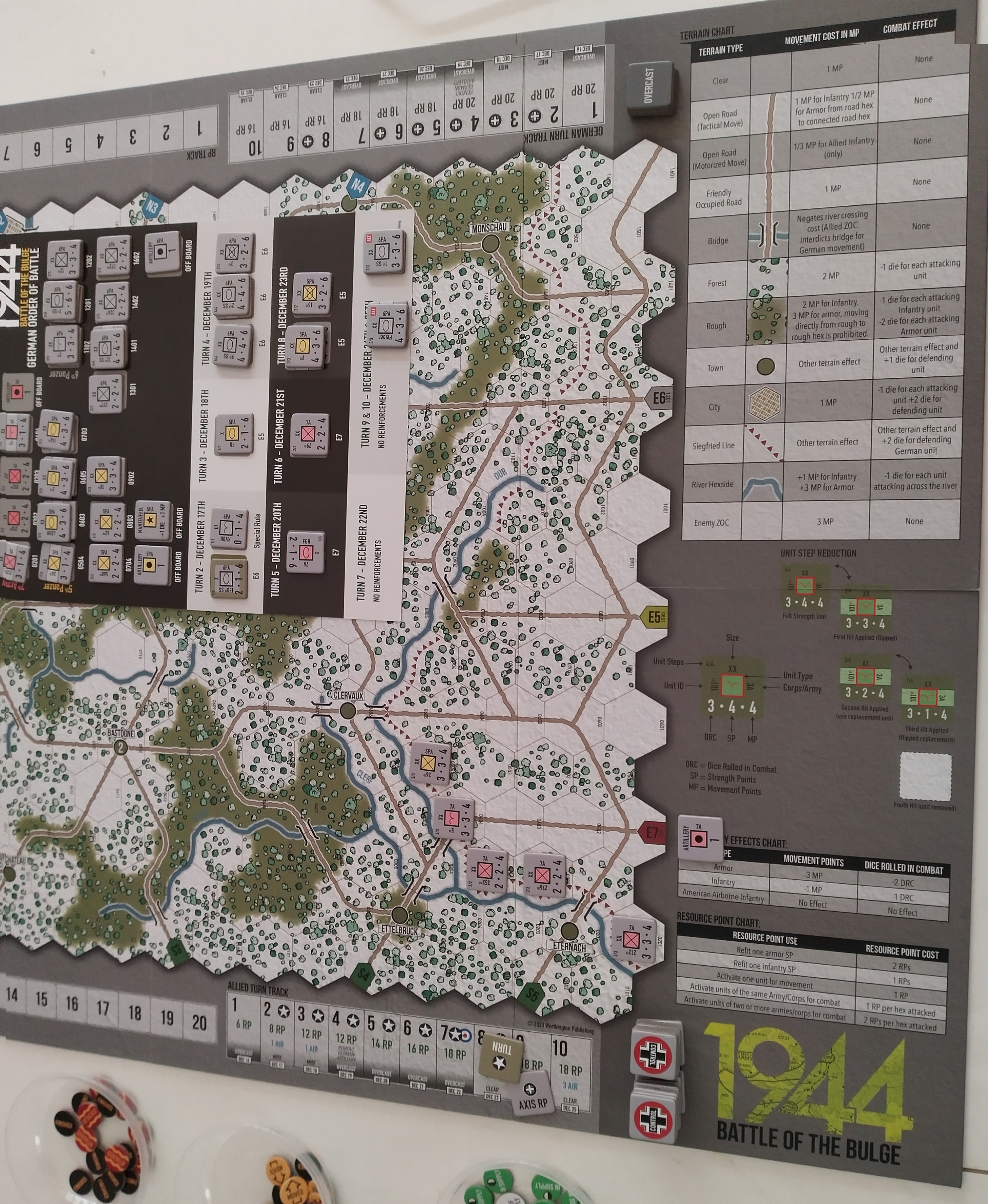
The first thing you notice when you set up 1944: Battle of the Bulge is the map. 22’ x 34” and mounted, it’s a slightly schematised rendering of the Ardennes region (compared to, say, the Avalon Hill Bulge map), concentrating on the road network that was so crucial to the action. Personally, I like the map; I think it is effective as a play-area, the terrain types are easy to differentiate from hex to hex (these will affect movement and combat, and they’re not always clear (no pun intended) in other games’ maps). The colour palette is toned down, but evocative and effective. Towns, bridges, and entry-points – all crucial features for game-play – are clearly defined.

While game has a low counter density, the action plays out in a fairly constricted space. The entire space is criss-crossed with a network of roads and trails connecting towns and cities, and it’s along these paths that the meat of the game takes place. But I’m getting ahead of myself.

The game doesn’t have any player aids (except for the two order of battle cards that I’ll come back to soon), but it doesn’t need them; everything you need to play the game – Turn and Resource Point tracks, a Terrain Effects Chart, and a handy step-loss guide for the multiple counter units – it all presented on the mounted map-board.

The counters are large, pre-rounded easy-punch tokens on good-quality, heavy cardstock, and with good registration. These are a joy to use, easy to read and to manipulate on the board, as are the much smaller circular status markers for recording which units have moved or fired, and which are in or out of supply. The package is completed with a handful of bright red custom dice, and one lonesome pipped d6 for rolling some effects. Everything about the game says sturdy and built to last.

December 16th (set-up at Turn 1), It all begins at the Siegfried Line.

Play

1944:BotB, like I think all Worthington games now, comes with a custom counter tray with gutters wide enough to accommodate the (not quite) 1" counters. This is a blessing and a curse. There is much more gutter space than is adequate for the counters that accompany the game. Because I have to store my games edge-ways, there is inevitably some shifting of counters within the gutters. I’ve put a lot of thought into this, but I still haven’t come across the best way to store the counters in the gutters without resorting to elastic bands to keep them in order. Here’s the reason why keeping the counters in order is a good thing.

Each side has an Order of Appearance card where you can set out all of the counters (with the multi-counter units in descending order), then place the starting counters as guided by the notes on the OoA card. Because of the movement of counters between plays, what should be a ten-or-so minute takes up the better part of half and hour. This is not a criticism of the game or the publisher – the fact that the Wylies provide a counter-tray at all is laudable and far exceeds what we expect from the industry. It’s one of those minor irritations that by no means reflects on the game play.

Allies Order of Battle (note the alternative split-division
7th and 10th Armor, bottom).

The rulebook comes to twelve pages, of which the first seven are core rules (the eighth is a full-page terrain Effects chart; this is replicated on the board). The next three pages are given over to Optional Rules (such as variable weather (historical weather conditions are given on the turn track) and German fuel shortages), and the Variable Objective cards. The final page-and-a-bit offers illustrated examples of movement combat and supply-tracing.

A lot of 1944:BotB will feel familiar to regular wargamers; movement is regulated by a hex-grid and modified by terrain types, units exert Zones of Control, damage taken by a unit is handled by step-loss, and drawing a line of supply for individual units is crucial for movement and combat, but only necessary when that bit it activated. One thing I haven’t seen all that often is the option to move to a target then attack, or to attack an adjacent unit, and then move. Markers are provided as mnemonic devices to keep track of which units have fought but have yet to move, or vice versa. This opens up whole vistas of tactical options to the unwary player.

German infantry, Para and armor divisions, including the notorious 150th SS
(using captured Shermans and American uniforms (edged green).

The box assures us that victory is attainable in two hours or less, and the game runs smoothly enough that this should be the case, but I’be bever played a game that didn’t come out closer to three hours because of the mixture of possibilities and constraints at play in eery turn of the game.

Anyone who’s played a Holdfast series game from Worthington will be familiar with the concept of Resource Points. Resource Points are the game’s currency, and like any currency, they are limited; the balance of RP changes over the course of the battle; at the beginning the Germans have the initiative, and they carry that momentum into the first three or four turns; their Resource Points amount to 20 for the first three turns, then begin to ebb from the fourth, at 18, while the Allies begin with just 6 RP and slowly build up from there. This proves t be an elegant way to impose the strictures the Germans were operating under, while reflecting the Allied command being caught off-guard and struggling to overcome their own inertia in the early days.

Resource Points can be spent in a number of ways. They can be used to bolster damaged units at a rate of one per step for Infantry and two per for mechanised. Activating a unit to move costs one RP. As does initiating combat, but here’s the interesting thing; attacking a single target with multiple units from the same formation (units from both sides have colour-coded affiliations for combat and tracing supply) will still only cost one RP.

Elements of the German Seventh Army tie up troublesome remnants of
the US Third army proving difficult to dislodge.

1944: Battle of the Bulge uses custom dice to resolve combat. In a fight, each side adds the fighting strength of the unit(s) involved, the attacker will add any additional support – a leader attending will add one die, artillery support will add another – and subtract any defensive bonuses the defender’s terrain offers. Both sides roll and the results are considered to be simultaneous (though even with the number of custom dice provided, sometimes you’re going to have to take tuns). Each custom die has four blank faces and two with symbols, one with an infantry cross, and the other with an oval representing armour. Each face rolled is a hit, and the owning player gets to distribute the hits he takes, but armour hits have to go on armoured units if they can. Armour on both sides took a hammering in the Ardennes, and this simple rule reflects that eloquently.

Variable Objective cards.

Another nice touch that extends the replayability of 1844:BotB is the inclusion of Variable Objective Cards. There are four of these, one representing the historical objective, while the other three offer “what-if” options for other strategic goals that were considered or at least floated in the planning rooms of the OKW. The German player can choose a card or pick one at random, and it will fall to the Allied player to decipher what the German’s ultimate goal is by where he prioritises his efforts. Lots of room for feints and big plays.

The roads are key to victory in 1944:BotB; you track your supply (and ensure your units’ combat effectiveness) by roads. Cross-country movement is possible – more so for infantry units and mechanised – but in a game lasting a mere ten tuns, the board can already seem very long when you’re trying to reach the other end without trudging through dense forest and snow. Moreover, a German victory is almost certainly going to rely on Victory Points from captured towns. It’s not impossible to gain a sudden-death win by exiting a full-strength German armoured unit off the map at a preordained point – I’ve seen it happen just once – but it’s nearly impossible, and requires a combination of spectacularly good rolls from the German player and abysmally poor ones from the Allies; not something you can rely on in a pinch. The more Control markers the German player can lay down during the game, the better their chances for a win.

The Moved and Attacked markers each feature a Finished backing: when
the second action is performed, you can flip the existing marker to note
the unit as done.

Appraisal

This blog is called A Fast Game is a Good Game because the current circumstances in my life dictate a need for games that offer a fulfilling experience in a few hours. Most of my play opportunities fall on a school night, so two-and-a-half to three hours is kind of my sweet-spot for a game (at this stage – retirement may change that some). Obviously I’m not the only one in this situation, because games like 1944:BotB are still getting published and remain popular.

In recent years Worthington Publishing has carved out a niche in the wargaming landscape, filling a desire for good quality games that play out in a limited time but that still deliver a satisfying play experience. I’ve said here before that I’ve never been disappointed by a Worthington game I’ve come across remarks on Facebook and elsewhere that Worthington games are too simple to be good wargames. I’m left wondering if the folks that make these kind of comments have ever played a Worthington wargame. I get that some people don’t like block games (like the Blue and Gray series, the Holdfast series, just about anything by Columbia), or they don’t like low counter density games, or they think a game can't be worth their while if it doesn't consume twenty or more hours of their lives. That's okay; wargaming is a broad church, and people can find succor where they may. I know what works for me.

The board features a Terrain Effects Chart, RP spend-costs and other useful tools.

1944:BtoB owes something to the Holdfast series of games. Its spiritual antecedent is Drop Zone: Sothern France (Worthington Publishing, ~2024), a game Fournie had in development with GMT for a while. About Operation: Rugby, the spearpoint of Operation: Dragoon – the second French landing on the Mediterranean coast in August of 1944. At this stage, it was intended to be a block game, reminiscent of Holdfast: Tunisia (Worthington Publishing,  and others. For reasons undivulged, it was taken off the P500 list, but not before Drop Zone had evolved from a block game to a multi-counter unit representation game. This allowed for some units to have five or even six steps, instead of the mere four a block would allow.

The DNA of Drop Zone is conspicuous in 1944:BotB, and in its – not quite sister, more cousin game, 1944: D-Day to the Rhine (Worthington Publishing, 2022). After hints of a release in 2021 and 2022 (to no avail). It seems that Worthington is firmer on getting Drop Zone to print – or at least to a Kickstarter campaign – in 2024. One can hope.

In the upset of the season, the 9th SS exits entry-point N2
 through Liege for a sudden death victory.

But back to the game at hand. 1944: Battle of the Bulge received a second printing, coinciding with the release of 1944: D-Day to the Rhine. It’s a popular game by small-press standards. I’ve tried to catalogue the reasons for that popularity here. To wit, it’s a solid, relatively fast-playing game (if you can minimise the analysis paralysis), that is enjoyable and leaves you thinking about what you could have done differently. It’s a that rewards repeated plays, and offers lessons in logistics, co-ordination of units and marshalling of forces that someone new to wargames can carry to other, deeper or more intricate games. In short, this one’s a keeper.


* If we were talking theatres, I’m sure the Eastern Front would edge out the Western Front for most frequently portrayed in a game, though I my collection I think they’d hit around the same number. That might be worth exploring sometime.


Monday, 4 December 2023

By the Numbers: Wargame Collection by Publisher


I’ve been delving into the stats of my game collection. I keep a spreadsheet of what games we have, which has come in useful lately; I’ve been selling off a bunch of family games that we’ve either never played or are unlikely to go back to. My wife comes from a gaming family, and she has her old favourites (like Win, Place & Show (Avalon Hill, 1977, but originally part of the 3M Sports Game series), seriously, the best horse-racing game ever made, and Rail Baron (Avalon Hill, 1977)), as well as a few we’ve discovered since we’ve been married (like Dominion (Rio Grande Games, 2008) and Alhambra: the Card Game (Queen Games, 1992), so there’s no point hanging on to stuff that isn’t going to get played. I suppose this is another aspect of my wanting to get more games generally – and wargames in particular – to the table.

I’ve been using the information in my game spreadsheet to keep track of may progress in working through my collection. I wrote about this in a previous post. Here I thought it would be interesting to look at the publisher breakdown of my current collection. Here’s an annoying pie-chart with a hard-to-make-out colour legend.


Again, this just covers the base games in the collection. It comes as no surprise to me that the largest chunk of games in my collection comes from GMT Games (44% of core titles). I’ll point out again that these are just the base games; adding the expansions for Commands and Colors: Ancients (2006), C&C: Napoleonics (2010), Combat Commander (2006), Tank Duel (2019), and Wing Leader (2015) would add another 28 titles to that count (I do have a completist tendency that sometimes gets the better of me; it’s one of the reasons I’ve never got into Warfighter (Dan Verssen Games. 2014). I tend to show brand loyalty when it comes to publishers. I was a huge fan of SPI back in the day – their games made up nearly all of my adolescent collection  and I was heartbroken when the company was absorbed (FitA) by TSR. When I started playing and buying wargames again, GMT seemed to be everywhere, and everyone I talked to recommended one or another of their games.

When I was less committed to wargames (spending more time and resources on RPGs), I bought a not inconsiderable number of GMT one-off games quite cheaply as package fillers when buying things from US sellers (damn, but I miss the days of dollar-dollar parity. I’ve got GMT games that I bought from game stores to make up the difference to get free shipping, like Halls of Montezuma (GMT, 2009) and Mike Nagel’s Sun of York (GMT, 2005) but never actually got to the table (though I expect to get to them eventually). This has artificially bloated GMT’s share of my collection.

That brand loyalty has extended to Worthington Publishing (previously Worthington Games) whose games make up over a quarter of the collection. I think I can confidently say I’ve never been disappointed by a Worthington game. A lot of them seem to be on the simpler end of the wargame complexity continuum, and I get why that might put some folks off, but if it's just snobbery, it's misplaced. In my experience, every Worthington game I’ve played, starting with Boots on the Ground (2010), has presented a rich narrative experience with a lot of decision points throughout the play. I’ve played a higher proportion of Worthington titles owned than any other publisher, 18 out of 26 games - nearly 70% - probably because they tend to be easy games to teach and learn. Of the eleven reviews I’ve posted on the blog thus far, five of them have been for Worthington games.

The title of fastest-growing publisher representation in my collection goes to Compass Games. Roughly two thirds of the fifteen games on my core list (plus the French expansion for Commands and Colors: Tricorne) I’ve bought in the last two years, and I've got a bead on a couple more. Compass’s production quality is, in my experience, excellent (and they’re very responsive when they screw something up, like sending out free errata counters out to every customer that bought a game directly from them, free of (extra) charge. I’ve liked all the games; my only complaint would be that sometimes the choices around the rulebook layout (mostly background colour or colour graduation, like in No Peace Without Spain (Compass Games, 2011) make the rules a little difficult to read (Barbarians at the Gate (Compass, 2023) falls into this category as well). Well, I find them harder to read. But I’m old and should remember to use my reading glasses more often. Compass is one of the most prolific publishers in the wargaming space, and they make a lot of winners. Expect to see some Compass game reviews over the coming months.

Something worth pointing out is a full 17% of my collection is made up of games from European publishers (okay, I’m including Osprey and PSC in this number, but everything else in my collection is from North American publishers). For a long time. Wargaming publishing was the domain of a handful of prolific publishers (Avalon Hill, SPI) and a couple of smaller operations, like The Chaosium (and Warhammer, across the pond). In the last twelve or fifteen years we’ve been seeing a lot more really good games coming out of Continental Europe. That is to say, there have been European designers creating fun, thoughtful and innovative wargames and European publishers printing them for a lot longer than that, but they’re now making their way outside of Europe, and with rules translated into English. It might be an artefact of the rise in popularity of Eurogames like Settlers of Catan (KOSMOS, 2008) in the English-speaking world. Frankly, I could care less. If it means I easier for me to access games like Verdun, 1916: Steel Inferno (Fellowship of Simulation), Great War Commander (Hexasim, 2018), and Chase of the Bismarck (Vuca Simulations, 2023), then let a thousand Euros bloom, let the children play Power Grid (2F-Spiele, 2004).

The rest of my collection is a scattered mix, though Legion Wargames is nearly into double digits. Some games I’ve bought because the subject interested me, or I wanted to see how the designer approached a particular situation. Some were recommended by people whose judgement I respect.

And some acquisitions were the result of a confluence of factors. I read recently an interview with John Poniske (if I ever do a post of designers represented in my collection, he’ll be up near the top), and he mentioned his favourite of his own designs was Lincoln’s War (Multi-Man Publishing, 2013), because he felt it achieved what he set out to do with it. About the same time, I was ordering some games from Noble Knight Games for shipping to a friend visiting the states. I needed to make up another $10.00 to qualify for free shipping (the shipping would have cost a tenner, but it’s the principle), and NKG had a second-hand copy of Lincoln’s War for $10.45. Like it was meant to be. When it arrived, not only was it unpunched, but it included a complete set of pieces crafted at about 160% larger size on craft board. I suspect the previous owner was a play-tester for the game, for John had written a really nice thank-you message inside the box cover.

A couple of the titles represented here are miniatures or miniature-adjacent games. While I really enjoy playing miniatures games, I’m not a big minis guy, I possess no real talent for painting, nor do I have the time, patience or space to acquire that particular hobby. B, our Wednesday-night host, lives in a house with a whole second floor dedicated to gaming, and much of that space is taken up with immaculately painted lead and resin figures; I live in an inner-city apartment, and I’m looking at having to introduce a one-in/one-out policy for boxed games. I’ll save talking about those games for another post.


Stripped Down for Parts: Cuius Regio: The Thirty Years War, 1618-1648

  I was really in two minds about writing up an unboxing of Cuius Regio: the Thirty Years War, 1618-1648 (GMT Games. 2026), not because I d...