Showing posts with label Commands and Colors: Napoleonics. Show all posts

Thursday, 13 November 2025

State of Play: Commands & Colors: Napoleonics – Talavera (French attack on British) - 28 July 1809


After an enforced break of a month, T and I caught up on Tuesday for our (ir)regular Monday Game. Meeting at his place, T set up an old favourite (no doubt with images of Sharpe’s Eagle running through his head); the Talavera scenario from the Commands & Colors: Napoleonics (GMT Games, 2010) core set. He must have been feeling nostalgic, using the original blue-reverse card-deck that came with the core game.

Playing the Talavera scenario is like catching up with an old friend. Conservatively, I’d guess we’ve played it at least eight or nine times over the years, probably closer to fourteen or fifteen. For the first several years we would play each scenario twice, swapping sides the following week, and we must have played the core set through at least four or five times over the years, and in recent years it’s been a go-to game for a palette cleanser.

T set up the game, and mistakenly gave the British Rifle Light an extra block
(bringing their starting strength to four). This was corrected before the
first card play (but not before I’d taken some photos.

T – playing the French – opened with some chess movement, just getting some units off the back line. The French need to advance to engage. There’s no reward for the British to come down off the long range of high ground with its incumbent melee bonus in defence; better to let the French come into range. I adjusted units on my thin flanks to offer better firing options on my Right and to get the cavalry forward on the Left, to give it a few more options.

End of turn two: action without resolve.

Attack the French did, securing a Victory Banner in turn three and two more in the fourth turn. This along with some thinning of my infantry though accurate canon-fire; even at extended range, nearly every shot cost the British a block. With turn four, the French infantry began to reach the range of the British muskets. At the end of turn two I managed a to hit a couple of T’s infantry for a Line block and two Light infantry, but I wouldn’t seize my first French Banner until turn five. I was beginning to despair of my chances. T was due for a win, and C&C Napoleonics is in his wheelhouse.

As it turned out, T gained his full measure of success in those early rounds. Due to the initial set-up, the British are strongest in the Center (albeit with a solid anchor on their Right with a pummelling Light Regiment, and Rifle Light and Foot Artillery for extended range fire). Consecutive Assault Center orders in the fourth and fifth turns withered the first French press and earned me my first Victory Banner.

Scores even - around turn six.

T's dice luck was spent on securing his second and third banners, rolling enough hits to take out a full Line infantry unit and a Light Cavalry squadron in single rolls (this was the source of my despair. After this, his attacks were nibbling, taking blocks but never whole units. For my part, I had to make two or three attacks on every unit I eventually broke; the French fought valiantly, giving nearly as well as they received.

The final disposition of the forces. Remarkably, no Leaders were harmed in the making
of this battle (though not for want of trying).

In the end, the match ran to ten full turns, with the British securing their seventh and last Victory point in the final action of a hard-fought final round. T took the loss stoically, but it was plain to me and the attendant cats that he felt robbed after such a strong opening. I think outside influences that have interrupted out schedule lately are beginning to settle, so he’ll have another opportunity to hand me my hat next week, all things being equal.


British Orders over ten consecutive rounds. I hoped to show the French orders as well,
but T had already shuffled them back into the deck in disgust.


Tuesday, 17 June 2025

Not Created Equal: a Block Wargame Primer, Part 1 – Commands & Colors


Note: this was originally going to be a single post about various types of block wargames. But as sometimes happens, the further down the rabbit-hole I went, the more I found I had to add. Rather than try to trim it down excessively, I’m going to write this as a short series.

I know Commands & Colors is an odd place to start, but of all the block wargames available, it’s the one I have the most familiarity with, so it seemed like a good launchpad.

I don’t have a schedule for this series, but I anticipate maybe one post a month or so  until I run out of things to talk about.

C&C: Napoleonics - EPIC Napoleonics: Austerlitz


This post – or post-series – was prompted by a comment on Facebook. When I posted my first Ten Game Challenge AAR on the Tac-UP group, Napoléon 1807 (Shakos, 2020), a fellow group member commented that the game looked interesting and mentioned that they had never played a block game. This got me to thinking about block games and their place in the hobby.

The term “Block wargame” seems to conjure different pictures for different people; everyone can agree that Columbia’s Julius Caesar (Columbia Games, 2010) and Hammer of the Scots (Columbia Games, 2002) are definitely block games, but can the same be said for Churchill (GMT Games, 2015). Are games from the Commands & Colors family block games? Wooden blocks make up nearly all the moving parts of the game, but they don’t function like the blocks in a traditional block game, like Julius Caesar. And then there’s Atlantic Chase (GMT Games, 2021).


Setting the parameters

For the sake of this rabbit-hole-dive, I’m going to cast the net particularly wide, taking in pretty much anything that uses wooden blocks within the game’s parameters. From the get-go, I should also define what I mean by blocks. I’ll be specifically looking at games that use wooden pieces to convey meaning beyond the merely being a marker for a presence (like the Control discs in WWII Commander: Battle of the Bulge (Compass Games, 2020), or numerical superiority (as in COIN games, or Academy Game’s Birth of America series). This isn’t a criticism or dismissal of these games – it’s just not what I’m interested in here. The wooden components in these instances could easily be replaced with punchboard counters or another kind of marker (like the little resin cubes in Pandemic (Z-Man Games, 2008)) without the game suffering any playability issues.

To try to head off some of the arguments at the pass, I’m going to apply a broad but simple definition of what I’ll go into here. For the sake of this discussion, a block game is a game that uses wooden components (regardless of precise shape) that present information further to their placement on the board. All the games for consideration will feature individual blocks as units or several blocks comprising units. The blocks tend to be of a uniform size, but not always. It is rather broad in scope, but I wanted the opportunity to talk about block games in their configurations and contrivances.

At this point, it may be useful to address what I won’t be considering in this post. I decided to disregard COIN Cames at the outset. This is not an indictment of COIN games – I’m not very good at them but I nonetheless enjoy playing them and even own a couple – but the information conveyed by the blocks in a COIN-system game is solely numerical and locational. After some deliberation, I decided to leave out Levy and Campaign games as well; There is more information conveyed by the colour and shape of the pieces, but it comes down to tiered numerical values.

I’m by no means an expert on the subject either. I‘ve played probably a couple-dozen block wargames of different stripes, but there are a lot I haven’t played, and still others I probably haven’t heard of (suggestions for future exploration welcome). This series isn’t meant to be an exhaustive survey of block wargames, or a cook’s tour of block games I have known. What I hope to present is a broad brushstroke look at what different styles of block game are trying to do and how they go about it, and maybe some thoughts abo what they’ve brought to the hobby and how they’ve influenced hex-and-counter games and vice-versa. I don’t expect anything earth-shattering to come out of this, but maybe a post will nudge a reader toward a type of game they haven’t tried before. As ever, comments, criticisms and recommendations are welcome.


C&C : Ancients: Marathon, BC490 - not going so welll for the Greeks.

Commands & Colors - basic blocks

Anyone who’s been keeping up with A Fast Game knows that I’ve played a LOT of Commands & Colors in a number of flavours. When I started thinking about this as a post subject series was in two minds about including C&C, but it does fill the requirements of the earlier stated definition, and it seemed like a good – if chronologically unsound – place to start.

My first experience with Commands & Colors was an introductory game of Commands & Colors: Ancients (GMT Games, 2006), with two guys from my long-standing Wednesday group. I wasn’t aware of the game’s lineage, sharing the DNA of Battle Cry (Avalon Hill, 1999) and Memoir ’44 (Days of Wonder, 2004), but my initial reaction to seeing the battle (Cannae - 216BC) set up was “This is a minis game without the minis. That’s so cool!”

Commands & Colors is something of an aberration in the world of block games. Where most block games use the block mechanism to ensure certain information is hidden from the opponent, such as the current strength or even the type of unit, the units in Commands & Colors games proclaim much of their information for all to see. The blocks themselves have matching stickers, front and back, and the number of blocks conveys how many steps the unit has left (how much more of a battering it can take before losing cohesion). And if they didn’t declare themselves, you could at least make some educated guesses at to what you faced by the size and shape of the block.

The multiple blocks making up a unit act as hit points for the unit. When a unit takes a hit that it can’t otherwise soak, it loses a block. This is another point of separation from the traditional Columbia-style block game, which uses the individual unit to keep track of losses but tries to keep that information from the opponents. This, of course, doesn’t mean a for block unit loses a quarter of its functional strength as a fighting formation with each hit – Commands & Colors: Napoleonics (GMT Games, 2010) is the outlier here – but the loss represents a combination of reduction of troops, cohesion and morale, with the final loss representing the unit’s breakdown of cohesion and cessation of effectiveness as a fighting force.

C&C Tricorne: The American Revolution,

So, what’s the game trying to do? The whole idea of blocks for manoeuvre units, back with the very first block wargame, Quebec 1759 (Columbia Games, 1972) was to replicate the lack of adequate intelligence on both sides regarding opposing strengths during the French and Indian War. In Quebec, movement was also simultaneous. This was accomplished through the necessity of writing orders for your troops, while trying to second-guess your opponent’s plans. This creates a sense of what is referred to as “fog of war”, the creating a facsimile of the limited intelligence all tactical commanders have had to deal with since the dawn of battle.

Commands & Colors accomplishes something similar through the use of Command Cards. Rather than try to hide each player’s units or intentions from their opponent, the game system limits the ability to act on this intelligence by limiting what actions you can take in a given turn. You can see the enemy readying to strike on your thinly defended Left flank, but you can’t respond unless you happen to have a card in your hand that allows you to order your units in that section. While it’s not perfect, the mechanism offers a fair simulacrum of the confusion of battle, with orders being misunderstood, if received at all, and in the era of Commands & Colors: Napoleonics and Commands and Colors Tricorne: The AmericanRevolution (Compass Games, 2017), or for that matter, Battle Cry), the very real fog of spent gunpowder, obscuring friend and foe alike.

This is a vector for criticism of the C&C system, with folks complaining of never being able to do what they want to do at any given time. Well, welcome to life during wartime. This artificial limitation of options is much closer to the realities of warfare than many hex-and-counter wargames can reflect. It’s all well and good to prefer games that let you move all your pieces each turn without such hinderance, but don’t tell me it’s more realistic.


No minis

For me, a big strength of the C&C system that it allows a miniatures-style experience, but with movement regulation (via a hex-grid) and without actual miniatures. The truth is, if all the Commands & Colors system games had come out with minis representing the units, I probably would never have bought into the system so thoroughly. I know Memoir ’44, Battle Cry, and the fantasy-flavoured BattleLore (Days of Wonder, 2006) all have their fans, but it’s not for me. I don’t need plastic laying pieces to transport my imagination, and the lack of scale adhesion between units and such in Memoir ’44 is like fingernails on a blackboard for me; I really find it hard to look at (this is why I was never interested in Axis and Allies or Tide of Iron either)

GMT's C&C: Samurai Battles. No brittle figures to real with.


As I’ve said previously., I enjoy miniatures games. Our Wednesday game night host has an impressive collection of them, and we’ve played out situations from 4th century Britain to 1980s Africa on his big table, but I personally don’t possess the talent or the patience (or the money, or the storage space, or frankly, the desire) to pursue the miniatures hobby myself. I came very close at one stage to buying Russian model and plastic figure company Zvezda’s Samurai Battles (Zvezda, 2012), which used Zvezda’s excellent 20mm (1:72 scale) feudal Japanese warriors instead of blocks, but ultimately decided against it. Imagine my delight when GMT re-released the game in a block version as Commands & Colors: Samurai Battles (GMT Games, 2021). It turns out the high-impact plastic Zvezda minis (the same quality plastic used for model planes or ships) are prone to breakages and very difficult to store, so I dodged a bullet there.


The Romance of Loss

Which brings me to another joy of block games generally. The pieces offer a tactile experience in moving – and in removal – that cardboard counters can’t replicate. This sense of weight and of loss is increased in a Commands & Colors game by the removal of blocks with each successful hit. It makes the audacious attack or dogged defence conducted by a reduced unit that much more valiant; it creates a mini-narrative withing the unfolding story of the whole battle.

C&C: Medieval. This battle was from the Crusades expansion.

I worked professionally with wood for some time – my father was a carpenter and my brother a cabinet maker, and I spent about two years as a machinist – so maybe I feel an affinity with wood. To me it feels like a natural fit for games. My earliest childhood games, draughts and dominoes, were made from wood. And in wargames especially, you can’t get away from it. Cardboard and paper are just radically transformed products made from wood. Coloured blocks with stickers applied aren’t comparable to ornate, hand-carved chess pieces, but to me they still bring a gravity and sense of connection beyond their basic function. This is probably, at least in part, what prompted me to pursue this series.

In the next part, I’ll go back to the beginning, starting with Columbia Games and the revolution the company began with Quebec 1759. There’s a long road ahead – I keep stumbling across other games where the designer has chosen three dimensional blocks instead of two-dimensional tiles to achieve some or other effect. And at least one case of the reverse, but that will be for another post.


Sunday, 1 June 2025

The humblebrag: first post to hit 500 views


No new content today, but I just wanted to pop a post up to mention that my Commands & Colors: Napoleonics (GMT Games, 2010) review just hit 500 views! This is the first of my posts to make 500 (a couple have got around 300-350, nearly all reviews with a couple of unboxings thrown in – but no surprise there). A lot of folks visit the A Fast Game and just read whatever is current, working through from the most recent post and work down until they get through the new stuff. 

I took me a while to work out, but the analytics only count direct link views; in the case of my C&C Napoleonics review only views accessed via the direct link, https://fastgame-goodgame.blogspot.com/2024/07/this-is-review-i-never-intended-to-write.html. It also took me a while to realise that if you’re preparing a post and you save a draft without including a title, the link generated will pick up the first few words of the text instead.

Full disclosure: the review did get a leg-up after a link appeared in GMT’s monthly newsletter. Rachel Billingsley who, among her other responsibilities at GMT, puts together the Content Creator section of the newsletter (well toward the bottom of the page), has been kind enough to include GMT-related posts from A Fast Game, which usually pushes the numbers up. When that newsletter came out overnight, the review has been up for a week, and the twelve or so views I’d received was suddenly around 280.

Ultimately, this doesn’t mean much – a lot more people have probably read the review who didn’t end up visiting by the link – but my brain responds to numerical stimulus, and a pair of zeros at the end of a number will flick a switch in my brain. So, this post is the endorphins talking. 

Around the same time my C&C Napoleonics review hit 500 views, A Fast Game passed the 30,000 unique lifetime views. to put that in context, in my second anniversary post from January, I mentioned hitting 20,000 visits just before Christmas. I don't think I mentioned that I'd be very happy if I'd made 30,000 by my 2026 anniversary post, but I was thinking just that. Instead, A Fast Game reached that in about for months. So I'll keep doing what I'm doing - sporadically lately, but that should improve with my recuperating health.


Monday, 10 March 2025

State of Play: Commands & Colors: Napoleonics – Vimiero, 21 August 1808


The plan was this week to tackle my second Ten Game Challenge game (specifically We Are Coming, Ninevah (Nuts! Publishing, 2023) for my Monday night game with T, but a couple of things happened;  I read through the rules when I first received the game, but I hadn’t gone back to it since, and I’ve been unwell for a couple of weeks now, nothing too serious, but less able to concentrate on digesting the rules every time I picked them up for a refresh, and sickness delayed the game ‘til Thursday.

At the same time, a Facebook friend and content creator commented on another FB friend’s post about a Commands and Colors: Napoleonics (GMT Games, 2010) game; he was interested in the game, he said, but he balked at the overall cost of the seven (soon to be eight) boxes that make up the set, and asked how much gaming goodness he would get out of owning just the base set. I offered my rote answer, but I was still thinking about this when I decided to set up a C&C: Napoleonics game for my Monday night game with T. So, this one’s for you, Cardboard Commander (and everyone should check out CC's channel - he's doing some good work over there).

The Vimiero set-up map.

Vimiero is the third scenario in the C&C: Napoleonics base game, and a battle from the early days of the British military intervention on the Iberian Peninsula, under the temporary command of an already celebrated Lieutenant-General Arthur Wellesley. The first scenario, Rolica (First French position), is the ideal teaching scenario because of the low unit count, representation of all the basic unit types (Line and Light Infantry, Cavalry and Artillery), and a forgivingly short five Victory Banner target. It also encourages the French to try to concentrate on the Allied right, underpinned by the weaker Portuguese troops, and roll up the British line, disrupting their plans. When I’m introducing a new player to C&C: Napoleonics, I always start with this one.

Vimiero is more of a free-for-all. The two town-hexes of Vimiero are worth to Victory Banners for the French player who can take and hold them, but this is a big ask, and they’ll probably earn their sixth banner just clearing the Allied forces attempting to reach the town. The action is somewhat channelled by the Macciro River on the French Left and the patches of rough (impassable) terrain on the French right and Allied Left, inhibiting manoeuvre options. The scenario usually descends into a slugfest, with the winner being the player who can best manage their inevitably difficult hands. This isn’t a criticism; it can be its own kind of fun and makes for a close game and a very gratifying win.

The battle awaits (while the French commander checks his messages). 

T played the French and I took the Anglo-Portuguese Alliance forces. If we have a matching number of cards, I’ll deal off two hands and let T choose his, but in this case, the French begin with a five-card hand (and move first), where the Allies have a slight advantage with six cards. This advantage didn’t help me initially, as I began the game wanting to bring my Reserves off the rear-line the Center but had no Center manoeuvre cards for the first couple of turns.

One of the criticisms of the Commands & Colors series generally is that due to the random distribution of order cards and the limits of hand-size, the player doesn’t have the facility to do whatever they want to do to maximise the effectiveness of their forces. I’ve expressed a few opinions on this take a few different times here, so I’ll just say I think people who think this are missing the point. Constraint of options in a given turn forces you to consider other options. Commands and Colors is a tactical system portraying a dynamic situation, and the use of cards to limit availability of orders is an enforced fog-of-war mechanism. The hand of cards mimics a situation of limited intelligence – it prevents you from responding to everything your opponent does, some of the time.

Ferguson holds Ventosa (Allied Left). I feel a banner coming on.

Being an old hand at C&C: Napoleonics, I didn’t waste time bemoaning what I couldn’t do, but looked at what I could do. So, I started to bring my units up on my Left flank to better position them. One of the toughest things to do in Commands & Colors of any stripe – for me at least – is to exhibit the discipline to get my troops up off the baseline. The rear-most units are often the most versatile, or the hardest-hitting in battle, but if you’re just responding to the action at the front, these units tend to languish. T’s single Grenadier unit never received a single order to advance through the entire game. It’s often a little easier to bring Cavalry forward from the Reserve given their greater movement allowance, provided there’s a gap in the lines for them to pass through.

The action started on the French Right (Allied Left). Three of T’s first four orders were across the whole front; a Forward (two units in each sector), followed by a Probe (two units) Right Flank, then a Coordinated Advance (two ordered Center, one each flank, and a Recon in Force (one unit activated each sector), I could only respond with an Attack left flank (three units activated) on my second round to meet the onslaught, along with An Attack Right Flank for my first move, then Assault Right Flank (activations up to hand size – a bit of a waste as I only had five units in the sector), and a Probe Center (two units ordered) for my fourth play, nudging some infantry forward, including the famous 95th Rifle Regiment (popularised by the Sharpe novels and movies). I’m always wary bringing these chaps out; in the seven or eight times I’ve played the Allies in Vimiero, I’ve only managed to score a hit maybe twice before the three-bock unit was wiped out. At the end of four rounds, the French sat on two banners, while the Allies had yet to score.

Some low-hanging fruit for the right attack.

T's next gambit was Fire and Hold; any unit capable of ranged fire (Infantry and Artillery) cold be ordered, and each would gain an extra die to their roll. Unlike other Commands & Colors games, strength is adjusted down with loss of blocks in Napoleonics. T’s two cannon units were at full strength but also at full reach (maximum range of four hexes from a target), so they each only rolled two dice, while two of the three infantry units in were reduced to one and two blocks respectively. They nibbled at my Line troops (two hits between them and the cannon) while his full-strength Line (attached to St Clair. On the French Left) managed only to push my cannon off the ridgeline before the town of Vimiero.  

The game see-sawed through the action, which always makes for a more intense experience. Toby took his first banner early in the game. He had scored three banners before I won my first two (off a Recon in Force order), which is always encouraging. The six-banner Victory target comes up quickly after the first units begin to fall. T made a big push (Assault Center, but the action was all focused on the Vimiero front to the French Left), and at just two banners short of victory might have won him the game had it come off, but a combination of poor rolls and a solid defence on my part, managing to push back his advancing troops in the Center.

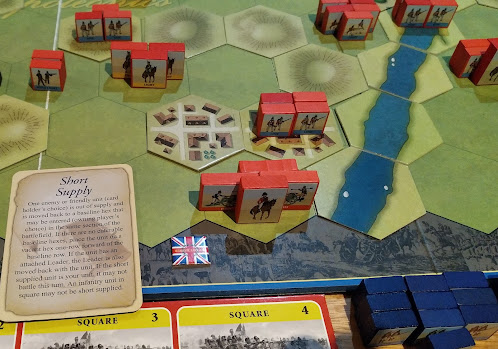
At round ten, T played an order that, if the game had gone much longer than it did, may have opened up Vimiero for the taking. He played Short Supply on my Foot Artillery battery set up on the ridgeline on the Center/Right sector border. This was a perfect position for Artillery, as it allows the unit to be ordered on a Center or Right sector manoeuvre order, and up to then I have been able to use the cannon to good effect. Short Supply pushes a unit of the player’s choice back to the opponent’s baseline (though the opponent gets to choose the position it ends up at). The best I could do in response was a Recon In Force order to bring some fresh units forward, including the aggrieved Foot Artillery.

Shorted.

By the last round, the scores were 5-4 in my favour. In the past we have both won games by gaining two or even three banners on the final round, so it was still anyone’s game.

Throughout the game, we’d been chipping away at each other’s forces. Knocking a block or two of several Line units especially. When the right card comes along, it can bring a swift conclusion, but it’s not a guarantee. T’s last play was a Forward order (two units in each sector), which lead to four opportunities for ranged fire (not the French side’s strong suit), and some losses on my part but nothing critical. I retorted with an Assault Center order, which cost T his loitering, depleted Heavy Cavalry, and the game. We have a house rule that if the last turn has multiple combats, we play them all out, and if the final losses are even, we declare a minor victory for the triumphant side. That wasn’t the case here, but I think it helps keep a more sportsmanlike view of the game.

In the end, the whole battle took fourteen rounds to reach a conclusion. The game played out in a little over an hour (plus about twenty minutes to set up, and another ten to tear down afterwards), which makes the game perfect for a weeknight. The final result was a 6-4 win for the Allies.

Six banners. 'A close-run thing."

As with nearly every time we’ve played this scenario, the town of Vimiero was never really in danger. The fighting was brutal, and T’s tactics were on the mark. In the end it came down to a couple of lucky rolls on my part; before the last turn it was still anyone’s game. And if it had played to another round the results may have been different, with a closer result a neat certainty. It’s these knife-edge that keep Commands & Colors: Napoleonics fresh and challenging.

Going back to the inspiration for the play, it should be pointed out that GMT is once again out of stock of the core C&C: Napoleonics box, but it is possible to find copies in the stores. It's my understanding that for future releases, the base set will be combined with the into a Peninsula Box, with other national expansions also being combined into dual or larger releases in an effort to reduce the overall costs. Whichever way you tackle it, after going on fifteen years of regular play (and one replacement board), Commands & Colors: Napoleonics is, for my money, definitely worth the price of admission.


Tuesday, 9 July 2024

Review: Commands and Colors: Napoleonics


This is the review I never intended to write. I feel a particular fondness for Commands and Colors: Napoleonics (GMT Games, 2010) for several reasons. While it’s not the first of Richard Borg’s Commands and Colors series I ever played – that appellation goes to Commands and Colors: Ancients (GMT Games, 2006) – it is the one game in the family with which I’m most familiar. It was, I think, the first game I bought within a month or two of its release (thank you, Noble Knight Games).

My wife was in hospital for about three-and-a-half months in 2010; in that time Jess’s eldest sister and her husband would have me around on a weekly basis to make sure I was getting at least one home-cooked meal a week, and one night I brought the game along and taught my brother-in-law how to play. The following week we played it again, and the one after that. After a couple of months, T wanted his own set, which saved me from dragging it over each week. That weekly Napoleonics game helped keep me sane while Jess was healing and convalescing. After she came home, we kept up with our weekly game, most weeks at least, and we’ve been doing it since. But in those first few months, this game helped keep body and soul together.

For the first nine or so years, we played C&C: Napoleonics almost exclusively (toward the end of year six we had to get a replacement board from GMT – the fold-hinges start to give out sometime north of 300 games – and about a year later, a new set of stickers because some of the faces had worn off the original dice set). We’d play the scenarios in order from the book twice over consecutive weeks, taking turns as the French. Not long after we’d finished the last scenario and begun replaying them from the beginning, the Spanish Army expansion (GMT Games, 2011) was released, offering a new army to get to know, and a suite of new scenarios to try out.

And this happened for another three nation expansions, roughly a year apart from memory. Each time we were reaching the end of a new army box, another would be released, with a completely new set of scenarios to try, and a new army with its own strengths and foibles to get to know.

While I was writing this review, we played the Quatre-Bras scenario from the core
set at T's house. Note the under-strength Guard Grenadier units on the British Right
flank. In our shared parlance, this is called "doing a Peter," an instance where
one makes a (probably) innocent but personally beneficial mistake.

We played C&C: Napoleonics without interruption for the better part of nine years before I could convince T to try some other different games. These days we play a lot of other games, including many of the other flavours of Commands and Colors, but we still play C&C: Napoleonics probably half a dozen times in a year. We keep coming back to it. I did some calculations a couple of years ago and estimated – conservatively – that We must have played somewhere well north of 450 games together, just of C&C: Napoleonics. We’ve played through all the scenarios in the four Army expansions at least twice, all but two, I think, of the scenarios in Expansion 5: Generals, Marshals and Tacticians (GMT Games, 2015), and about two-thirds of those in Expansion 6: EPIC Napoleonics (GMT Games, 2016). Which brings me to my hereto reluctance to review the game.

After this duration and with my level of familiarity with C&C: Napoleonics, I’ve always felt too close to it to be objective. I wasn’t sure I could trust myself to examine the game through a critical lens, or to not gloss over its shortcomings. What motivated me to write this review was the number of times I’ve heard complaints or condemnations of the game that really just boil down to personal preference or a dislike for a particular mechanic (and if it’s on a forum, Dunning-Kruger sets in if somebody calls them on their grievance not being a legitimate fault with the game, but I digress).

This was my opening hand for the aforementioned Quarte Bras game. A pretty solid
start. Alas, this tends to be the exception rather than the rule, but that, as a player,
is what keeps you on your toes.


Appearance

I’ll start out like I’m talking to someone who has never played a C&C game before, so bear with me. When you open your new box, you are confronted with a huge bag of wooden blocks painted red, navy blue and mission brown, of varying sizes. These are blank. If you’ve read the back of the box, you know about the sticker sheets – each block needs a matching sticker applied to both sides, in matching orientation, before you can start playing the game. Even if you did read the back, the sheer number of these blocks is daunting. You may have grumbled to yourself before about having 400 counters to punch and sort, but this is next level prep, and not for the faint of heart. You’ll find out for yourself just how tricky it can be to get those stickers to apply square to the block-face, without any overhang.

Opening rounds. The majority of cards are discrete section or combination
activation cards like these. The special activation cards usually offer
something a little extra, like +1 die to combat roles (Cavalry Charge,
Fire and Hold), or an additional movement space for that turn
(Bayonet Attack).

(Pro-tip: I use a cheap little Kiwi-Brand knife from the local Vietnamese grocers to gently lift the corner of a sticker that’s gone on crooked, or hanging over an edge, then re-apply it more carefully. Be careful not to cut the sticker itself, as these knives are thin-bladed and pretty sharp out of the box. If it’s done immediately, even if it takes a couple of attempts to get right, you shouldn’t have any problems with the sticker re-adhering. Finger-and-thumb pressure is enough to too get a good bond, but apply some pressure to all the edges to make sure they’re stuck down all round You’re welcome.)

There are two booklets in the box, as well as two Player Aid Cards (PACs) and a couple of Terrain Effects Charts (TECs). The PACSs and TECs are printed on a nice weight cardstock and wear well. You’ll be using both quite a bit for your first few games, at least (I think it took us about four or five games when we began playing before we only needed to check these for things that hadn’t come up yet in the game, but I still go back to them sometimes for the really obscure things, like sand pits). The first booklet is the Rulebook. The C&C Napoleonics rules are clear and well laid out, probably because there’s a legacy of nearly half a dozen other games using essentially the same system to build on. In fact, if you’ve played Memoir ’44 (Days of Wonder, 2004), Battle Cry (Avalon Hill. 1999), or C&C: Ancients, the movement and combat rules and the card-driven actions will seem very familiar. The other booklet contains the scenarios, of which there are fifteen in all.*

The board is a plain, grass-green hex-grid, and the hexes are probably larger than any you’ve seen before. The green makes a welcome change from the limestone-coloured board from C&C: Ancients, but this is your first game, so you probably don’t know that yet. The board is divided into three roughly equal sections by two dashed lines. The divisions are called the Left and Right Flanks and the Center. This distinction of areas will come into play with some of the Command Cards used in the game, which may order units from a particular section. You’ll notice the dashed lines bisect some of the hexes; for the sake of section orders, these hexes can count as either a Center hex or a Flank hex (this will  make more sense when we get to talking more in depth about the Command Cards).

There are several sheets of cardstock, but only a few flag counters on some of them (the Victory Banners for tracking your success in the field), as well as eight Square markers yellow with blue or red borders (we’ll come back to these later as well). The rest are hexagons with hills, forest groves, river segments and towns. These are terrain tiles; these go on the otherwise featureless map to transform it into an approximation of the historical battlefield on which the represented battle was fought. The scenarios each feature a set-up map which tells you where to place the terrain tiles, as well as the placement of the French and Anglo-Allied units.

The French Right make their move. The French are always blue, the British Red. The
Brown blocks normally represent the Portuguese, Britain's ally in the Peninsula, where
most of the scenarios in this set are set. Here the brown blocks represent Coalition
troops from Nassau, Hanover, and the newly independent United Netherlands. 

Play in C&C: Napoleonics is driven by a 70-card Command Card deck**. Players take turns playing a cad from their hand to order their troops to move and/or attack their opponent’s forces. There are two narrow boards, each with four card- and four counter sized silhouettes. These are unique to C&C Napoleonics, and we’ll look at them more closely when we consider how the game is intended to be played.

In the bottom of the box are the six label (sticker) sheets. Not only do all the blocks need to be stickered-up before you can play a game, but in my day, the eight dice that came with the game had recessed faces which each had to have an adhesive label applied to them as well. In the most recent printing, these have been replaced with complete dice with etched and coloured faces. I hear they’re nice.

Play

Once you’ve labelled two entire armies** (and eight dice), punched the terrain tiles, Victory Banners, and Square counters, and availed yourself of the rules, you’ll be ready to embark on your first game. The first couple of scenarios are a good entry to the system, introducing the most common unit types and offering the chance to see how the terrain elements work (hills, woods, a fordable river, and impassable terrain), as well as the concept of map locations that offer victory points to one or both sides.

To someone coming to Commands and Colors from a regular hex-and-counter wargame background, some things might seem to be handled differently. The first thing is the blocks. These represent full-strength units at their capacity (usually four blocks, but there are exceptions, e.g., British Light units have five blocks at full strength (this is something I’ll circle back to later), while the Portuguese Light units only have three blocks, as do all of the Anglo-Allied cavalry). Something else you’ll notice about the blocks, is they present a representative picture – say a soldier or cavalryman – and the name of the type of unit represented, but no values: no Movement Allowance, no Strength Points, no Defensive value. What gives?

All the information regarding the different unit types for each side are listed on the inside of that faction’s Player Aid Card. The number of different unit types and their varying capabilities, strengths and weaknesses can seem daunting, but by the end of your second or third game, you won’t have to refer to the PACs for the more common unit types at least. As a rule of thumb, when engaging in combat, each unit rolls one die for each block. There are exceptions to this. Light units roll an extra die in ranged combat (a distance of two hexes), but one per block in melee (adjacent hexes), while some infantry units (French Line, Guard units) and heavy cavalry roll an additional die in melee.

Crooked tiles and a French Line block on its side (left); two indications that I didn't set 
up this scenario (I'm much more OCD about the tile placement, though I do screw
up the block-placement occasionally). 

The dice are specialised, with the faces exhibiting symbols instead of numbers. The faces are colour-coded, with Infantry (blue, with a soldier silhouette), Cavalry (yellow, with a charging steed), Artillery (red, exhibiting a cannon), crossed sabres, and a flag (these are both white on black backgrounds. When you roll for an attack, you compare your results to the unit you’re attacking, keeping in mind the nature of the attack. At range, the only results that will count are any symbols matching the type of unit you’re attacking, and the flag symbols. The unit- matching faces will result in the elimination of a block, one for each successful die-roll. The flags indicate a retreat, which will force the unit to move back one or more spaces. Sometimes a unit can ignore a flag or two; it the unit has an attached Leader, it can shrug off a retreat result under the officer’s steadying hand. If the target unit has two or more friendly units in neighbouring (adjacent) hexes, they can also ignore a flag. In the case of both, they can ignore two flags, but the roll of a third will push them back regardless.

In melee, things get bloodier. Die-rolls hit for effect on symbols but also on the crossed-sabre rolls, retreats still apply, but are only taken after you apply any hits and find out what’s left of the target unit. If the defending unit survives at least in part, and is not forced to retreat, it can retaliate and counterattack with their remaining unit strength. This is where C&C Napoleonics differs from other flavours of Commands and Colors, where units fight at full-strength regardless of their disposition. But everything is done for a reason in C&C: Napoleonics; the diminishing fighting strength reflects the nature of Napoleonic-era combat with the fighting proficiency of a regiment or squadron being worn down by a combination of exhaustion and demoralisation on top of the casualties sustained. Combat can be chaotic, and success is never assured. A well-planned attack is no guarantee of victory, but playing without any regard for the enemies intentions is a sure path to failure and defeat.
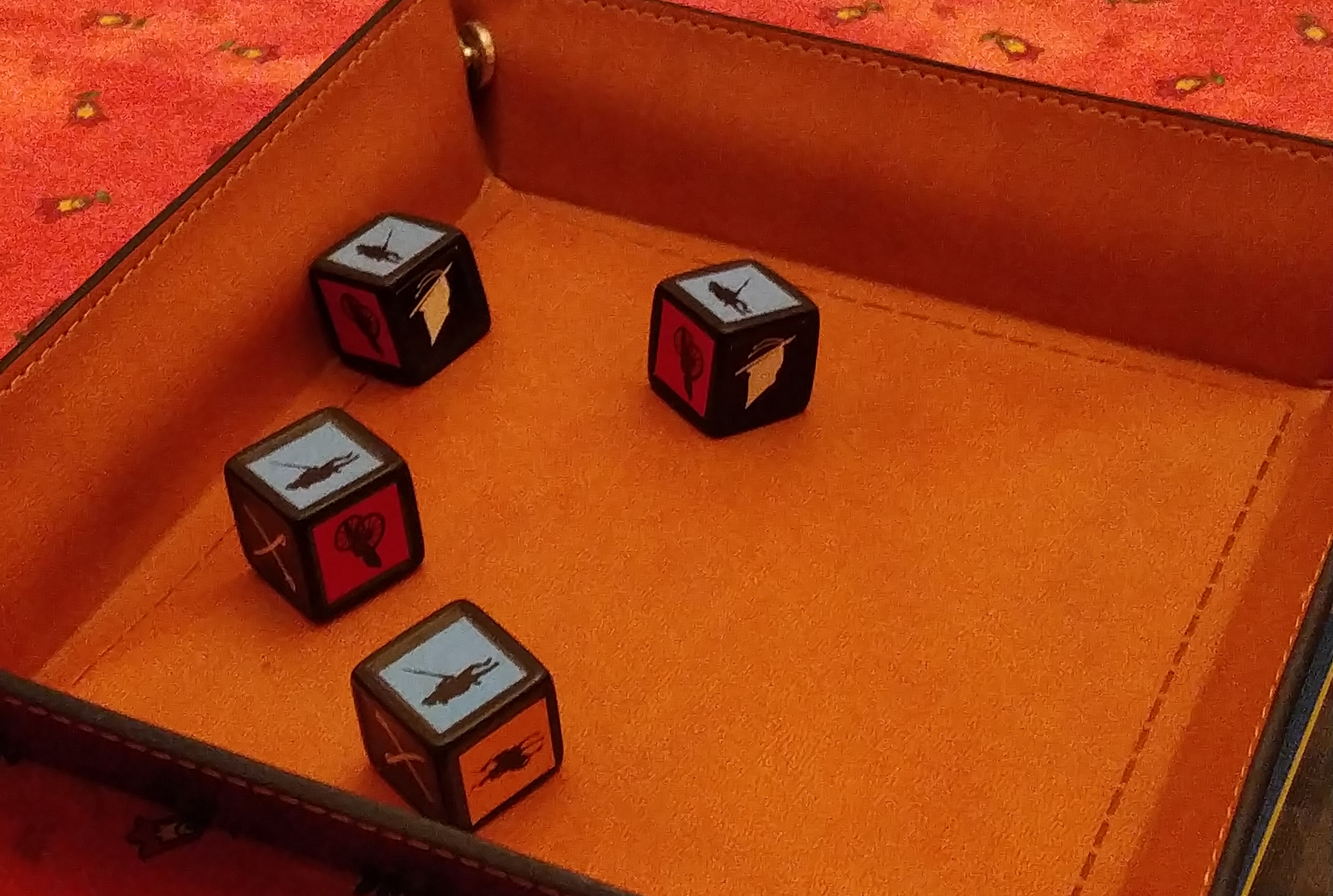
Okay, this was a dice roll form a game we played last year, but I really wanted to put it in.
It was prompted by a First Strike card-play on my part, T attacking a British Line unit with
his French Line (who get and extra die in melee). A roll of four soldiers wiped out his unit,
and he failed the survival check for his attached Leader. Two banner for me! Good times.

Contributing to the battlefield chaos is the activation system. C&C: Napoleonics uses a deck of Command Cards to regulate what each player can do on their turn. Players each have a hand of cards, and play involves the players taking turns to play a card from their hand, performing the actions allowed by the play of that card, then replacing it at the end of their turn with another card from the deck. A given scenario will spell out which side begins the game and the hand-size of each side. The hand-size will often vary, to reflect hampered communications or logistical difficulties inherent in that side’s situation.

Each Command Card allows the player to order a unit or units, based on certain limitations built into the command. Most cards order a unit or units of the player’s choice, but limited to a particular sector, while others will allow one or two units to be activated in each area. Other cards will offer special manoeuvres, like Fire and Hold (standing ranged fire infantry/artillery fire) or Cavalry Charge, each offering an extra die to attack rolls for that activation.

To avoid a possible comprehensive loo of an infantry unit from a cavalry attack, the defending player has the option of having the unit form square. This involves the sacrifice of a random card from your hand (not permanently, only for the duration of your unit being in square), which is placed on one of the spaces on the Form Square panel; the marker token is placed atop or next to the unit that has formed square as a reminder. Forming square reduces the assailant cavalry’s attack to a single die. Plus, it allows the defender single die defending roll before the cavalry attack. While a cavalry unit is adjacent, the infantry unit must remain in-square, but an activation order will allow it to break square again and act normally (breaking square will return the purloined card to your hand).

About six rounds into the game, and I had gained four French banners to T's two British.
We start with our own banners in front of us, and hand them over to the opponent as
they are earned (often with some muttering about lucky rolls).

Victory goes to the side that reaches the quotient of Victory Banners required in the scenario instructions. A Victory Banner is earned with the annihilation of an enemy unit or the killing/capturing of an enemy leader, and in some scenarios, with the taking and holding of particular locations on the board, usually a hill, structure, or town of strategic importance. The first to reach the required Victory Banner quota wins the game, and that won’t necessarily be the active player; a lucky defensive action or two can and has snatched victory from the jaws of defeat.

Like all good historical games, a lot of research as gone into each scenario. While the battlefield is by necessity an approximation of the distances and topography of the actual landscape, efforts are made to make the situations both realistic and challenging approximations for the players.


Appraisal (and Apologia)

Commands and Colors games are purely tactical in nature. The situations portrayed usually took a few hours at most to be resolved. A Commands and Colors scenario will often play out in a similar amount of time; of all the multitude of C&C Napoleonics games I’ve played, only a handful have gone over the two-hour mark, and these have usually been eighteen or twenty banner EPIC-scale games.

There is a lot of talk about Commands and Colors being a good introductory game for people new to wargaming. I think in some cases, at least,  this is a back-handed compliment, dismissing the system as not being a real wargame. As for the voracity of the statement, I think it might be a good introduction to wargaming if the fresh recruit already has an interest in the Napoleonic era. Pound for pound, I think C&C: Ancients or Memoir’44 might be a better general gateway to wargaming, given the lower rules exceptions overhead.

On the Simulation-Game continuum, all of the Commands and Colors flavours are firmly and unapologetically placed closer to the Game end. C&C: Napoleonics is no exception in this respect, and only the most one-eyed fanboy would try to argue for it to be nudged any further to the left. As I mentioned earlier, the parameters of the game only allow an approximation of a given conflict, lacking the granularity of, say, an Eagles of France or Vive l’Empereur series game. One of the strengths of the Commands and Colors system is that it doesn’t pretend to be more than it is. C&C: Napoleonics offers a fast-playing, dynamic tactical engagement that, remarkably, rewards the use of period battle doctrine.

C&C: Napoleonics has an aggregate rating on Boardgamegeek.com of a touch over 8 out of 10, across over 3,200 submissions. That said, the game has its share of critics. Some criticisms are fair, while others just sound petulant. Some peoples’ issues with the game boil down to the Commands and Colors system simply not meeting their expectations of what a Napoleonic wargame should be. That’s fine; you probably already have a go-to game to scratch your Bonapatean itch. Go play that.
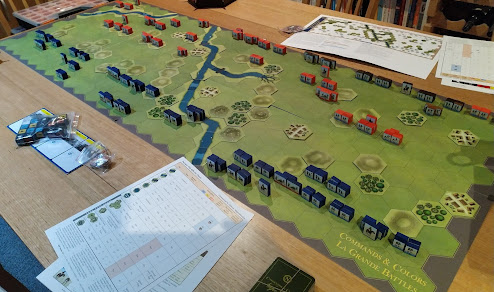
The set-up for a Grande Battles-scale game of Vimiero, from the fifth expansion:
EPIC Napoleonics. A long game (a battlefield 26 hexes across and a duration of
well over two hours),nut not at all unruly to play. Dare to dream.

Mostly people seem to complain about what they perceive to be a lack of player agency; “I never have the cards I need to do what I want,” or, “The cards make it too random.” I think people confuse player agency with personal preference, or simply try to legitimise their personal preferences by giving them a fancy label. It’s okay to not like a game. It’s okay not like a game mechanic, like card-driven games. It’s okay not to like games with blocks (“Some assembly required”). But these things don’t make the game inherently bad or unplayable.

As I’ve already said, everything in a Commands and Colors game is there for a reason. Like in most wargames, both players can see where all the units are and their relative strengths. Like other facets of the game, using a hand of cards to limit your command options is a way to approximate both fog of war, the unreliability of communications between headquarters and individual formations, and the apprehension of some generals to engage the enemy. If you don’t like randomness in your games, there’s always chess.

Block games aren’t everyone’s cup of tea, I can respect that. They are usually hard to play solo – this isn’t an issue using Stuka Joe’s CDG solo system (available in a kit from GMT or as a downloadable print-and-play kit from the product page). The stickering-up of hundreds of blocks (340 in the base game, but less in successive expansions as you’re only labelling one army and some French extras), will take a few hours and it’s done. No mounting and painting of miniatures necessary.

I’d be loath to try to pick a favourite game, or even a Top 10. If I did, though, I’m not sure Commands and Colors: Napoleonics would make the short-list. In spite of this, it remains one of my got-to games. There are a couple of reasons for this:

Familiarity. After so many years of near-weekly games, playing is second nature now. It’s like picking up a favourite book again, except the ending it different every time.

Satisfaction. While familiar and – let’s be honest here – not particularly mentally taxing, the game is time and again a very fulfilling experience. Win or lose, the experience of playing the game is almost always a tense one, with a natural ebb and flow of battle developing as the narrative unfolds. Some of my most memorable games have been when both sides are one Banner away from victory, but neither can seem to get over the line, until one finally does. It probably helps that, after this long, T and I are fairly evenly matched (though if asked, he’d say I win all too often).

Brevity. Most of my gaming opportunities come on school nights (this blog’s appellation comes from our informal, oft-quoted Monday-night motto). Knowing that, when set up, nearly any scenario should play out inside of an hour-and--half makes any flavour of Commands and Colors a natural choice for a weeknight.

Hanoverian Line troops take a pounding from the French artillery. Attacking at range is
twice as effective against infantry as other unit types.

Coda

Alas, the Commands and Colors: Napoleonics base set is currently out of print. The fifth printing was always meant to be a stop-gap measure for people who wanted to get the individual boxes (the national army expansions have now all been through reprints recently, and the Russian Army (GMT Games, 2013), Austrian Army (GMT Games, 2013), and Prussian Army (GMT Games, 2014) expansions are now also out of print).

The good news is that out-of-print does not mean forever. Publisher Gene Billingsley has alluded to re-packaging the series into two or three big-box editions, in much the same way that Combat Commander: Europe (GMT Games, 2006) and the Mediterranean (GMT Games 2007) expansion have been combined for pre-order on GMT’s P500 list. Commands and Colors: Napoleonics may not be my absolute favourite game (all contrary evidence aside), but it definitely deserves to be in print for a good while yet.


Final turn of our Quatre Bras game. Coalition win, 9-4.


* Fifteen scenarios isn’t a bad count – that’s thirty games if you and your buddy take turns as the French just once through (and who doesn’t want to play the French sometimes?) but some of the expansions come with twenty or more. And then there is C&C.net (www.commandsandcolors.net/), a repository for fan-constructed scenarios that cover battles not portrayed in the official scenarios, and sometimes even revisit those that are featured in a sort of, “But have you considered this?” manner. And it covers all the historical flavours of Commands and Colors (as well as Red Alert (PSC Games, 2019)) Well worth a visit.

** A new, expanded 90-card Command Card deck comes with the fifth expansion, Generals, Marshals & Tacticians (GMT Games, 2015).

*** Okay, this was written for effect. To be honest, I don’t mind stickering up C&C blocks, and at least four or five other people in the Commands and Colors Fans group on Facebook have declared they find the process “relaxing”, “meditative”, or even “therapeutic”.

I’ve always through of the blocks in Commands and Colors games as the poor man’s minis. In truth, the plastic miniatures in Battle Cry and Memoir ’44 always put me off trying the game. But this doesn’t stop hard-core tin-pushers from co-opting the C&C: Napoleonics rules for their miniatures games, as a scroll through the Commands and Colors Fans group on Facebook will demonstrate. Now that I’ve played maybe half a dozen different Napoleonics minis rules-sets, I think I can say that the C&C would work at least as well as or better than several of them. 


Blog note: A long absence and another milestone

      It’s been a week – strike that; it’s been ten days since I last posted. I try to get something up at least weekly (I aim for six or se...