Showing posts with label Undaunted: Battle of Britain. Show all posts

Saturday, 7 September 2024

Review: Undaunted: Battle of Britain


Nominated for the Charles S. Roberts Award for Best World War II Game, 2023


Since the release of Undaunted: Normandy (Osprey Games, 2019), David Thompson and Trevor Benjamin’s Undaunted system has proven to be a robust and adaptable framework for presenting tactical combat situations in a playable form, using unconventional mechanics that, either by accident or design, appeal to non-wargamers. Who knew deck-building and action restriction could work in a wargame? Obviously, a lot of people think they do, otherwise the Undaunted series would never have made it to series-status, and Undaunted: Normandy wouldn’t still be in print five years after its initial release.

Undaunted: Battle of Britain (Osprey Games, 2023) is the latest iteration of the essential system*, but it’s also something of a departure from the close combat of the earlier games. The canvas is broader – the skies over the English Channel and the eastern coast of England – and instead of sections of troops or a support weapon squad, each token represents a group or staffel of fighters or a handful of bombers, and conversely the stakes are higher. The field of battle is still somewhat abstracted but is granted a more familiar hex-grid; the game still uses a series of compatible map-sections to create unique altercation spaces over coastal regions of open ocean. There are differences in the way the cards work in Battle of Britain compared to the other land-based games, but the essentials of the mechanics are the same; you still work through and build a deck of command cards (and some filler cards, but we’ll come back to those), and the command cards for the units in play still act as hit-points or step-losses when that unit takes a hit. In most of the scenarios the goals of the two sides are different and their strengths asymmetric. And, as with the previous games, every turn presents challenging decisions for both players. 

The game's stack of large terrain tiles (26 in all). There are also three-hex extension
 tiles and single hex markers for things like cloud cover and barrage balloons.


Appearance

Like its predecessors, Undaunted: Battle of Britain is a visually stunning and decidedly tactile experience. If there’s one thing that Osprey Games does well (though I truth, there are several things they do exceptionally well), it’s their presentation, making a game look and feel not just gorgeous, but right. There is a weight to the board pieces and the components that conveys the seriousness of the venture. The game’s Battle of Britain incarnation dispenses with the four-inch square terrain tiles for a hex-grid format, but a morphic one created from sections that combine more neatly than the square pieces, creating an assortment of Channel and coastal backdrops for the aerial action. The plane pieces are top-down views of these familiar planes.

Sample hand for the Commonwealth player.

Like its stable-mates, Undaunted: BoB is a card-driven game, and the cards are where the game really shines. Each boasts a picture appropriate to the role that card fills; pilots and navigators for the aircraft, a view of the planes for the section command, a radio operator for squadron command, a destroyer for the Ship activation card, and a Bofors gun for the Anti-Aircraft artillery.

Osprey always spends time working out the best way to
store the games components, not just ship them.

As with the other volumes in the series, all of the art is provided by Roland MacDonald. I’ve heard some complain about the cartoon-iness of the art in the Undaunted games, but for me it harks back to the Commando comics of my childhood. There’s a heroic-realist quality to the work particularly in the portraits of flyers on the aircraft activation cards.

Set-up for scenario 8: 

As with the other Undaunted games, considerable thought has been put into the housing of the various components that make up Undaunted: BoB. It took a little while to work out, but the smaller three-hex board tiles and the single-hex object-overlay pieces (ships, barrage balloons, cloud banks, etc.) all fit perfectly into the space underneath the larger map-tiles. The aircraft tokens fit in the recesses under their own card decks, and the dice and target markers have their own places in between these. It’s all quite elegant.

Undaunted: Battle of Britain rulebook and scenario book.

That clarity of design carries over to the Rules and Scenario books. These are presented with wide margins and lots of space. The Rulebook covers the concepts and idiosyncrasies of the game in broad brushstrokes, then explains through examples how the elements work together in the context of play. To be honest, coming from a more traditional wargaming sensibility, it was a little jarring to be confronted with rules I didn’t have to wrestle with, and I kept thinking I was missing something crucial. There were instances during play that I simply couldn’t find a rule clarification for, in which case we’d muddle through with what seemed the most logical approach, and then going over the rules again after the game, I’d find that we had done what was intended. So, while the rulebook itself can be difficult at times (or maybe that’s just me), the rules, once you get into the cadence of the game, are quite intuitive and sensible.

Rulebook: sample page.

The Scenario Book is where the game shines, though. Two-page spreads offer a historical context for the situation, a breakdown of the materials needed, a visual aid for the placement of map tiles and starting locations of pieces, and short note addressing new rules incorporated into the scenario. The scenarios have some programmed learning built into them. They are however all interesting and challenging enough in their own right to warrant repeat play. As in other Undaunted games, they also appear in chronological order, lending a verisimilitude to the pay of the game when running through the scenarios consecutively.


Scenario 1: Battle of France.

Play

In Undaunted: Battle of Britain, the player takes the part of either the Royal Air Force (RAF) defending the central and south-east counties of England, or the Luftwaffe – the German Air Force – bent of destroying the industrial and defensive infrastructure of Britain and gain air superiority ahead of a planned amphibious invasion, Operation Sealion. Through the mission briefings and notes, the game conveys the sense of desperation on both sides of the English Channel.

The game is purely tactical. In a scenario, each player will operate a handful of planes and sometimes other resources. The German player has fighters (single seat Bf109s and two-seater Bf110s which serve double-duty as bombers) and dedicated bombers (Ju87 Stukas in the earlier scenarios, then later Heinkel 111s). The British player begins the game with just Hawker Hurricane IIs and Boulton Paul Defiants, with the Supermarine Spitfire (everyone’s favourite) coming into the game in the later scenarios, but they also have Anti-Aircraft Artillery (AAA) and barrage balloons to give the invaders pause. The game comes with eleven scenarios, all of which are eminently replayable.

Spitfires, Ack-Ack, and barrage balloons - oh my!

The game plays similarly to the others in the series, but not exactly the same. The system’s DNA is in evidence from the start. Each resource has a small set of cards, of which one will begin in your starting deck, with the others make a bank of cards you can draw to include in your deck, to be able to better – or at lease more frequently – utilise that resource. You may start with four or six fighter units, grouped into two sections (colour coded); in this case you will being with a deck comprised of one card for each plane (with another two available for drafting for each plane), one Section Comms card for each pair’s section, and a Squadron Comms card. You’ll also begin with two or more Discord cards. These serve the same function as Fog of War cards in the land-based Undaunted games – limiting your options in a given turn when drawn – but you will take another Discord card into your deck each time an ordered fighter finishes its movement more than two hexes from its partner unit.

Some elements in the game have a single action; when the AAA card is played, the anti-aircraft artillery can have a shot at any enemy plane in range, and drawing the Ships card will allow the destroyers to move a space in their indicated direction. Aircraft, however, are a different beast in this iteration of Undaunted.

Fly the (un)friendly skies.

When an aircraft is activated (a Command Card is played), it must move (at least one space) and may also commit one other action. A fighter will have a maximum movement of two or three spaces, while the bombers will move just one space. Fighters have the option of manoeuvring or firing, while bombers have the option of manoeuvre, shooting (usually in a choice of directions), or – like it says on the label – bombing. On an activation you must move, but you only get to commit one other action.  

The thing is, when a plane is activated, it has to move at least one space in the direction it’s facing before it does anything else, so sometimes the action has already been decided for you by the circumstances you find yourself in, like flying into barrage balloons or off the board in your next activation unless you take the Manoeuvre option to avoid said fate. fly off the board. The plane pieces on the board are cut in a teardrop shape that indicates the direction it’s going to be travelling in when it next moves. And this is the tantalisingly frustrating core of the action. It’s a game of positioning.


Aerial combat much more immediately dynamic than ground combat. For pilots and gunners, the hardest lesson to learn was diffraction fire, the discipline calculating the relative movement and speed and direction of your aircraft and the target’s and firing into the space where the target is going to be when the bullets or shells reach that point. It’s the same in Undaunted: BoB. To achieve your goals in the game, you must anticipate where the target, be it another plane, a ship, or a static ground target, will be during your plane’s next activation, and use your available speed and manoeuvre values to position your plane to put the target front of (or below) you on your next activation after you’ve moved at least one space. It’s tricky, and it’s never guaranteed to come off.

Shooting in Undaunted: BoB is handled in the same manner as the previous games; an aircraft will have a set number of dice to roll (indicated on the plane’s Activation card, usually two to three for fighters, one for bombers). The player has to roll a number higher than the target’s defensive rating the number in the shield on the counter plus the shooter’s distance from the target, adding any obstacles to the number (firing into or through a cloud-bank will add 2 to the difficulty of the shot). Sometimes you simply won’t be able to make the shot, but it’s the complications that make the game a rewarding challenge.

When it does come off, you then have to roll the designated number of dice and hope to roll a number higher than the target’s defensive value plus the shooter’s distance from the target. At the beginning of the Battle of Britain, the RAF combat doctrine called for a fighter’s armament to have a 250 yard focal range (meaning, for example, the bullets fired by all eight .303 calibre machine guns in a Hurricane would converge to a point a few inches across at 250 yard to maximise the damage caused), but within a few weeks of actual combat, the pilots would instruct their ground crews to set the focal range to around 150 yards to effect damage more reliably.
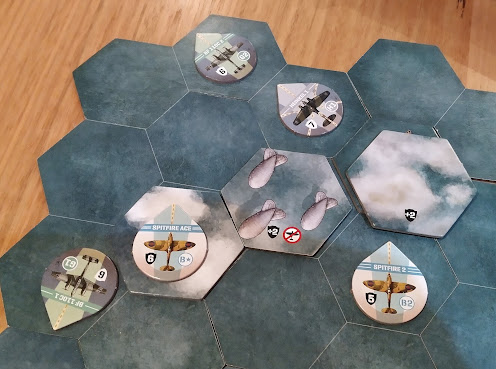
A lucky drop: The BF110 (top corner) claimed the third ship of the game for the win.
If it had missed, it would have been out of the game on it's next activation.

Similarly, the closer to your target when you do fire, the more likely it is to take a hit. The Heinkels in the game are particularly difficult to bring down (defensive value of 7), so you must be right on top of it (that is, an adjacent hex) to have a 20% chance of a hit. The bombers in Undaunted: BoB have four activation cards per counter, whereas the fighters (including the Bf110 fighter-bomber) only possess three cards at most. And the bombers can fire back when not engaged in manoeuvring or bombing. Protecting ground targets or ships from aerial assault is a tough gig for the Commonwealth player. But who doesn’t like a challenge.

In my experience a scenario will usually be resolved in between one and two hours, plus set up time. Set up is a lot easier and quicker if you put the map tiles back in their alphabetical order when you’re packing up a game (something I learned the hard way). There is a tally at the bottom of the Scenario Map page what indicates which tiles will be requited for that scenario. Similarly, the card chart will spell out not only which sets of cards will be required for the scenario, but how many of each should go into a side’s starting deck. Like all Undaunted games, a lot of care has been taken to make the game as easy to set up and play as possible.

German casualties at end of game. Still wasn't enough to save the ships.

Appraisal

I’m under no illusions that the Undaunted system wouldn’t be every wargamer’s idea of fun (or, indeed, every wargamer’s idea of a wargame), but I think there is clearly a place for them in the broad church of our shared hobby. I’ve enjoyed Undaunted: Normandy (you can read my review of the game here), and Undaunted: North Africa (Osprey Games, 2020) even more so. I have a copy of Undaunted: Stalingrad (Osprey Games, 2022), as yet unpunched, that I tell myself I must get to some time. But for my money, Undaunted: Battle of Britain is probably my favourite of the series. Stalingrad is probably the most complex and fully realised of the games, with its cascading narrative mechanics allowing the results of one scenario to influence the situation of the next, but the tweaks to the system, combined with the subject matter, make for a more satisfying play experience.

Messerschmitts negotiating the Barrage balloons to engage the Spitfires of Red section
in an attempt to keep them away from the bombers.

For a tactical air warfare game, Undaunted: BoB will feel clunky at first, given the random nature of the card activation, and operations can take on a staccato feel, quite alien to what one is used to playing a wargame. It doesn’t bear comparison to a more technically simulative game like Wings of War/Wings of Glory (Ares Games) or Age of Dogfights (Forsage Games), but neither is it purely a logic puzzle, though it has elements of such. There is a rhythm that starts to appear in the game, the more you play it. And like the two aforementioned games, much energy will be devoted to flying around in circles trying to gain the advantage over your foe. But I don’t think this is a valid criticism of the game; it simply mimics the reality of aerial combat for much of the discipline’s history.

Undaunted: Battle of Britain feels like the purest implementation of the design philosophy behind the Undaunted system thus far. The game that rewards careful planning and consideration of exigencies. Each player has a clear set of victory conditions in each scenario, and the player who can best adhere to those priorities will have a greater chance at victory, but as in all things, success is not guaranteed. The draw of a new hand each round brings uncertainty to the mix, though this can be somewhat mitigated by an awareness of how your deck is built (not card-counting per se, but knowing what is left to come out before the next reshuffle), but the requirement to bid for the Initiative with each round means that you may have to sacrifice a useful card to gain a useful position. 

Crowded airspace. A Bf110 and Heinkel jockey for a run at the fleeing destroyer (left).

Subtle adjustments in the mechanical aspects of the game reflect real aspects of the battle. Stukas are relatively easy to shoot down (Goering pulled them out of service in the Channel only weeks into the battle to preserve their numbers for the planned incursion into the Soviet Union, Operation Barbarossa), but the Heinkel 111 medium bombers were better armoured (as reflected in their defensive rating of 7 and four command cards instead of the fighters' three) and bristled with defensive weapons. Allied pilots soon learned the most effective attacks were to run in from behind and target the engines or brave the frontal defenses in a head-on attack, firing into the cockpit. The Hurricane was only armed with Browning machine guns, compared to the Spitfire's and Bf109's cannons, and had to put a sustained dose of fire into a target to effect damage (rolling two dice in attacking to the three dice of the Spitfire and 109). And ace pilots receive four command cards instead of three, to reflect the likelihood of them lasting longer in combat. The average life expectancy of a newly minted RAF pilot during the battle of Britain was just two weeks (about ten missions).

The Discord cards in Undaunted: BoB feel more visceral than the Fog of War cards in the land-conflict versions of the game. In the earlier iterations, Fog of War always felt like a mere hinderance, a speed-hump slowing the execution of your plans. The two flights of a Section operate best co-operatively, flying in unison. Sometimes it will be necessary to split the team to gain the advantage against the opponent, but that will come at a cost, and it’s not always a simple thing to bring them back into radio contact. Too many Discord cards can slow your response to immediate threats, leaving your aircraft hanging out in the open, easy prey for an opportunistic foe. Like the previous games, there are ways of mitigating the Discord in your hand, but that will come at the cost of not being able to do something more proactive in your turn. Again, difficult choices have to me made with every new hand.

As I said earlier, Undaunted: Battle of Britain isn’t going to be a game for everyone, that goes for the whole series. Some will look at the gorgeous production and components and the easy to read and understand rules, decide that it’s a child’s game (or, ye gods, a Euro) and dismiss it without further consideration. I was guilty of this when I first heard about Undaunted: Normandy. But this series isn’t just a teaser to get non-wargamers into the hobby. The Undaunted games offer a challenging wargame experience requiring a much shorter span of time to achieve a resolution than, say, Wacht Am Rhein (Decision Games, 2005). While shorter translates to simpler, it doesn’t mean easy or unengaging. Far from it.

Having played Undaunted: Normandy, I can now say I enjoy it (though I think I like Undaunted: North Africa a little better), but in Undaunted: Battle of Britain I have found a new favourite. Growing up, I was obsessed with World War II planes – mostly from the European theatre - and would save up my meagre pocket money to buy Airfix and Matchbox model airplane kits. This would account, at least in part, for my affection for Undaunted: Battle of Britain. But there’s also a greater sense of the historicity of the events portrayed. In this game more than the others there is present a sense of what is at stake, no less than the preservation or the extinction of the last defiant glimmer of Democracy in Europe.


* Yes, I know about Undaunted 2200: Calisto (Osprey Games, 2024), but being such a departure from the earlier games in the series, and with all the extra chrome built into the game, it feels like the start of a separate series. Related, but more cousins than siblings. I mean, the new game even has its own trade dress.


Thursday, 15 August 2024

State of Play: Undaunted: Battle of Britain (with 100% more Heinkels)


Nominated for the Charles S. Roberts Award for Best World War II Game, 2023


Another week, another game of Undaunted: Battle of Britain (Osprey Games, 2023). This report will be a short one because it was over so quickly, and probably the last one before a review of the game because there are other things I want to write about.

Initial set-up for Scenario 4: Hellfire Corner

We played at my place this week, which accounts for the slightly better lighting (the generally poor quality of the pictures is still all down to me). I decided to skip Scenario 3: When the Bombs Fell and go on with Scenario 4: Hellfire COrner. A number of new elements are introduced in this (and the previous) scenario. Land targets – markers placed on land hexes indicating valuable infrastructure and therefore worth risking a flight of expensive bombers to try to take out – make their debut appearance, as to Anti-Aircraft Artillery. Also new are cloud cover (which a plane can fly through but will make offensive actins more difficult), and Barrage Balloons, which can really mess up your day (you don’t want to finish your movement facing a Barrage Balloon hex or you’ll crash with your next activation – it’s less about the balloons and more about the cables tethering them that will sheer through a wing like a hot knife through butter).

This was the shortest game we’ve played yet. I think we both felt confident with the rules and parameters of the game, and bombing land-based targets is functionally the same as attacking ships at anchor in the Dynamo scenario. Also, as the British defenders, I only had two sections of Hurricanes so I was cycling through my deck much more quickly*, and we had both taken up all the reserve cards early on, which meant we didn’t have the choice of using Bolster or Inspire when the Squadron or Section cards came up. Limited choices make for quicker decisions, and both of us used these cards for the Guide (a free extra move and manoeuvre for one plane) to good effect.

T was on mission for the whole scenario. While the German bombers only move one hex per order, they each begin with two cards in the German player’s starting deck, and each has a total of four order cards instead of the fighters’ three. In our last contest, I was only just able to snatch victory from the jaws of defeat with a lucky shot that took out T’s second Stuka a round or two before he would be in place to sink his fourth ship for the win. Going into this scenario, I knew it would be a tougher thing to pull off.

Maintaining a Defensive posture.

The German victory conditions require the destruction of five relatively soft targets; like the ships, land targets can have an innate defensive value of 6 or 8, meaning once over he target, a bomber may attack the target below and needs only to exceed the target number (in this case all 6s) on one of their three dice to neutralise it. The Heinkel 111 has a base defence number of 7, to the Stuka’s 6. This means that even if the British player gets in just one hex away from the plane to fire, they need to roll a 9 or 10 to hit the damn thing. Then to take it out, you have to hit it again three more times.

As the Battle of Britain developed, a doctrine of mixed interception waves was adopted whenever possible, where the Spitfires would keep the escorting Bf109s busy while the Hurricanes would go after the bombers. Hurricanes through the course of the battle accounted for many more bombers than the Spitfires for this reason, but with just browning machine guns, even eight of them focussed to a tight grouping at about 150 yards, would often be unable to penetrate the Heinkel’s armour. A direct hit to an engine or the cockpit would often stop a bomber, but it wasn’t a guarantee.

T showed remarkable discipline in bringing his flights into the fray, guiding his planes around the barrage balloon obstacles, while keeping his fighters in comms range. By dint of our respective starting positions, I was cautious, waiting for him to come to me. I knew this was going to be a big ask, and that I would lose some of the positions I was trying to protect, but it’s a game of triage, and you have to save the ones you can.

Mechanical engineers build weapons. Civil engineers build targets.

I could wax eloquent about the brave boys who risked their lives every time they took off, defending this Sceptred Isle from the encroaching Nazi menace and thwarting Goering’s plans of an easy victory, but that fact it, that wasn’t what happened this time. I’d argue that the scenario is weighted slightly in favour of the Germans – I think this is true but the fact is, through a combination of card draws and some hesitation on my part at a crucial moment, T’s Germans took the day. He handily took out five targets in quick succession, and try as I might – I had at least five good shots on his Heinkels – I managed only two hits and one of those was an opportunistic potshot at a passing 109.

T tried not to crow too much, disingenuously claiming this was his first victory for the whole year. He told me my look of frustration at losing was palpable. If I’m honest, I did feel like I’d let the side down. That Gerry had slipped through the net and made mischief in the Home Counties. But that’s a good thing, I think. It speaks to the immersive quality of the game, the way the unfolding narrative draws you in.

On the upside, I didn’t lose any pilots and all the planes came back safely, which at this stage of the battle was nearly as important as spoiling the enemy’s efforts. And, of course, there’s always next time.

I flew in Hellfire Corner and all I got was two mingy hits.


* By this stage in the battle, the Defiants, which were not designed nor ever intended for interception duty, had proven to be inadequate for the roll and taken out of the mix. Many were transferred to Coastal Command where they proved more than adequate for ocean surveillance, especially over the Channel, until more Short Sunderlands and other aircraft with a much greater range became available.


Sunday, 11 August 2024

State of Play: Undaunted: Battle of Britain (redux)


Nominated for the Charles S. Roberts Award for Best World War II Game, 2023


For our Monday game T and I returned to Undaunted: Battle of Britain (Osprey Games, 2023). We played the second scenario in the set, I went to T’s house this week, so I had to set up before we could play (if T is coming to mine, I can usually have a game and a cup of coffee ready to go when he arrives).

This gave me the opportunity to gauge just how long a game takes form set-up to tear-down. We played Scenario 2 – Operation Dynamo. Set up time for this scenario (from scratch) was about twenty-five minutes, which I think I may have been able to keep to twenty if it weren’t for some unrequested assistance of a junior member of the household. Upturning the game's box lid fixed this intrusion.

Undaunted: Battle of Britain - now with all Claude-approved components.

We began play at about 9:20pm and wrapped up at a little after 11:00 and were packed up again by 11:15pm. So, the game took a shade over an hour-forty to play out. Take out the time for rules referrals, cat-petting, and taking phone calls a couple of times, and we’d be getting down to about hour, maybe an hour-fifteen of actual play, which would fit with our experience of other Undaunted games, but it made for a late night.

Like it says on the can, Scenario 2: Dynamo is concerned with the Dunkirk evacuation. There are six seagoing vessels at anchor off the coast of France. It’s up to the RAF to protect the seaborne evacuation effort from the threat of air assault as best they can. Gerry has to try to stop as many of the BEF from making it home as he can. For a mechanically fun and breezy game, Undaunted titles can cover some pretty dark history.

A couple of rounds in, and everybody's still in comms.

The Dynamo scenario introduces two new elements to the game; bombers and targets. More specifically, A couple of Stukas for the German player, and six ships anchored off the coast of Dunkirk. The British player has his trusty Hurricanes and a pair of Defiants with which to protect the ships. The victory conditions for the match are tied to these new elements; German player has to try to sink four of the six ships with his Stukas, while victory (however fleeting) will go to the British player at the expense of both the German player’s Stukas before they manage to complete their task.

It can be an easy thing to be distracted from strict victory conditions, especially when they don’t match your opponents. T used his Bf109s to good effect on the board, screening his bombers and getting some shots in against my aircraft, but he lagged in building his Stukas cards into his functioning deck. The bombers don’t have a Section Comms card, so they rely on the Squadron Comms to bring more Stuka action cards into the deck. But T was giddy with the power to increase his hand size through the use of the Command order, giving him more chances to shoot at my Hurricanes at the expense of his Stukas’ manoeuvrability. Now, I love the visceral pleasure of scoring a palpable hit on my opponent as much as the next grognard, but in any Undaunted game it’s important to keep your eye on the prize. In Undaunted: Normandy (Osprey Games, 2019), there may be some satisfaction in taking out that annoying Sniper who keeps taking pot shots at your troops, but that won’t bring you any closer to victory. So it is with Undaunted: BoB.

The moment of truth. One round had just finished, and we were waiting to see who
would be able to activate first, my Defiant or T's last Stuka.

One thing I realised in this game was how neglectful I’d been of the Defiants. Designed as a light bomber, the Defiant had no front-facing armaments, just a rear-facing hydraulic turret, albeit with a very wide traverse. It only gets one die on a shooting roll compared to the Hurricane’s two dice (having only four Browning .303 machine guns in the turret – the Hurricane had that many in each wing hardpoint), but it can shoot in any direction except forward. I’d been a bit dismissive of the Defiant in the past, so this was something I didn’t use to full advantage in our first game. Having it in front of mind this time out, I used my Defiants to much better effect, scoring at least four hits against the enemy, including the fatal blow to the second Stuka.

I think with our second outing, we’re both more aware of the need for flight cohesion between the flight teams, although having said that, by the end of the game we were both racing up Discord cards with nearly every hand.

Three down, and he had the fourth in his sights...

In the end, I held mastery of the skies over Dunkirk, as evidenced in my (unusually) superior shooting, but it was a close-run thing; before either Stuka had finally been brough down, T had sunk three of the six ships at anchor, and would have almost certainly destroyed the fourth within a couple of hands if I hadn’t been able to stop them before they reached their target, and he managed that with just two activation cards in his deck for the first two-thirds of the game; that's an impressive accomplishment. All in all, it was a very satisfying win.


My final tally. Claude must have brought me luck.


Thursday, 1 August 2024

State of Play: Undaunted: Battle of Britain


After a week’s break due to a combination of work commitments (on T’s part), sickness (me relapsing), and airport pick-ups (T again), we got together this week on Tuesday for our Monday night game. I’ve been spending my time on a side project that I’ll write something about here soon, so I haven’t been doing any solo gaming, and lately we’ve been roleplaying with the Wednesday group, so things have been quite here. I also have a couple of things half-written, but each needs more time and attention than I’ve been able to spare them or late.

I really wasn’t in the right frame of mind for anything too taxing. This, I thought, is the perfect opportunity to pull out a game I’ve been meaning to get to all year, so we introduced ourselves to the joys and challenges of Undaunted: Battle of Britain (Osprey Games, 2023).


I grabbed Undaunted: Battle of Britain late last year. I wasn’t going to get this one as I didn’t think the essential mechanics would translate so well to arial combat, but I started to hear some very good things about is from people whose opinions I respect, and I found a copy for a good price, so I took a punt. It’s been sitting on my shelf pretty much since. I’d read the rules and had a look at the scenarios, and I’d punched the game and toyed with how best to store the components in the game’s box (it’s not as obvious as previous entries in the series, but I think I’ve worked it out now). I’ve been meaning to pull it out for T for a while now. It’s not the only Undaunted game we haven’t played. I’ve gone through about the first five scenarios of Undaunted: North Africa (Osprey Games, 2020) solo, but I’ve had Undaunted: Stalingrad (Osprey Games, 2022) for even longer than BoB, and have yet to get it to the table; if I’m honest, I find the thought of playing through a dozen of more linked scenarios of Undaunted: Stalingrad, well, let’s say intimidating.

Opening set-up for the first scenario, Battle of France.

This wasn’t T’s first Undaunted game; we did the first in the series, Undaunted: Normandy (Osprey Games 2019) as a 6x6 game last year (you can read my review here), so it didn’t take long to get into the swing of the game. It probably doesn’t need to be spelt out that Undaunted: Battle of Britain is concerned with the air war over the English Channel and eastern England after the fall of France, as Germany tried to gain air superiority on the front ahead of a proposed invasion of the British Isles. Obviously, that didn’t happen, but it was a close-run thing.*

Undaunted: Battle of Britain plays out in much the same way as the other games in the series as far as the use and play of cards is concerned. After the first turn – the scenario dictates which player has the initiative in the first round - each player draws four cards and uses one of them to bid for the initiative (the right to play their remaining cards first) for that round. The cards will either allow the player to activate one of their planes, or a selection of other options to enhance your chances of victory (such as adding cards to your deck or removing Discord cards, the game’s equivalent to the Fog of War from the other titles). The differences are in the play area and the way the units behave.

Opening set-up from the German perspective.

The play area is a traditional hex-grid, though it’s still made up of interlocking tiles. This makes sense given the importance of movement regulation in this flavour od the game. The components are individual planes grouped in pairs. These are teardrop-shaped counters with the plane illustration facing the pointy end. This marks the direction the plane is facing, important for both movement and combat.

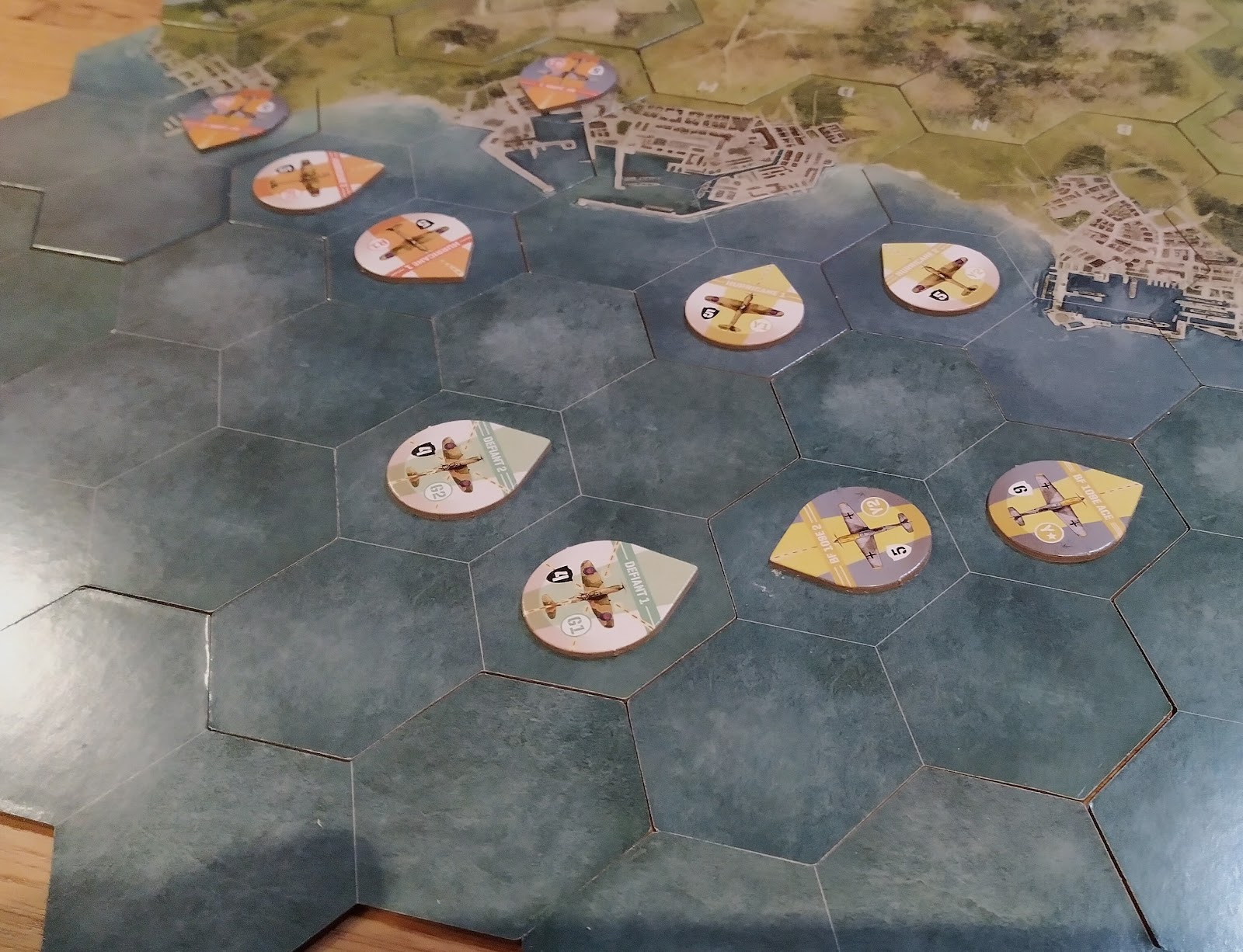
We played the first scenario, The Battle of France. This is a meeting engagement over the French coast between two pairs of Hurricane I’s and a pair of Defiant light bombers on the British side, and two pairs of the faster Bf109's for the Germans. A lead pilot and a wingman make up each pair – this is an important distinction, mechanically – and the pairs are colour-coded for ease of identification. The coal in the scenario is simple; to shoot down a number of the opponent’s planes. The first over the line is the winner.

One round in, and maintaining comms discipline.

Being a first scenario, things are kept simple to introduce the essential concept of the game. When a plane is activated, it does two things; it has a move action, and it has to move at least one hex in the direction it’s facing (in it’s turn it can move it’s total movement allocation, two to three spaces , depending on the plane) and it can either Manoeuvre (turn left or right one hex-side after each space moved, up to it’s Manoeuvre allocation), or it can fly straight and shoot at an enemy plane in its trajectory. This is all pretty straight-forward, but there’s a complication. If a plane finishes its movement with more than one empty hex between it and its partner, they are considered out of communication (comms) and the layer places another Discord card in their discard pile. Like Fog of War, Discord cards clog your hand, giving you less options to act. As T was to find out.

It's possible to want something too much. T was focussed solely on trying to score hits on my planes, at the expense of the cohesion of his units. By about round six he was trying to operate with all eight Discord cards crammed into his action deck. I was able to maintain my pairs’ cohesion – I only gained one Discord card the entire game but at the cost of flumming a potential opportunity or two to strike – but as is my want, when I did manage to get it position I could not roll I couldn't seem to roll higher than a five. T drew first blood on my Yellow lead Hurricane, and eventually I put some holes in the fuselage of one of his 109s.

The Y (Yellow) Flight of BF109s about to lose cohesion (right).

The planes must always face one hex-side. To fire, it must have an enemy plane in the trajectory it's facing. Remember, you can either turn (Manoeuvre) or shoot, so you have to anticipate where the target is likely to be in the next turn and position yourself accordingly, then hope you get to act on your advantage before the other guy gets away. When you take your shot, your chance of hitting is rarely better than 50%, usually much lower. Like in other undaunted games, the base to-hit number is the number on the shield on the plane token (usually 5, though the Defiants are rated four, which feels right), and you add to that your distance in hexes from the target. If you're shooting at a Messerschmitt three hexes distant, you'll need to roll higher than an 8 (5 armour/pilot skill + 3 range) on one of the two dice you're rolling. The 109s get to roll three dice, which is fair; Hurricanes and Defiants were outfitted with .303 calibre machine guns, whereas the 109s toted a nose-mounted cannon with exploding shells.


The first hit went to T. When you take a hit, you remove one of the cards for that
plane from the game (placed sideways to indicate it's a loss). The order serve
double to act as hit-points and to reduce the flight and combat effectiveness
of the damaged plane.

As it was getting late, we called the game before reaching a definitive conclusion. We had each scored two hits each, but no planes were actually shot down. Everyone made it back to their home airfields ready for the next altercation. But by the end of the session, we both had a good working knowledge of the game, ready for the next scenario, Dynamo (introducing Stukas and targets… er, ships to the mix).

The Y-flight Bf109s continuing to accrue Discord with every activation.

While it’s a departure from the other games in terms of board-play, I’m leaning toward declaring Undaunted: Battle of Britain as maybe the best entry for players new to the system, I want to play a few more games before I make a hard call, but there is a trimming down of options here with all of the units being subject to the same set of limitations (though with varying capacities within those constrains), making it an inherently simpler game, while still maintaining the tension of multiple difficult decisions with every round.


* If you’re interested in learning more about the Battle of Britain and the significance of Britain’s victory in the broader canvas of the Second World War, you could do worse than to read Stephen Bungay’s The Most Dangerous Enemy: A History of the Battle of Britain.


Stripped Down for Parts: Commands & Colors: Napoleonics – The Grand Battles Expansion

        Note: I started writing this post about a week before the GMT Monthly Newsetter for July came out and was struggling to get it ...