Showing posts with label Napoleon 1807. Show all posts

Friday, 29 August 2025

Review: Napoleon 1807


The French commander contemplates his next action.


Charles S. Roberts Best Napoleonic Era Board Wargame 2020 Nominee


Last year I reviewed Denis Sauvage’s Napoléon 1806: La Campagne de Prusse (Shakos, 2017), French wargame publisher Shakos’ first entry in their Conquerors series (you can read what I had to say about that one here). Two more additions to the series have been published so far – Napoléon 1807: La Campagne de Pologne (Shakos, 2020), and Napoléon 1815: Waterloo (Shakos, 2022), with persistent rumours of a new addition in the wings which I won’t mention here by name for fear of jinxing it and delaying the release even more. 

I enjoyed Napoleon 1806 so much I went out and bought 1807 without too much thought. While this could have gone badly, it didn’t. Napoleon 1807 not only lives up the promise of its predecessor, but manages to deliver, to my mind, an even better play experience just a little extra complication in a couple of ways, which I will recount through the course of this review; for now, I’ll say cryptically that there is not only more game, but more play, and deeper strategic concerns.

The twelve-inch square box can be a little awkward for storage, but height-wise it's
comparable to foolscap-sized games from Hexasim or Nuts! Publications.
 

I bought the last copy of Napoléon 1815 that Hexasim had in stock when Shakos posted it was out of print. (Yes, Hexasim is a game publisher, but they also run a virtual store-front from their website for dozens of European and many North American publishers, as well as their own games.) I believe – at time of writing – game is happily back in print. I haven’t spent enough time with that one yet for a review, but maybe this time next year.

Note: if you’ve read my review of Napoléon 1806, there will inevitably be some redundancy between that and this post – they’re equally please games to look at and to play. Check out the pictures and scoot ahead to the Play and Appraisal of the game.


Appearance

Napoléon 1806 set a high bar for presentation – it was certainly one of the big selling points for me engaging with a new, untried system. The mounted gameboard was artfully rendered to have the appearance of an unfolded ordinance map from the period (this conceit has been kept with the two subsequent Conquerors releases), beautifully illustrated with cities and towns, roads, and bridges. The cards were printed on good quality cardstock, as were the army boards and shields, and the wooden cubes and little drums were remarkably uniform. The whole package worked well together.

Napoléon 1807 is very much cut from the same cloth; it retains all of the solid aspects of the first game’s design and presentation but increases the scope and depth of play. The 1807 mounted board is two whole panels larger than the 1806 board, putting it at 24” by 36”, so slightly larger than a standard poster-sized map-sheet.

Elbing, having been retaken by L'Estocq, falls again to Soult corps. Will Hielsburg
be next? The red pawn marks the turns, while the white block indicates
the scenario length; in this case a battle of just four turns.

The other increase in Napoléon 1807 is the number of army boards. There’s one more board included, but these are now double-sided. This means a slightly different army composition; each scenario dictates whether the two armies use the Friedland, Pultusk, or Eylau boards.

Each side’s army board – with its accompanying shield – allows the player to keep track of each unit’s strength and exhaustion levels without revealing this information to his opponent. depending on which scenario you are playing. The strength and composition of each corps is represented by cubes in two colours, one representing the infantry and the other the attached cavalry (if available – some formations are all infantry).

The Winter Quarters cards are a new innovation. If the rule is in effect, the first troop
losses (cubes) on each are placed on the side's Winter Quarters card. When it holds
five cubes the card is put into the discard pile. When drawn again, the Winter Quarters
card is placed again on the board. When the second card has been drawn from that
player's deck and returned to the board, the game is over at the end of that turn.

From the map-board to the illustrations on the cards, everything in Napoléon 1807 works to immerse the player in the era of the conflict. Of course, this is true of all the Conquerors series games. The series artist, Nicolas Treill manages to create a coherent look and sensibility through this game and the other titles. M. Treil has lent his pen to the upcoming Napoléon 1870 (Shakos, ~2026), covering the Franco-Prussian War of that year. The early glimpses of this game, which should be coming to crowdfunding before the end of the year, indicate an adherence to the style of presentation consistent with its predecessors.


Play

Like its predecessor, Napoléon 1807 is a block game, and each block represents a corps of troops made up of infantry, cavalry, or more often a mix of the two, under the command the general or marshal who appears in name and effigy on the counter, The corps is represented only by its commander, rather than by its numbered designation. This may rankle with some hard-core (hard-corps?) Napoleonic enthusiasts, leaving out a measure of historical detail, but at this scale it would be an extra information that isn’t pivotal to play. Personally, I don’t have a problem with it.

Like its predecessor, Napoleon 1807 is a block game, and each block represents a corps of troops made up of infantry, cavalry, or more often a mix of the two, under the command the general or marshal who appears in name and portrait on the counter, the corps is represented only by its commander, rather than by its numbered designation. This may rankle with some hard-core (hard-corps?) Napoleonic enthusiasts for leaving out a measure of historical detail, but at this scale it isn’t pivotal to play. Personally, I don’t have a problem with it. At the corps level there is always going to be some measure of abstraction, and I think in this regard the nuances of strength and command quality within the two armies are handled well here.

Some blocks will also incorporate icons that serve as a reminder of a particular leader’s special qualities (such as gaining an extra movement point or drawing an additional card in battle). The identity of the general is hidden from the opponent; the reverse of every block (once stickered) shows the French or Russian eagle crest. Unlike other block games, where the block is rotated to represent depleting strength from engagements, the strength of each corps is tracked on a separate board listing each of the corps commanders in a column with two tracks running off each. The top row marks out the corps strength (one colour for infantry, another for cavalry), while the lower row – empty at the start – tracks the corps’ the accrued fatigue. A corps can be removed from the game in two ways, either having their strength reduced to zero or by letting their fatigue run to the maximum. There are ways to reduce a unit’s fatigue, which I’ll come back to, but it’s not always possible.

The Eylau campaign board for the French forces. Blue block represent infantry, yellow
for cavalry. Not everyone gets cavalry, which can be a problem if forced to retreat.
The overall number of blocks dictate how many cards are drawn in combat; two for
five or more blocks, but just one for for or less. The heavy dotted line down the
centre of the display is a helpful reminder.
Unlike other block games, where the block is rotated to represent depleting strength from engagements, the strength of each corps is tracked on a separate board listing each of the corps commanders in a column with two tracks running off each. The top row marks out the corps strength (one colour for infantry, another for cavalry), while the lower row – empty at the start – tracks the corps’ the accrued fatigue. A corps can be removed from the game in two ways, either having their strength reduced to zero or by letting their fatigue run to the maximum. There are ways to reduce a unit’s fatigue, which I’ll come back to, but it’s not always possible. The off-board tracking adds a further element of fog of war; you can never be absolutely sure of an opponent’s unit’s strength until they are finally taken out of the game, either by receiving enough hits to destroy their cohesion, or simply garnering maximum exhaustion from repeated movement, combat and retreats.
The game systems of Napoléon 1807 are a duplicate of those found in Napoléon 1806 and should be essentially the same through further additions to the series (the little time I have spent with Napoléon 1815: Waterloo, would seem to bear this out). Napoléon 1807 is an operational game set in a more challenging operational situation than its predecessor. With the larger board, there is sometimes more terrain to cover, more options for approach or retreat. One of the added complexities is that depending on the scenario, some cities may begin under siege, represented by a yellow explosion marker. The fortress or oppidum markers are also newly introduced to the game. These represent the garrisoned towns under siege. The familiar wooden Flags from Napoléon 1806 mark the target citadels. Like in 1806, the key to victory is gaining Victory Points enough to reach your side’s end of the pendulum score track (handily located on the map board) for a sudden death victory, or to finish the last turn with the marker further toward your end than the opponent’s. Napoléon 1807 also introduces a small set of white discs that, depending on the scenario, will be placed roughly in the middle of the VP track. If the game ends with the score token upon one of these spaces, neither side can claim victory.

Sample cards. This actually happened to be a particularly bad battle draw for Marshal Soult 
in one game. The box at the bottom left indicates the cost to the opponent's forces in a fight
(in this case, no blows landed). If the Rain card was drawn in the player's Draw phase, it
would be placed on the board as a reminder that all movement cost one extra point for
that turn, and that card would not be replenished. If the Care card was in the player's
hand at the Recovery phase, he would be able to use it to either replenish one Infantry
cube loss (maybe stragglers catching up to the main force) as per the card's Action, or
to remove two Fatigue markers from a formation of his choice (but not both things).

This is an unashamedly card-driven game (CGD), even more than many others that fall under that heading. Each side has its own card deck, tuned to that side’s strengths and weaknesses, and in a turn these are used to determine Initiative, adjust the weather and other random effects during the draw phase, dictate the available movement points to a formation after movement intent is declared, apply a positive function to one’s units, or a negative effect to an opposing force, as set out in the terms of the card’s event, to resolve the effects of combat between the belligerents, or to relieve the exhaustion of a failing unit in the at the end of a turn.

Each card has an Operation Points value at the top right, a coloured title banner which dictates when a card can (or must) be played, a paragraph of text conveying the card’s Event, and two sections at the bottom of the card, the left indicating the damage dealt if it is drawn as a Combat card (the coloured squares indicating Strength hits, the orange circles the number of Fatigue points applied among the enemy units, and the right, the number of Fatigue points  removed form a chosen unit if the card is played from the player’s hand in the Recovery phase at the end of a turn.

Each turn (roughly a fortnight in game terms) runs through four phases; Draw, initiative, Operations and Recovery. In the Draw phase, the players each draw three cards into their hand. If a Red bannered card, such as Rain or Snow, is drawn, its effects are immediately applied (this will usually affect the weather, but can have other adverse effects as well). If multiple weather cards are drawn, only the first is applied.

The Flag or Pennant markers represent each side's Citadels (key, victory point-yielding
cities) for the given scenario. Player's earn points by hitting their opponents forces and
taking their Citadels away from them. Points are accrued on the tally as earned, so it's
possible to achieve a points victory (reaching your end of the pendulum track)
mid-game, though I've never seen it happen.

To establish Initiative for the turn, the players simultaneously reveal the next card from their deck. The higher Operations value wins the draw; with ties, the Initiative goes to the French.

In the Operations phase, the players take turns – starting with the player holding the initiative – attempting to move their forces on the board. These can be moved individually, or in groups, so long as they originate from the same location and are kept together (no shedding units in transit). Moving units must stop if they reach a location with another unit present, friend or foe. If a unit moves more than three locations in a single turn, it will take a fatigue point for each location above the third. If two corps move together, the first point is spent on coordinating the advance, then the units may move as many points as are left. Three units moving in unison will cost the first two movement points before anyone actually get going. You get the idea.

Movement will sometimes lead to combat. Combat is not initiated simply by moving into an enemy-held location. If it is declared on arrival, the defender get’s an extra card drawn in their defence (defenders also draw an extra card when defending a Citadel or in Woods terrain). The winner of a battle is whoever commits the greater carnage on the other, and the loser is forced to retreat. If the victor still retains any cavalry, they may attempt to pursue the retreating force.


Some people apparently don’t like using the card-deck for combat, presumably because it offers a sense of more control over one’s destiny. Special dice are included in the game, that can be used in preference to the card draw. The faces feature Hit and Fatigue symbols in the same proportions as appear in the deck, so the French have a slightly better chance of hitting on a given roll. Where you would draw a given number of cards, you instead roll that number of dice and accept that fate. Personally, I prefer to use the cards in the way the maker intended.

After movement or combat, the unit or units involved are meant to be inverted. In play, I’ve found it easier to lay the blocks face down to indicate their activated status, but that can get hairy with three or four corps present in the same location. When all movement and combat has been executed for the turn, or when the players have consecutively passed on their turn, the Operations phase is over. In the Recovery phase, any formations that weren’t activated may clear all of their Fatigue, and cards may be played on the activated corps to remove however many points of Fatigue the card indicates. After this, if a unit still holds more than four Fatigue points, it loses a Strength point. While it’s a relatively simple game and very playable, Napoléon 1807 captures all the brutality and attritional cost to armies campaigning in a Polish winter.

"You should have seen the other guy." The parlous state of the Prussian forces after a
close-run victory against Napoleon's best.

The emphasis in both games is on manoeuvre and lines of supply, and it’s in the simplicity of the rules governing these areas are where the Conquerors system excels.  Napoléon 1806 is a cat-and-mouse game, where Prussians are doing their best to delay the French progress with inferior numbers, and protecting his citadels, all the while running down the clock. Meanwhile the French commander is doing his best to get his troops moving forward, force his opponent into costly engagements, and keep his supply corridor open. It’s a fine game and quite replayable, but it does turn to variations on a theme. I would maintain it’s still the best game for learning the system, and I still enjoy playing it; 1806 is my go-to when time is a factor.

In Napoléon 1807 you’re simultaneously playing against your opponent, the turn track, and the intemperate conditions of a Polish winter. Weather conditions will often take a harsher toll on your troops that contact with the enemy, if the rain or snow, or worse, a muddy thaw, allow you to make that contact. It’s this triple-threat a player’s well-laid plans that makes Napoléon 1807 so compelling a situation, whether a short, four-turn battle scenario or the entire historical campaign. Everything outside of clear or overcast will bring more fatigue on your troops. As in the earlier game, spending a turn doing nothing will clear all of a unit’s accrued exhaustion, but it comes at the expense of a turn it could have otherwise been pursuing the enemy or seizing a prize location. These decisions are even more crucial in a shorter game. The tighter duration rewards bold actions but punishes foolish ones.

To share the burden, the French also have real estate to protect in the Polish campaign. It’s difficult to cut a formation’s supply paths, but not impossible.

An early push to bottle up Napoleon's forces around Warsaw, his logistical hub. The
Cavalry unit visible in the top left of the picture is a Vedette unit. These units have no
value in combat and they cannot stop opposing units in their progress, as Cavalry
units can in Worthington's Blue and Gray series. They simply add to the fog of
war, making weak formations look stronger. Scenario instructions will dictate
how many each side has at the start of a game.


Appraisal

Napoléon 1807 is a worthy successor to Napoléon 1806. I’ve really enjoyed 1806. I’ve played over a dozen times and nearly all the games came to tense, nail-biting conclusions. Success in combat won’t necessarily guarantee overall victory, and the game rewards good overall strategy.

The Conquerors system elegantly captures many of the factors to be considered at the operational level in an overland campaign like adverse weather, distance, limited communications and the fog and friction of the battlefield, without getting bogged down with mechanical miniate, and all conveyed in a two- or three-hour timeframe.

This was the Prussian response to Soult's lacklustre attack pictured earlier. One unit
block casualty (the blue square with a cross through it) and three fatigue points. 

While the system remains unchanged, Napoléon 1807 offers a broader experience with even greater replayability. The board is roughly 40% larger in its play or manoeuvre area, though this can be a curse as much as a blessing, sometimes increasing the distances formations need to travel just to remain relevant to the game. It comes with a dozen scenarios, compared to the three (if you count the variation of the short three-turn scenario featured in the quick-start rules brochure), plus a campaign game to incorporate the first game into the second. There are more adverse weather conditions potentially at play, as well as a swarth of new playable events for both sides.

With the placement of the formation cubes and the Leader blocks on the board, the set-up time in any game in the Conquerors series is unavoidably on the long side; I started off allowing a full half hour from removing the lid, just to be on the safe side, but with practice I’ve managed to get it down closer to about fifteen minutes. To be fair, I have thick, clumsy fingers and struggle sometimes with the little wooden components in their rows on the Order of Battle boards, which probably add a little to the set-up time generally. I’ve started using tweezers for placing the Fatigue drums between the rows of Strength cubes during play.

For some people, the fact of being a block game will be enough to put some off. These are not games that can easily be played solitaire, so I can appreciate the apprehension from that quarter; this series will not translate well to solo play. I would encourage anyone with a buddy who is willing to try something new to take a run at Napoléon 1807,or any of the Conquerors series. For me, it ticks a lot of boxes for playability, teachability, the pace of play, and the buckets of tense, frustrating fun it brings to the table. 


Wednesday, 19 February 2025

State of Play: Napoléon 1807 (The War Room Ten Wargame Challenge #1)


After missing a game last week due to my brother-in law and regular Monday night gaming partner T visiting overseas for work, we got together this week and tabled Denis Sauvage’s Napoléon 1807: La Campagne de Pologne (Shakos, 2020). We’ve been playing a lot of the Crusades expansion (GMT Games, 2024) for Commands and Colors: Medieval (GMT Games, 2019), because I wanted to review it, but that and a few missed weeks due to other commitments on both sides got me to the third week of February without having begun my Ten Game Challenge games list. So, this week I have the first domino a push.


Napoléon 1807 is familiar as a game and a system. It’s the second game in Shakos’ Conquerors series. I posted a review for the first in the series, Napoléon1806: la Campagne de Prusse

(Shakos, 2017) last year, and I’ve been keen to follow up with a review of 1807. We played it several times in 2024, but it’s been a while, so the Ten Game Challenge list seemed like a good excuse to pull it out and refresh my thinking about the game.

Napoléon 1807, like all the Conquerors series games, is an operational-level block game of Napoleon’s Polish campaign of 1807, played out on a point-point map covering Poland and eastern Prussia. The action of the game follows on from Napoléon 1806, and there are instructions for combining the two into a relatively seamless grand campaign. I’m unlikely to ever try this, but it’s nice to know I could.

French corps dispositions at the start of battle. The blue blocks represent infantry
regiments, the yellow, cavalry squadrons.

Dispositions of the Russian corps at start of game. The green and pink blocks
represent infantry and cavalry strength respectively.

So, last night we played the Battle of Eylau scenario, with a forgiving four turns. The game still took us the best part of an our and a half to reach the conclusion, but the play was extremely satisfying, even if the result was less so.

T took the French - I, the Allies (Russians). Like its sister games, Napoléon 1807 is a game of manoeuvre. It’s a block game, and each block represents a corps of troops made up of infantry, cavalry, or a mix of the two. Each block represents a corps and bears the name of the corps’ commander. The blocks are single sided, with a crest on the side facing the opposing player, but the strength of each corps is tracked on a separate board listing the corps commanders in a column with two tracks running off each. The top row marks out the corps strength (one colour for infantry, another for cavalry), while the lower row – empty at the start – tracks the corps’ the accrued fatigue. A corps can be removed from the game in two ways, either having their strength reduced to zero or by letting their fatigue run to the maximum. There are ways to reduce a unit’s fatigue, which I’ll come back to, but it’s not always possible.


Napoléon 1807's Tun Track (top) and Victory Point track, both
incorporated into the board.

Napoléon 1807 is also a card-driven game, but not in the conventional sense. All actions are, to a degree, propelled by each side’s card deck. The cards serve several function, and depending on the phase of the turn, you’ll only consider one element of the information presented on the card. The decks are each comprised of46 cards, so in a longer game you’ll likely cycle through the deck two or three times.

The cards. The title banner exemplifies what kind of card it is (Red title must be played
 for their event in the Draw phase at the beginning of the turn, a single Green banner
card may be played out of the player's hand to gain some concession for the turn in
the Initiative phase, and the blue banners may be used during the Activation phase
(before or during battle of while moving, depending on the nature of the card,
but only one per activation).
During combat, each player will draw a specified number of cards and consult the
symbols in the bottom left hand space for damage inflicted on the enemy. In this
instance, the French player drew poorly. 

Turns run through four steps; Draw, Initiative, Activation, and Recovery. In the Draw phase, players each draw three cards from their deck to their hand (there’s no hand limit, so these can get unwieldy in longer games). These are checked for Red (Event) or Blue (Initiative) title headers, Events are played immediately, and will probably have some kind of detrimental effect on the game for at least the coming turn. In the first turn, I drew Rain, which means for that turn every unit that moves, or even tries to move, in that turn will accrue an extra fatigue point (there’s a Rain box on the board to remind players that it’s, well, raining that turn). Plus, I also drew Cold; when Rain or Snow is already in play, the Cold card adds yet another fatigue point penalty for each activated corps.


Adding injury to injury: complementary Rain and Cold event cards drawn on
the very first turn (which also left your correspondent with a single card in
his had to his antagonist's three)..

In the Initiative phase, both players draw the next card off the top of their deck. Each card has a number in the top right-hand corner which does double duty as the Initiative number and as Movement Points (MP) in the Activation phase. The player with higher number drawn wins the initiative for that turn, and ties are given to the French player. You can also play an Intuition card from your hand at this time (it’s the only time you can pay these). Depending on the card, this may allow you to size the initiative back, or to add a single infantry block to an under-strength corps, usually some small advantage going into the Activation phase.


A rather crowded centre at turn 1. The flags represent Citadels each worth
a set amount of points.

In the Activation phase, the players take turns trying to activate one or more corps at a time. The phasing player declares which corps are being ordered, then draws a card off the top of their deck and checks the number at the top. This dictates how far the ordered unit can move. If you draw a 1, a single unit can only move one location. If you ordered two corps to move in unison, you lose the first point in coordinating the movement between the two corps, so you’d need a 2 to move one location. Also, if you move more than three locations in a turn, you accrue one point of exhaustion for each movement point spent over the three.

In our first round, with Rain and Cold in effect, nobody was going anywhere with one point of movement, but nonetheless the attempt at activation was made, so the unit is considered to have acted for that turn and takes the fatigue points from the conditions at play. Poland in winter shouldn’t be easy for anyone.


The battle of Ebling: L'Estocq is bloodied but triumphant, while Ney is vanquished.

The movement we did manage in the first round didn’t amount to much, but it gave any unit that tried to move at least a couple of fatigue points. These can accrue very quickly and must be managed (or not, at your peril).

In turn two, the rain stopped, but under the scenario rules, a turn after Rain or Snow gets the Mud condition. This adds an extra fatigue on activation and reduces movement by two. Turn two did see some action; Savary attacked Essen I near Pultusk, making the Russians withdraw a space, and L’Estocq managed to out-manoeuvre Ney and claim the one-VP citadel of Elbing. Ney struck at the now entrenched L’Estocq but was soundly routed. Ney’s corps became the first casualty of the game.

Essen I cuts the bridge across the Vistula and retakes Warsaw. Sacken's corps
will have take the long way around.

Turns in the game are a little abstracted and represent around two to three days of campaign time. The third turn saw Marat make a dash, seizing Königsberg (three VP), pursued by Sacken. The two fought to a stalemate. In a lucky draw, Essen I managed to take Warsaw (and her two VP), demolishing the Vistula bridge behind him to prevent the still battleworthy Savary from crossing to engage. Savary would have to march to the next bridge further south; doable but unlikely to be completed in two turns, even if the fatigue effects could be ignored.

The end-state. Three corps routed, but too many strategic locations lost.

Rain visited the fields of battle again in the final turn. While Elbing and Warsaw remained in Russian possession, in an audacious move, T split his forces, sending Davout and Brassieres against my stymied attack force of Olsufiev and Galitzine – this ended in tragedy for the French, losing two corps, while Napoleon accompanied Soult and Augereau in an attack on Heilsberg, putting rout to the defenders and gaining another VP.


The final dispositions of the Russian (top) and French forces.

Scoring in Napoleon 1807 is on a pendulum, and in the Battle for Eylau scenario the marker starts at 8, The white tokens in the photo on spaces 5-7 equate to a tie (no clear winner). Through the game we traded blows pretty evenly (slightly in my favour) while the clear winner by territory was T, losing only Ebling and Warsaw, while taking Königsberg and Hielsberg (five VP collectively) while maintaining Ostande and Allenstein, and the fortified towns of Danzig and Thörn while maintain the siege of Graudenz. The towns held were already factored into the overall score (their points are there to wither hold on to or lose to the other side). When everything shook out, the point marker had nudged two spaces in favour of the French, placing it smack in the middle of the tie region. This was a hard-fought and well managed battle on both sides, stymied by inclement weather (that cost T at least one corps to fatigue, and would have taken Marat in one more turn). It was, in the worlds of Wellington, a near run thing.

The result after the final tally. On reflection, I think I may have short-changed myself
one point, but this would not have changed the Tied result. All in all, a good game,.

I can’t say enough good things about the Conquerors series. Napoleon 1806 is a fun and challenging game and an excellent place to learn the system, but with eleven scenarios and another two related to Napoléon 1806, this is the clear winner for value for money.


Thursday, 16 May 2024

State of Play: Napoléon 1807 – the Battle of Eylau


Left to his own devices, T would happily continue trying to win as the Germans playing WWII Commander: Battle of the Bulge (Compass Games, 2020) for another five or six weeks, but I’m falling behind on my review schedule, so he agreed to only slightly grudgingly agreed to a game of Napoléon 1807 (Shakos, 2020).

Set-up at start of the game.

Napoléon 1807 uses the same mechanics as Napoléon 1806 (Shakos, 2017), which I reviewed at the beginning of the year and have written about extensively elsewhere. It plays similarly as well, offering the same constraints and challenges as it’s predecessor, but overall, the game has increased in magnitude. The gameboard now covers a 22” by 36” board, instead of the 24” square of its predecessor, and while 1806 offered just two scenarios, the full seven-turn game and a three-turn introductory scenario, 1807 brings a total of thirteen scenarios, including one that allows you to combine Napoleon 1806 with 1807 for a continuous game. For our first outing with this game, we chose a shorter scenario, the Battle of Eylau (historical placement – four turns), to get to know the system again.

In most respects, Napoléon 1807 plays like its predecessor. Movement and combat work just as in the first game; both are driven by a multi-use card deck, along with all the game’s other functions. The differences come with the larger map, the addition of Winter Quarters cards, which I’ll come back to, and two new markers; x-shaped garrison markers in each side’s colour, and yellow blast-shaped markers, used to indicate that a garrison is under siege at the opposing side at the start of the game. The Conquerors series uses a pendulum system for Victory Points, and if the siege marker remains on the board at the end of the game, this will shift the VP marker two points in the direction of the besieging force.

Beginning of Turn 2. The map by artist Nicolas Triel has some really lovely detail.

Another change to the original game is the scope of victory. Where the earlier game had a clear definition of French victory, with anything else being a default win for the Prussian player, the scoring in Napoleon 1807 is a little more nuanced, with the possibility of a draw if neither side makes a significant enough gain.

As is his want, T played the French, while I took on the role of the Russians. The scenario starts with the Russian formations concentrated at Heilsberg, with the French split over the south and west (the left short edge of the board is north). The VP track runs from 0 (automatic French victory if this is reached) to 20 (auto Russian victory). In the Battle for Eylau, the VP marker starts the game at 8 points, the bottom threshold for a Russian win – 5 o 7 points will result in a tie. With only four turns and so much ground to cover, the Russians have to break the sieges in Danzig and Graudenz, protect their own holdings, and take a French-held town or two to hold on to a victory. The French need to make a decision early, either to move quickly to nab Osterode and Konigsberg, and defend their own garrisons, while maintaining the Danzig and Graudenz sieges, or to try to hammer the Russian formations and hope to inflict enough damage to shift the VP marker their way. The French have the edge in combat, but four turns is not a lot of time to pursue either course.

As the game opens, each player draws three cards to have in their hand. If one of these has a red banner at the top (Rain, Snow, or Cold) this enters play for the turn, affecting both side’s formations. Remarkably, a Rain card only appeared in the third turn.

After the players have examined their hands, each draws their next card off their deck. This is their Initiative bid; whoever has the higher value card (in action points) takes the first action, then the players take turns ordering – or trying to order – their units to move or engage the enemy, or both, until both sides “pass.”

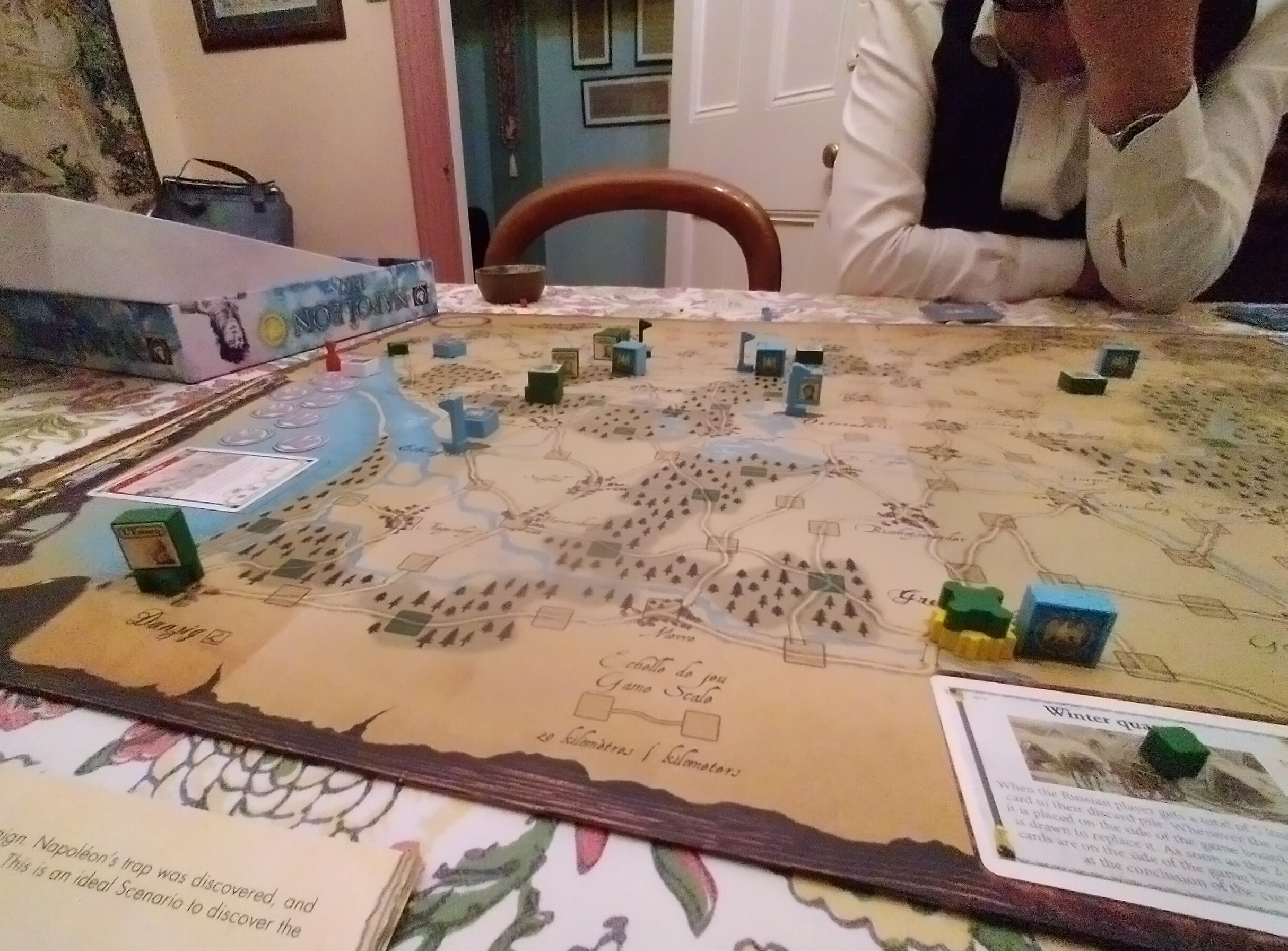
New innovations: Garrison and Siege markers, and the Winter Quarters card.

As it happened, both of us played a sub-par opening. I drew the initiative, and I should have ordered Essen I, well to the south, and a stone’s throw from French-held Warsaw, but instead I began breaking up the bulk of my army into smaller groups, trying to manoeuvre to screen my citadels and garrisons. The Conquerors game series rules reward bold action and audacious plays. I forgot this and went into a defensive mode from the get-go. By the time I’d woken up to that particular opportunity, Sarvey had already blocked my hereto clear path to Warsaw.

T wanted to bring a hammer blow, so he kept his grouped formations together, trying to bring them into action in twos and threes. Unfortunately, this makes them unwieldy; to move a unit or group of units, the player declared the ordered unit(s) – we simply point to them – then draw a card. The number od action points the card offers dictates how far a single unit can move. But if you’ve declared for a group of units to move, each on above the first will cost an extra point (this is to reflect the logistical difficulties in trying to manoeuvre multiple corps in unison). If you nominate a three-formation army for movement and draw a card with a value of 4 points, you’ve already lost two points with the two extra units; the army will only be able to move two spaces. Without the luxury of many turns, the safer route would be to break up the larger units for movement, then try to reunite them, or some of them, at the final destination.

Third turn rain, and the siege of Danzig lifted (lower left corner).

The French player begins the game with an extra penalty as well. Bernadotte begins the game with a one-block reduction in his strength, with that block on the French Winter Quarters card. When Winter Quarters are in effect, the first strength losses for each side are placed on their own Winter Quarters card. When the fifth block is placed, the Winter Quarters card is placed in the player’s discards, and when next drawn, the card is set aside near the board. When both cards have been drawn, the game comes to an end, regardless of the remaining turns. Probably not something to worry about in a game this short, but one more layer of uncertainty in a game with a lot of uncertainty already baked in.

Turns one and two saw some altercations between individual corps, but nothing decisive. L’Estourq outmanoeuvred Ney to liberate Elbing, only to see it recaptured by Ney in pursuit and L’Estourq ventured west to lift the siege of Danzig. Murat broke for Konigsberg and by turn four the city was in French control (had it not been for the Rain card in effect in turn three, the garrison would have fallen a turn earlier). All-in-all, it was a fumbling effort on both sides, with the French denying a Russian victory, but not delivering a decisive-enough blow to secure victory. The end score was 7 – a tie.

Defeat is the best teacher. Next time, we’re going to try one of the longer-duration scenarios, and we’ll see who has taken their lessons to heart.

Bottom of the fourth. French one point short of a marginal victory.


Saturday, 27 January 2024

Review: Napoléon 1806


Napoléon 1806: La Campagne de Prusse (Shakos, 2019) is the first game in the Conquerors series by designer Denis Sauvage and French game publisher Shakos. Since it was released, two more games in the series, Napoleon 1807: la Campagne de Pologne (Shakos, 2021) and Napoleon1815: Waterloo (Shakos, 2022), Rumour has it the next Conquerors game in the series will be Napoléon 1870 (pertaining to Napoléon III and the Franco-Prussian War – one can only hope).


Napoléon 1806 is also the third game completed from my own 6x6 challenge. After six runs at this game, I’m still not sure I can speak with any real authority about it without making it seem somehow less than it is. It’s true, it’s the most rudimentary of the three games; 1807 offers a multitude of scenarios compared to 1806’s two, while 1815 brings the option of a third player to the mix (again, with a higher number of scenarios). In case I forget later, in the tall grass of the review, I’ll mention now that 1806 is an absolute gem of a game, a finely wrought puzzle, a balancing act, and a game that will reward repeat plays with new insights.


Appearance

The production values in Napoléon 1806 are as good as the best-produced games I own. Nicolas Treil’s artwork is at once evocative of the subject and the era, and quite beautiful in its own right. All the action and a lot of the activity takes place on the 24"x24" mounted game map, and presented to appear like a Napoleonic-era map, complete with spyglass, compass, and map-creases. The movement is point to point, the distance between points representing around five or six miles. The map also contains the game’s turn track, scoring-track, and a placeholder for a weather event card, which I’ll come back to.


While Napoléon 1806 is technically a block game, it takes a quite different approach than the Columbia or Worthington block games you may be familiar with. Rather than having a unit’s status represented by pips on the block which you rotate to indicate its current health, a unit’s status in a Conquerors series game is recorded on a separate, concealed board. This board lists all of that side’s marshals, each with his own track to indicate the strength and health of his troops. Each marshal has a corresponding block on the Board with that leader’s name and portrait, and any special abilities he brings to the table (this information is replicated, slightly more readably, on the tracking board).

Napoleon and his marshals, with pennants and retreat markers in the foreground.

The blocks themselves are coloured in an appropriate dark blue for the French and grey for the Prussians. Every block has an eagle on its reverse, opponent-facing side, French Eagle and thunderbolts and Prussian crowned eagle (the Alliance blocks in Napoléon 1807 feature the Russian double-headed eagle on appropriately green blocks). The intention is that during play, when a block had been activated – regardless of whether the formation had managed to act during its activation – it would be turned upside-down, so the little arrowhead at the top of the eagle would point downward and make it clear to both sides it had been activated that turn. By our second game we found ourselves placing them face-down instead to more clearly indicate activation.

French Order of Battle

With it’s separate Tracking boards, referred to in the game as Orders of Battle, coloured blocks – two colours for each side to distinguish infantry and attached cavalry – and orange cylinders, as well as the wooden playing pieces and track tokens, you could be forgiven for mistaking Napoléon at first glance for Euro-style resource management game. Part of the game’s charm is its emphasis on tactile experience, and it does indeed have an aspect of resource management in maintaining the operational efficiency of your forces while pushing them to the limits of their endurance. The blocks feel weighty and move ponderously along the paths. Every loss of a block or gained exhaustion cylinder is a visceral reminder of the precarious state of your army. Other wooden components are also provided, standing pennants on poles to indicate the control of citadels (or to provide the enemy with a visual reminder of their target destinations), and little arrows to be used as a mnemonic for the direction of retreat for an attacking force.

The Prussian Order of Battle after a narrow victory by the French.

The game leans heavily on the use of symbols and illustrations to convey the meaning of rules and actions in play. The shields for the force tracking boards are usefully decorated with the game’s symbology, succinctly explaining what can and cannot be performed at each step of the action. Everything in the game is at once decorous and informative, an elegant synthesis of design and communication.

The game comes with a box-sized, four-page Quickstart booklet which will (after stickering up the block for play) will allow you to get straight into play. The quickstart guide strips the game back to its essentials (movement and combat), offering a good grounding in how to play, but leaving enough meat on the carcass to still provide a challenging experience. If you are looking for a fast game, you might be happy enough to stick to the quickstart rules for your first couple of goes. Even at three turns, the first couple of games are probably going to run to about 45 minutes to an hour.

The Quickstart rules set-up guide.

The Rulebook s 24 pages in length, printed on good gloss paper-stock. It’s been produced in full colour and with copious illustrations, and with a pleasant, buff background that is merciful on the eyes. The first thirteen pages cover the “Rules for the Recruit”. This is the meat and potatoes of the game, covering in a little more detail what has been sketched out in the Quickplay rules, but incorporating the start-of-turn card draw, the use of Actions, Rain and other hindrances, and a few more details that enrich the play experience. The remaining pages introduce the “Rules for the Grognard”, optional rules spelling out the free-placement guidelines and the use of the Cavalry Vedettes blocks, “Rules for the Marshal” which cover tournament play, some notes on the card events and actions, and a brief (three-page) history of the campaign, interspersed with designer’s notes.

Every aspect of the production is of excellent quality, from the wooden components to the poker-weight cards in the two decks. My only grumble (given my age and history, I’m entitled to one from time to time) would be that the Order of Battle cards, while a pleasing weight of card (about 2.5mm thickness) have developed a slight camber and don’t lay perfectly flat, but while the use of a thinner card would have rectified this, it wouldn’t have been sturdy enough to ensure the shield stays in place around the board. For that, it’s an inconvenience I’m prepared to put up with.


Davout and Soult engage Blucher, Tauentzien and Ruchel in a moving attack (at the
cost of one combat result card. If the battle had taken place in the woods(the green-
coloured areas, top-right), the defenders would have gained an extra card. 


Play

For such a gamey-looking game, Napoléon 1806 offers a satisfying simulation of l’Empereur’s Prussian campaign. You’re not going to get the granularity of a regimental-level simulation (à la Hexasim’s Eagles of France series), but the game achieves what it sets out to do.

Victory in Napoléon 1806 can be secured in a number of ways. The scoring is kept on a pendulum table, starting at ten. Twenty points on the board will secure a French Victory immediately; in the unlikely event the Prussians can beat down on the French hard enough to get the score to zero, they will win. After seven rounds (a fortnight in game time) if the French haven’t secured victory, it’s a default win to the Prussians – the home team must hold out long enough for international support to arrive. A sudden death victory can be won by one side controlling all four citadels at the beginning of their turn. The Prussians start with three – Eufurt, Halle and Leipzig, while the French begin with Bamburg as their home base. On the remote chance that one side kills/captures the others leader, that will also result a sudden death victory,

Napoléon 1806 runs on its cards. Each side has its own deck of thirty-six cards, much like Combat Commander (GMT Games, 2006), and like that game, cards fill in for several roles, including dice damage applied in combat. Each card has a points value printed in the corner (1-5 for the Prussians, 1-6 for the French). These points are used for both determining initiative and establishing how far an ordered unit can move, if at all. The cards provide mandatory events and tactical options, and determine the amount of damage inflicted on the enemy in combat.

Bernadotte and Soult harass Halle and Leipzig as Napoleon considers his next move.

At the beginning of a turn, the players simultaneously draw cards from their draw deck and compare the number, with the highest point-value winning the initiative for that turn (meaning that player goes first, with the French winning ties). Then the players draw three cards each for their hands. There is no hand-size limit in the Conquerors series, so a player can end up with more cards in their hand than in their deck if they’re not careful. Cards in hand can be used for their Actions, usually small perks that can offer an edge in combat or movement when played at the appropriate time.

There are two types of Actions, before play Actions – assuming you have some in your hand, you can play one of these at the beginning of each turn, before any action has taken place. (they’re marked with a light blue title banner at the top) – and in-turn Actions – these are the ones you may play before combat, gain and extra step of movement, or to shrug off some exhaustion (marked with a green banner). Some Cards actually have Automatic Events instead of Actions; these are marked with a Red banner, and if you draw one of more of these at the start of the turn, you need to play it immediately. Some are punitive (such as preventing one of your formations from acting in that turn), but most are Rain events; there is a place-holder box on the map for a Rain card, below the Turn track, to remind the players of the change in conditions. Rain effects movement and exhaustion for everyone for the turn. At the end of the turn, the Rain card is removed and goes into the appropriate player’s discard pile.

A lucky play that paid off.

In a turn, starting with the established initiative holder, each side will take turns “conducting an operation”. This involves choosing a corps or a stack of units, declaring what you would like the to do, then drawing a card from your draw deck to see if chance and fate agree with your intention. Most often, the order will be to move, either to a fixed position, or along a path as far as the points will allow the formation to go. The currency is one point will allow one unit to move one space. If you’re moving two units together, the first point is spent coordinating the two units, then every point after may be spent on movement. Three units in a stack, you’ll need a 3-point card draw to move them just one space. There will be reasons at various times to have units moving together as one, but it going to take a toll on your manoeuvrability.

There’s also the matter of exhaustion. Units and even stacks can move up to three spaces without any ill-effects, but for each space above three the unit – or every unit in the stack – is going to take an exhaustion point. Exhaustion points are an abstraction of the wear and tear on an army on manoeuvre over an extended period of time. A little exhaustion is tolerable, but it can build up very quickly and sometimes unexpectedly.

With Halle and Leipzig in French hands, Napoleon takes Eufurt
for the game (a sudden death victory in Turn 6).

Below the Strength Points track for each leader/formation is an Exhaustion Points Track. Each time a unit takes an exhaustion hit, a little orange drum is added to this row. Say you draw a 5-point card and move Lannes five spaces because you want him to get past an intersection before a Prussian unit has a chance to cut him off; congratulations – you made it, but Lannes’ corps will now be two exhaustion points wearier. Two points aren’t that big a deal, but exhaustion accrues in other ways as well. If the turn has a Rain event, all movement will add one point of exhaustion to every unit moving, whether their card draw actually allows them to move or not (and added to that, it will cost an extra point to get those chaps moving, along with any stack penalties – Rain is as much an enemy as the opposition).

When you get into combat (which you will want to do, especially playing the French, as this is your best chance to shift the Victory Point marker in your favour) you will not want to be carrying to much exhaustion into battle because fighting is itself exhausting. Even if you win, your forces may come out of it with enough accrued exhaustion to push you up to the limit, which is nine points. A corps can carry up to eight points exhaustion, but if it goes over that for whatever reason, it is eliminated (there’s a handy little memento mori of this on the Exhaustion track – a little skull on the nineth position to say it’s over).

Kalckreuth creeping dangerously close to complete exhaustion.

This isn’t to say that once you’ve accrued exhaustion you’re stuck with it. At the end of each turn, any units that haven’t been activated (i.e., are still upright) can lose ALL their exhaustion. But that’s the cost, they can’t have done anything for that turn. And choosing not to activate a formation may not be a guarantee; if they happen to be attacked by an opposing force whale they are trying to sit quietly, they’ll be classed as having been activated, and they may well gain even more exhaustion into the bargain.

Combat resolution is tied to the cards as well. Each unit will bring one or two cards to the fight. Some leaders gain an extra card, some Actions may offer another (or lower the opposition’s card-count), and in some cases, environmental factors will come to play; defenders gain an extra card draw for wooded terrain or defending a walled citadel.

A rare strong defence for the Prussians (three hits, and nine exhaustion), though those
two Destroyed Bridges cards may have been more useful in his hand..

Combat is conducted simultaneously: after establishing how many cards each side gets to draw, each player draws that number of cards, laying them out face-up in front of them. The cards present the damage inflicted in a box in the lower left corner. Orange circles mark exhaustion points taken, while squares with crosses overlaid indicate the physical damage inflicted on the force’s collective strength. Damage and exhaustion is shared out over the participating formations as evenly as possible (at the discretion of the owning player), and if there is a mispatch in the physical damage dealt, the higher damage recipient retreats. Single engagements will rarely see units annihilated (except perhaps by exhaustion), but they can be brutal. The total damage to each side is compared, and the difference is added to or subtracted from the Victory point track, in favour of the victor.


Appraisal

Napoléon 1806 is an extraordinarily finely balanced game. The French are the more effective fighting force. They have eight formations to the Prussians nine (though Werternberg doesn’t enter the game until Turn 5), and five cavalry units to the Prussians’ two), reflecting Napoleon’s superior theatre intelligence and the independent command of his forces. The Prussians field weaker forces; the average strength across the French corps is a shade under 6.4 blocks, while the Prussians average at 5.3 blocks per corps). They are forced into a reactionary posture; to some degree they must respond to the intentions – real or implied – of the French. They don’t really have the option of taking the fight to the enemy wholesale. The French superiority in command in control is reflected in their deck spread:

But the Prussians are playing a waiting game; all they have to do is run out the clock to guarantee a default win – not one shrouded in glory, but not an ignominious loss either. It is incumbent on the French forces to engage the enemy and inflict losses, which will translate to points, and to take the Northern citadels, which means they have to cover a lot of terrain just to reach their objectives. Fast movement means a swift accrual of exhaustion points. A corps can shake off all of its accrued exhaustion points by remaining inactive for a turn, but that hands the Prussians another turn to reposition themselves into a better defensive state, or to block a crucial chokepoint. Or allows them to attack while you’re still carrying all that exhaustion.

Drawing three cards every turn potentially removes a lot of cards from circulation. Having useful Actions to play – like the Destroyed Bridge card for the Prussians – can make an outsized impact on the unfolding drama of the game.  But the cards with the most crucial actions are inevitably have point-values, and these will often have superior combat results as well. In such a finely-balanced game, maintain a balance between your holdings and your potential draw pool is crucial.

The final turn; Prussian victory after the French fail to gain distance swiftly enough.

On the face of it, Napoléon 1806 may seem like a one-trick pony. According to the box-description, the game has three scenarios, a short (three-turn) getting-to-know-you game for those either unfamiliar wargames or just new to this one, the full seven-turn historical campaign, and a free-set-up option for the campaign game (places available to the two armies to set up in are marked by a French or Prussian Eagle). In fact, the Quickstart rules and the rulebook (pg. 15) offer alternative set-ups for the three-turn game, so there are arguably four scenarios included.

But this is a game of hidden depths. The paths through Prussia are tricky; there is always a way around, but it may be prohibitively distant, or take you even further from your objective. The cards can be fickle and using the same 36-card deck for every activity will see you burning through it a few times in a game. It's a tough gig for the French - they have to cover a lot of ground, and negotiate a dozen or more choke-points, to get the bulk of their forces north to threaten and harass the Prussians three held citadels. Each is worth three or four points; that's not to be sneezed at when a ten-point lead will secure victory. But France's Achilles heel is Bamberg. If left unprotected, a Prussian formation and some lucky movement-point draws could snatch the city and victory from them before they've begun to prosecute their campaign.

But that doesn't mean it's a cakewalk for the Prussians. The enemy has their work cut out for them, but they are faster, hit harder, and their formations are better-equipped to prosecute martial action. The natural choke-points in the paths offer some advantage, but there are multiple paths north, and you can't adequately guard them all. If you can run down the clock (at seven turns) you will win a minor victory, but it can feel like a long seven turns as you lose ground and French corps manage to slip past your blockades. Nearly every game I've played of Napoleon 1806 has got to the end of the fifth turn with both sides still having a good chance of taking the win. With so many variables at play, nothing is ever a foregone conclusion.

I have some suspicions about prudent courses of action in the game, things that might work in particular circumstances within the game, but I don’t think it’s the kind of situation that allows a player to find one path to victory that works every single time. And that’s a good thing. Napoleon 1806 is a game that will challenge you with new problems and entice you with hereto unseen opportunities each time you come to it.


Blog Note: a recent arrival

   I’ve been a little quiet on A Fast Game of late due to a combination of circumstances; my wife’s aunt and uncle are over from England at ...